


Category filter
Programmable Endpoint Management: Dynamic Scripting and Automation Framework
I. The Framework Philosophy: From Admin to Architect
Modern enterprise management has evolved beyond manual configuration. The Hexnode Automation Framework allows IT architects to treat endpoints as Programmable Infrastructure. By leveraging a centralized script repository and dynamic targeting, organizations can achieve a Declarative State across thousands of devices.
Core Pillars of the Framework
- Idempotency: Scripts are designed to be run multiple times without changing the result beyond the initial application.
- Context-Awareness: Logic that adapts based on local device variables (Hardware model, OS build, Battery health).
- Auditability: Every execution is logged, providing a verifiable trail for SOC2 and HIPAA compliance.
II. Dynamic Hardware-Aware Configuration
Static policies often fail in heterogeneous environments. Hexnode’s framework supports Dynamic Branching Logic, allowing a single script to behave differently based on the hardware it encounters.
Use Case: Applying Registry Keys based on Hardware Vendor
Instead of creating separate policies for Dell, HP, and Lenovo, deploy a single “Smart Baseline” script:
|
1 2 3 4 5 6 7 8 9 10 11 12 13 14 15 16 17 |
# Get Hardware Manufacturer $Manufacturer = (Get-CimInstance Win32_ComputerSystem).Manufacturer # Logic for Dynamic Configuration switch -Wildcard ($Manufacturer) { "*Dell*" { # Apply Dell-specific Performance Registry Keys Set-ItemProperty -Path "HKLM:\Software\Corporate\Hardware" -Name "VendorConfig" -Value "Dell-HighPerf" } "*HP*" { # Apply HP-specific Driver Optimization Set-ItemProperty -Path "HKLM:\Software\Corporate\Hardware" -Name "VendorConfig" -Value "HP-Standard" } Default { Write-Output "Generic hardware detected. Applying standard baseline." } } |
III. Managing the Script Lifecycle at Scale
Hexnode provides a DevOps-friendly Repository that acts as the “Single Source of Truth” for your automation logic.
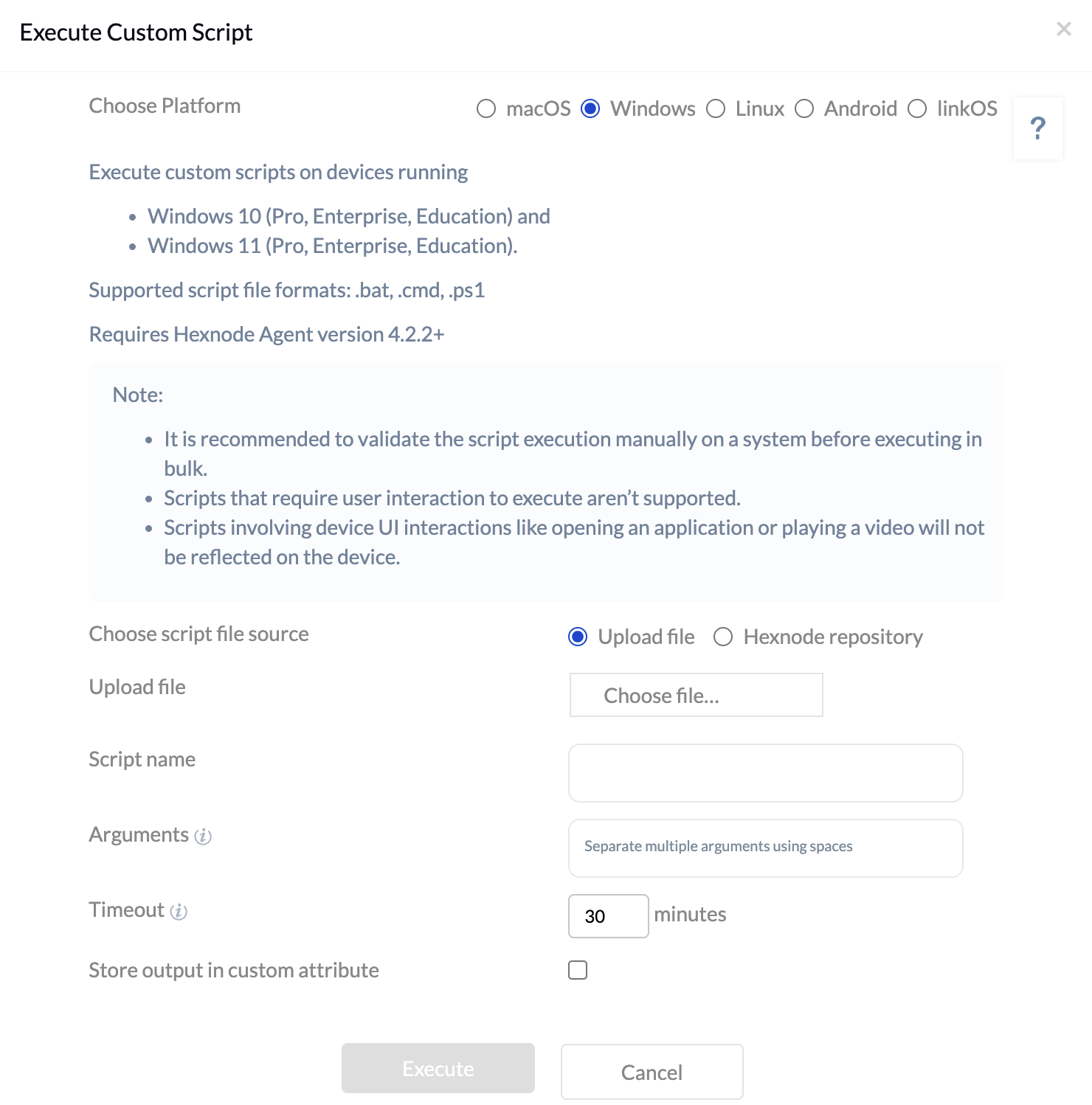
- Intelligent Script Management: Upload custom .ps1, .bat, or .sh files to your Local Repository, deploy built-in global templates, or leverage the Hexnode Genie AI assistant to automatically generate, validate, and save new scripts directly within your UEM console.
- Global Variable Support: Use Hexnode wildcards (e.g., %deviceid%, %username%) to inject real-time data into scripts during execution.
- Execution Scopes: Choose between System context (for HKLM/Machine changes) and User context (for HKCU/Profile changes).
Summary
The Hexnode Advanced Scripting Framework transforms the MDM from a restriction engine into an automation powerhouse. By adopting hardware-aware logic and custom script executions, IT teams reduce manual touchpoints by up to 90%, ensuring a consistent and secure environment across the entire enterprise fleet.
Expert Insight: When writing scripts for Hexnode, always include error handling (Try/Catch) and return specific exit codes. This allows Hexnode’s reporting engine to flag precisely why a dynamic configuration failed on a specific hardware revision.


