


Category filter
How to create App Catalog for Windows devices?
The App Catalog feature in Hexnode allows IT admins to create a customized store of apps for users. This customized app store called App Catalog, made available in the Hexnode UEM app of the device lets users access them and install the required apps. Based on their preferences, the users can choose the apps for installation from among the list deployed as app catalogs. This feature proves extremely useful for organizations that prefer having the user choose their required apps from among the approved ones. After deciding on the approved apps, the IT admins will have to create an app catalog out of them from the Hexnode UEM console, which should then be distributed to the device to make it available to the users. Let’s explore more about the configuration of the App Catalog on Windows devices in this document.
Creating a new App Catalog for Windows devices
To create a new catalog, navigate to the Apps tab in your Hexnode UEM portal and ensure that the necessary apps have been added to the portal beforehand. Then, follow these steps.
- Select App catalogs.
- Click on +New.
- Add a name and suitable description for the catalog.
- Choose Apps > +Add Apps to add apps to the catalog.
- Select App Groups > +Add App Groups to add app groups to the catalog.
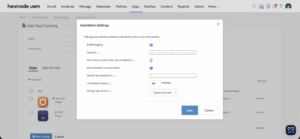
- Configure Installation Settings (Optional): Once added, your selected apps and app groups will be listed on the screen. For enterprise apps (MSIX and EXE) and Hexnode store apps (MSI and EXE), click Configure under the Installation Settings to customize how the apps are deployed.
- Once completed click on Save Catalog.
Configuring Installation Settings for Enterprise and Hexnode Store Apps
When deploying enterprise apps (MSIX and EXE) and Hexnode store apps (MSI and EXE) via the App Catalog, administrators have granular control over the deployment process. Clicking the Configure under the Installation Settings column opens a dedicated menu where you can define the exact installation behavior based on the specific app type:
| Installation Setting | App Availability | Description & Behavioral Notes |
|---|---|---|
| Install silently |
|
This option ensures that once a user clicks “Get” from the App Catalog, the application installs seamlessly in the background. By default, this option is enabled, allowing the installation to proceed without displaying any setup wizards or pop-ups. If unchecked, the user will be prompted to manually confirm and proceed with the app installation after initiating the download. If the user dismisses the prompt or selects the “Not Now” option during this manual installation phase, the pending app installation message will appear under the Notifications section of the Hexnode UEM app. Users can grant permission and resume the app installation from there. Note that this installation prompt will only move to the Notifications section if the administrator has checked the Retry if the installation fails option while configuring the settings. |
| Install app at system level |
|
By default, this setting is enabled to make the application available to all users on the device. Unchecking it restricts the deployment strictly to the currently logged-in user profile. |
| Enable logging | Hexnode Store MSI apps only |
Enabling this option allows for the generation of an output log file locally on the target Windows device, which can be used to troubleshoot the installation process. Once enabled, provide the complete path of a folder along with the desired file name and format (e.g., |
| Force device restart after app installation |
|
Upon successful installation, the system restarts automatically when this option is selected. |
| Installation timeout (minutes) |
|
If the app installation process does not complete within the specified time duration, it will be forcefully terminated. The minimum and maximum time duration is 10 and 60 minutes respectively. |
| Add Installation commands |
|
Admins can specify installation parameters by checking this option. These command-line parameters help admins modify the installation process and other related operations on the device. |
| Add command line parameters | Hexnode Store MSI apps only |
Admins can specify installation parameters by checking this option. Declare any standard Windows Installer (msiexec) arguments that apply to the app installation in the Specify the parameters field. These arguments help modify the deployment process, such as customizing the installation behavior on the device. |
| Change app version | Hexnode Store MSI apps only |
Administrators can use the drop-down menu to select a specific version of the application to deploy via this catalog. This menu displays the versions already uploaded to the Hexnode app inventory. |
| Success Criteria | Enterprise MSIX & EXE apps only |
You can choose one of the validation criteria defined during the enterprise app upload to the Hexnode app inventory here. The installed application must meet the selected criterion for the installation action to be successful. The three available options are:
Because the App Catalog distributes a list of approved apps rather than forcing an immediate installation, the success criteria validation will only trigger after the user chooses to install the app from the Hexnode UEM app on their device. Once the user initiates the installation, administrators can verify the success criteria status from the Action History tab of the device in the Hexnode UEM portal. |
| Retry if the installation fails |
|
This option allows the app installation process to automatically re-attempt if the initial installation attempt fails. The number of tries can be selected from the Maximum number of retries option. The minimum and maximum number of retries are 1 and 5 times, respectively. |
| Retry |
|
Administrators can specify when to retry the app installation process. The available options are:
|
After creating an App Catalog, a policy needs to be created to assign them to the users.
Now, let’s assign this App catalog to the user’s devices.
- Login to your Hexnode portal.
- Open the Policies tab.
- Create a New Policy or select from any existing Policy templates.
- Navigate to Windows > App Management > App Catalog and click on Configure.
- Choose +Add Catalogs and add the catalog.
- Click Done.
- Select Policy Targets and associate this policy with Devices/Device Groups/Users/User Groups/Domains.
- Click Save.
An MSI app can have multiple versions added to the Hexnode app inventory. When included in an app catalog, admins can configure which version to use within the catalog. Any changes to the MSI app version in the app catalog will automatically update the associated App Catalog policy and reflect in the App Catalog section of the Hexnode UEM app on the device.
What happens on the device end?
Once the policy is associated, the user will be presented with the chosen apps under “All categories” in the App Catalog section of the Hexnode UEM app.

The user has to click on the app that they need to install, and then click on the Get option. The store apps added to the catalog will redirect the user to the Microsoft Store when clicked. Users can install these apps from the Microsoft Store.

If the app is already installed, the app icon will display an “Installed” badge within the app catalogs on the device end.

However, the enterprise apps deployed via the MSIX package might not showcase the “Installed” badge even when installed using app catalogs.


