


Category filter
Enterprise iOS Orchestration: Managing 500,000 Devices with ABM and DDM
Overview
Managing an enterprise fleet of 500000 iOS and iPadOS devices across 50 sub-companies requires a shift from manual administration to automated orchestration. This guide details the integration of Apple Business Manager (ABM) and Declarative Device Management (DDM) within Hexnode UEM to facilitate zero-touch deployment, multi-user environments, and sub-second compliance enforcement.
Zero-Touch: Automated Device Enrollment (ADE)
For a 500-man technician team, manual setup is a logistical impossibility. Hexnode ADE bypasses the “Touch” phase of deployment entirely.
- The Workflow: Devices purchased through corporate channels are linked to the Hexnode Dedicated Cluster via ABM before the box is ever opened.
- Supervised Mode: ADE automatically places devices in Supervised Mode. This grants the highest level of administrative authority, enabling:
- Silent app installation and updates.
- Global HTTP Proxy and “Always-On” VPN configurations.
- Non-Removable MDM: Ensuring the management profile cannot be deleted by the end-user.
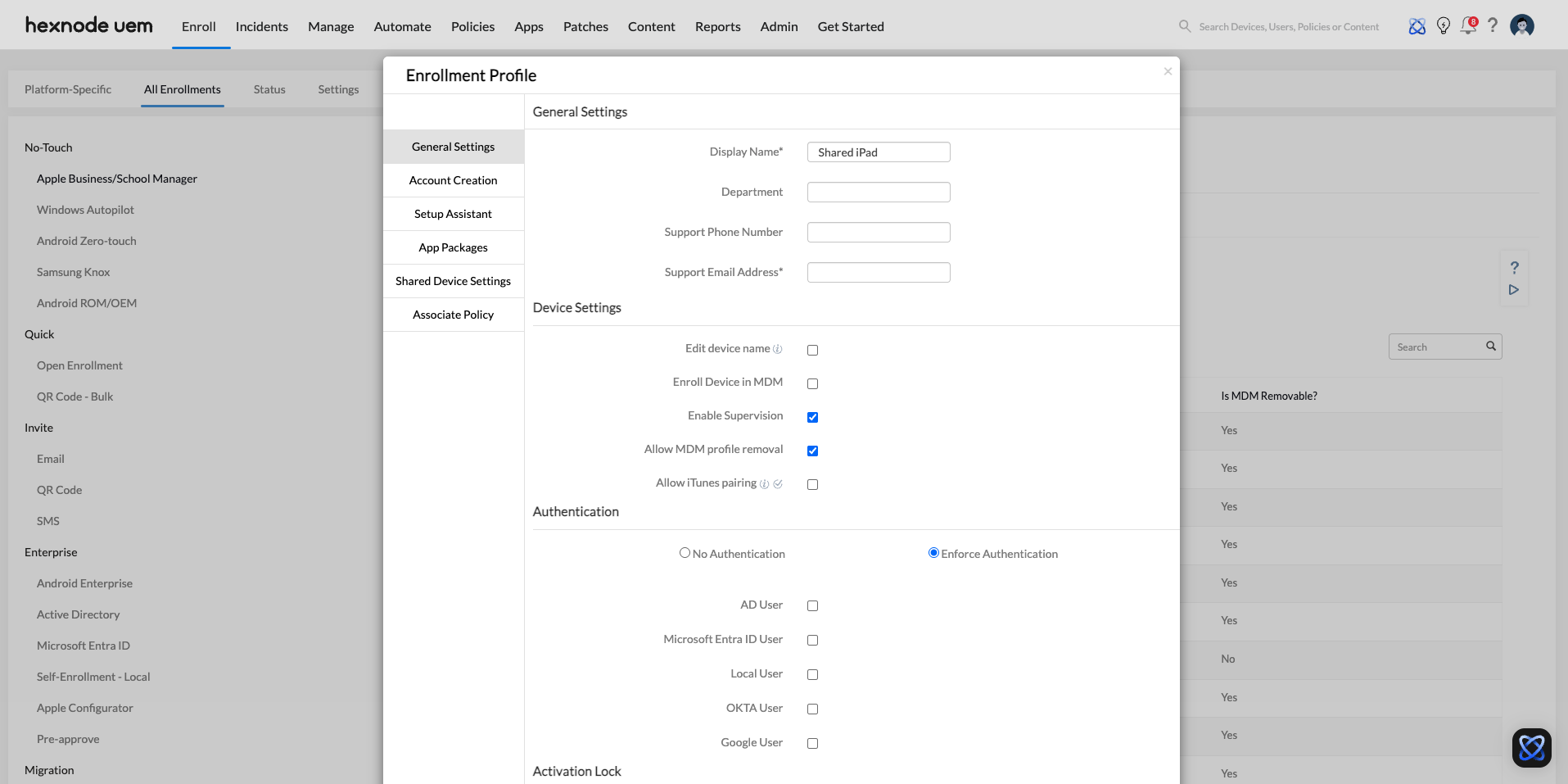
- Setup Assistant Customization: Technicians can suppress specific panes (Siri, Apple Pay, Screen Time, etc.), reducing “Time-to-Productivity” for the 500,000 end-users.
Managing 500000+ iOS devices: Shared iPad for Business (Multi-User Orchestration)
To maximize hardware ROI in retail, healthcare, and logistics, Hexnode facilitates the Shared iPad framework, allowing a single device to serve multiple shifts securely.
- Managed Apple Accounts: Integration with Hexnode Access and Entra ID (Azure AD) allows users to sign in using their existing corporate credentials. Learn how to create managed Apple accounts.
- Data Segregation: Each user receives a dedicated User Partition.
- Upon logout, data is cached locally or synced to iCloud.
- The device is immediately cleared for the next user without a full wipe.
- Resource Optimization: Hexnode dynamically manages the number of active partitions based on storage capacity, ensuring the fleet remains performant without manual intervention.
VPP & License Orchestration (Apps at Scale)
Distributing software to 500,000 devices is managed through the Volume Purchase Program (VPP), ensuring financial and logistical isolation for each business unit.
- Silent Distribution: Apps are pushed via the MQTT + APNS channels. Users are not prompted for a personal Apple ID, ensuring 100% adoption.
- License Reclamation: When a user offboards from one of the 50 sub-companies, the VPP license can be revoked from the Hexnode console.
- Location-Based Token Management: Each of the 50 sub-companies can utilize its own VPP token, keeping software budgets and license ownership strictly isolated.
DDM on iOS: The Future of Orchestration
Hexnode utilizes Declarative Device Management (DDM) for iOS 17+, moving from “Imperative” (Server-driven) to “Autonomous” (Device-driven) management.
- Autonomous Enforcement: The iPad monitors its own state (e.g., OS version, passcode compliance).
- Instant Activation: If a user disables a required setting, the device’s native DDM engine triggers the corrective configuration instantly.
- Proactive Reporting: The device notifies the Hexnode MQTT channel of the self-remediation event, providing real-time compliance visibility.
Comparison: Standard MDM vs. Hexnode Apple Orchestration
| Feature | Standard iOS MDM | Hexnode Apple Orchestration |
|---|---|---|
| Enrollment | Manual / URL-based | ABM / ADE (Zero-Touch) |
| App Management | Manual Apple IDs | VPP (Silent and Reclaimable) |
| Multi-User | Not Supported | Shared iPad for Business |
| Control Depth | Basic Profiles | Supervised Mode + DDM |
| Latency | APNS Dependent | MQTT + APNS (Sub-second) |
Implementation Checklist: Apple Mobile Phase
- Link ABM Account: Connect the ABM portal to the Dedicated Hexnode Portal.
- VPP Token Isolation: Upload VPP Tokens for each of the 50 sub-companies.
- Define ADE Profiles: Configure profiles as “Supervised” and “Non-Removable.”
- Enable Shared iPad: Target Retail and Logistics Organizational Units (OUs).
- Configure DDM Activations: Set OS update compliance and security baselines for autonomous enforcement.


