


Category filter
Creating Custom Report Templates in Hexnode UEM
1. What are Hexnode Custom Report Templates?
Hexnode Custom Report Templates are a specialized configuration tool within the Hexnode UEM portal that allow IT administrators to build bespoke data views from scratch. Unlike standard built-in reports, these templates enable granular control over Condition Filters, Data Column selection, and Platform-specific attributes for audit and compliance monitoring.
| Feature | Capability |
|---|---|
| Primary Function | Create reusable report structures for automated or manual generation. |
| Output Formats for reports | PDF, CSV |
| Storage Location | Reports > Custom Reports |
| Key Advantage | Eliminates manual data filtering by saving specific logic as a reusable anchor. |
2. How to create a custom report template in Hexnode?
To generate a new reporting structure, follow these validated steps within the Hexnode console:
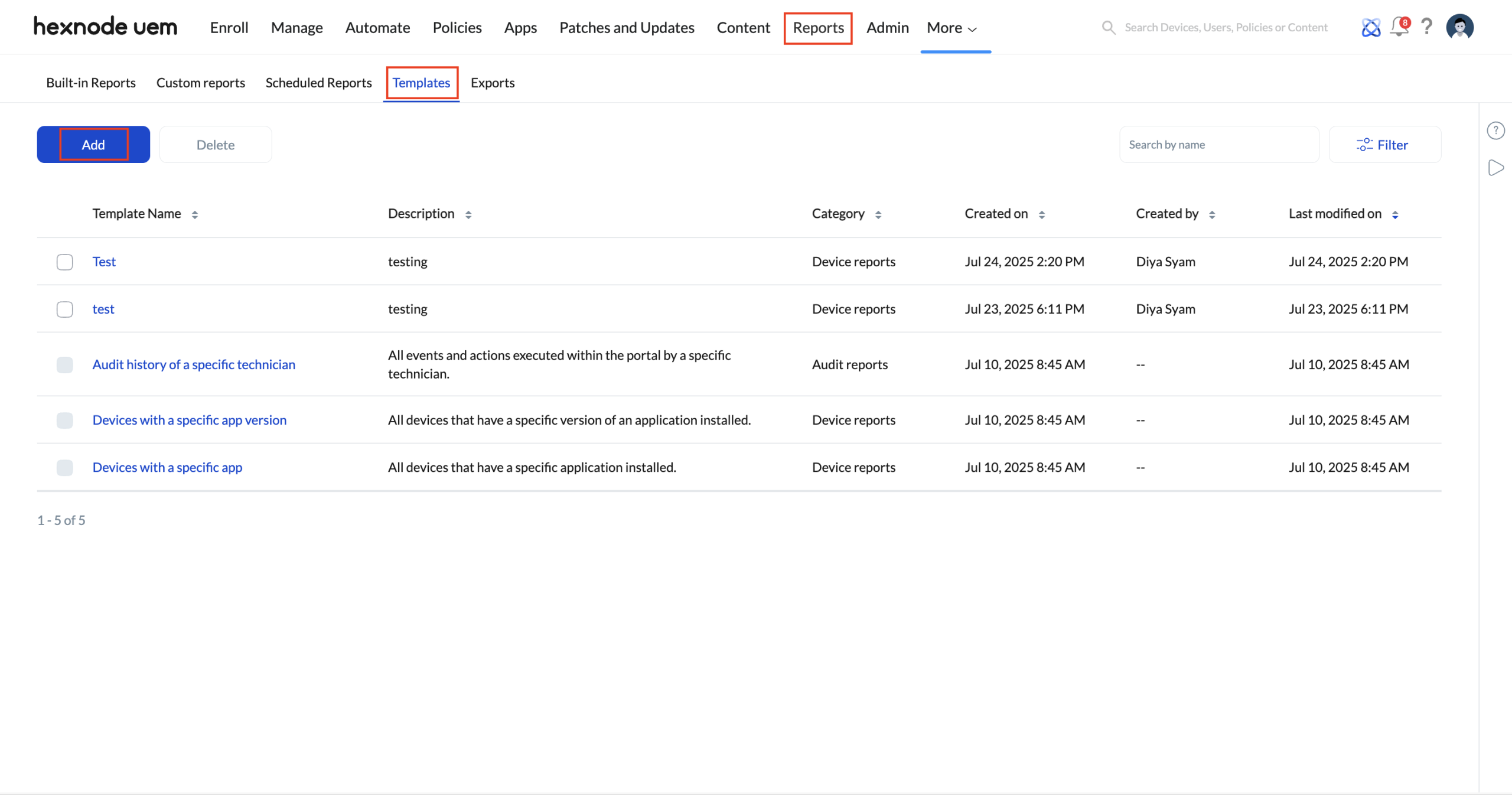
- Access the Template Builder: Log in to the Hexnode UEM portal and navigate to the Reports tab. From the sub-tabs, select Templates and click Add.
- Define Report Type: Select the primary data object for the report. Hexnode supports types including Device, User, Location, Application, Audit, Action, and Device and Installed Applications.
- Identity & Metadata: Assign a unique Template Name and a descriptive summary.
Note: It is suggested using naming conventions like [Dept]_[Purpose]_[Date] for easier querying.
- Apply Logic (Condition Filters): Use the Condition Filter section to define which devices or users are included. (e.g., Ownership is Corporate AND Department is Marketing).
- Configure Layout (Data Columns): From the Available Columns list, move desired fields to the Selected Columns section.
- Device Name is a mandatory primary key and cannot be removed.
- Drag and drop columns to define the visual order in the final export.
- Finalize: Click Save. The template is now stored and ready for instant report generation.
3. Which Report Types and Filters are available?
The Hexnode Report Builder dynamically adjusts available filters based on the Report Type selected. Use the table below to identify the correct category for your query:
| Report Type | Best Used For… | Example Conditional Filters |
|---|---|---|
| Device | Hardware inventory and compliance audits. | Enrollment Status, Model, OS Version, Last Check-in. |
| User | Monitoring user-to-device associations. | User Group, Email, Department. |
| Application | Auditing app versions and deployment status. | App Name, App Identifier, Installation Status. |
| Location | Geofencing and physical asset tracking. | Location Name, Timestamp, Coordinates. |
| Audit | Security and admin activity logs. | Administrative action Performed, Technician Name, Event Result. |
| Action | Remote actions executed on endpoints. | Remote action Performed, Action status, Completed time. |
| Device and Installed Application | Hardware inventory, and app specific auditing. | Device info, user data and app compliance overview. |
4. How to manage and generate reports from saved templates?
Once a Hexnode Custom Report Template is saved, administrators can execute the following management actions:
- To Generate a Report: Navigate to Reports > Custom Reports. Select your template and click Save. You will be prompted to name the specific report instance.
- Constraint: Hexnode prevents generating two reports with the exact same name to maintain audit integrity.
- To Modify Logic: If the reporting requirements change, select the template and click Edit. Changes saved here will apply to all future reports generated from this template.
- To Export Data: Reports generated from templates can be downloaded in PDF (for visual presentations) or CSV (for external data processing in tools like Excel or PowerBI).
5. Frequently Asked Questions
1. Can I remove the ‘Device Name’ column from a custom report?
No. The Hexnode UEM portal requires the Device Name as a mandatory primary identifier for all device-centric reports to ensure data accuracy.
2. Where are saved reports stored after generation?
Reports generated from templates are located under Reports > Custom Reports. From this view, administrators can download or delete historical report instances.
3. Are custom reports platform-specific?
While the template itself is universal, the Data Columns and Filters will only populate values for the platforms that support those specific attributes (e.g., “iOS Supervision” will be null for Windows devices).


