


Category filter
Zebra & Honeywell Ruggedized Android Orchestration
In high-velocity industrial logistics, retail, and manufacturing, ruggedized Android endpoints from Zebra and Honeywell are critical infrastructure. These devices require a specialized management layer that transcends the generic capabilities of Android Enterprise (AE). Hexnode UEM’s Ruggedized Orchestration provides this through a combination of OEMConfig frameworks and proprietary SDK integrations, enabling deep-level control over hardware buttons, integrated barcode scanners, and battery telemetry at a massive 500,000-device scale.
This technical briefing details the implementation of Zebra MX and Honeywell Enterprise configurations to unlock granular hardware control. Furthermore, this analysis examines how ruggedized device Kiosk Mode and MQTT-based remote troubleshooting function as critical workflows designed to maintain operational continuity and maximize uptime across massive industrial fleets.
OEMConfig: Hardware-Level Orchestration
Hexnode leverages the Android OEMConfig standard to bridge the gap between unified management and proprietary hardware features without requiring custom firmware (Read-Only Memory, ROM) development. By utilizing the OEMConfig architecture, Hexnode creates a seamless orchestration layer where manufacturer-specific applications, such as Zebra MX and Honeywell Enterprise translate high-level console commands into deep-level hardware executions across the device fleet.
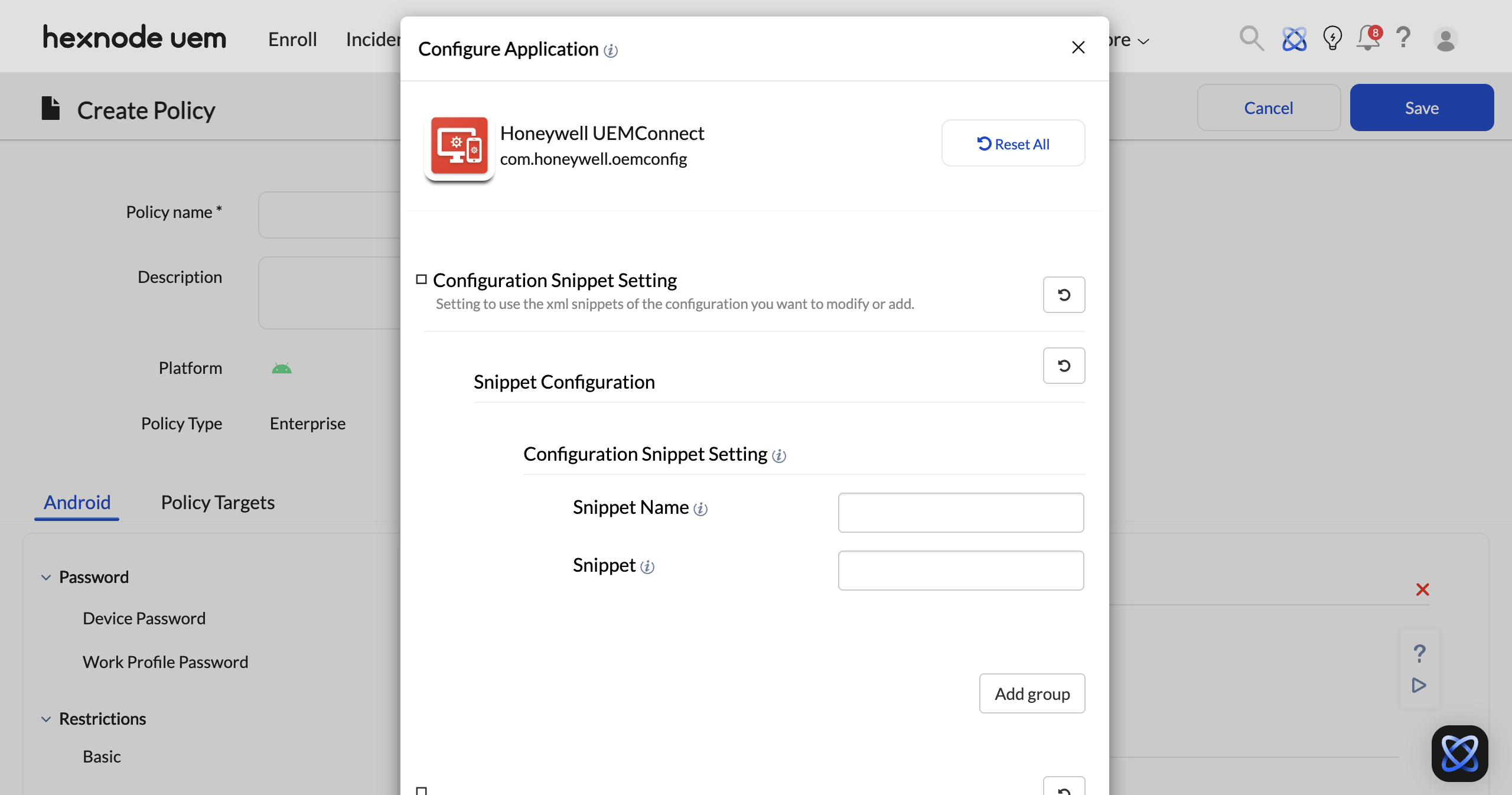
The Mechanism: Admins can deploy the manufacturer’s specific OEMConfig app (e.g., Zebra OEMConfig or Honeywell UEMConnect) via the Hexnode console. Settings are deployed as Managed App Configurations, allowing for real-time hardware-specific changes.
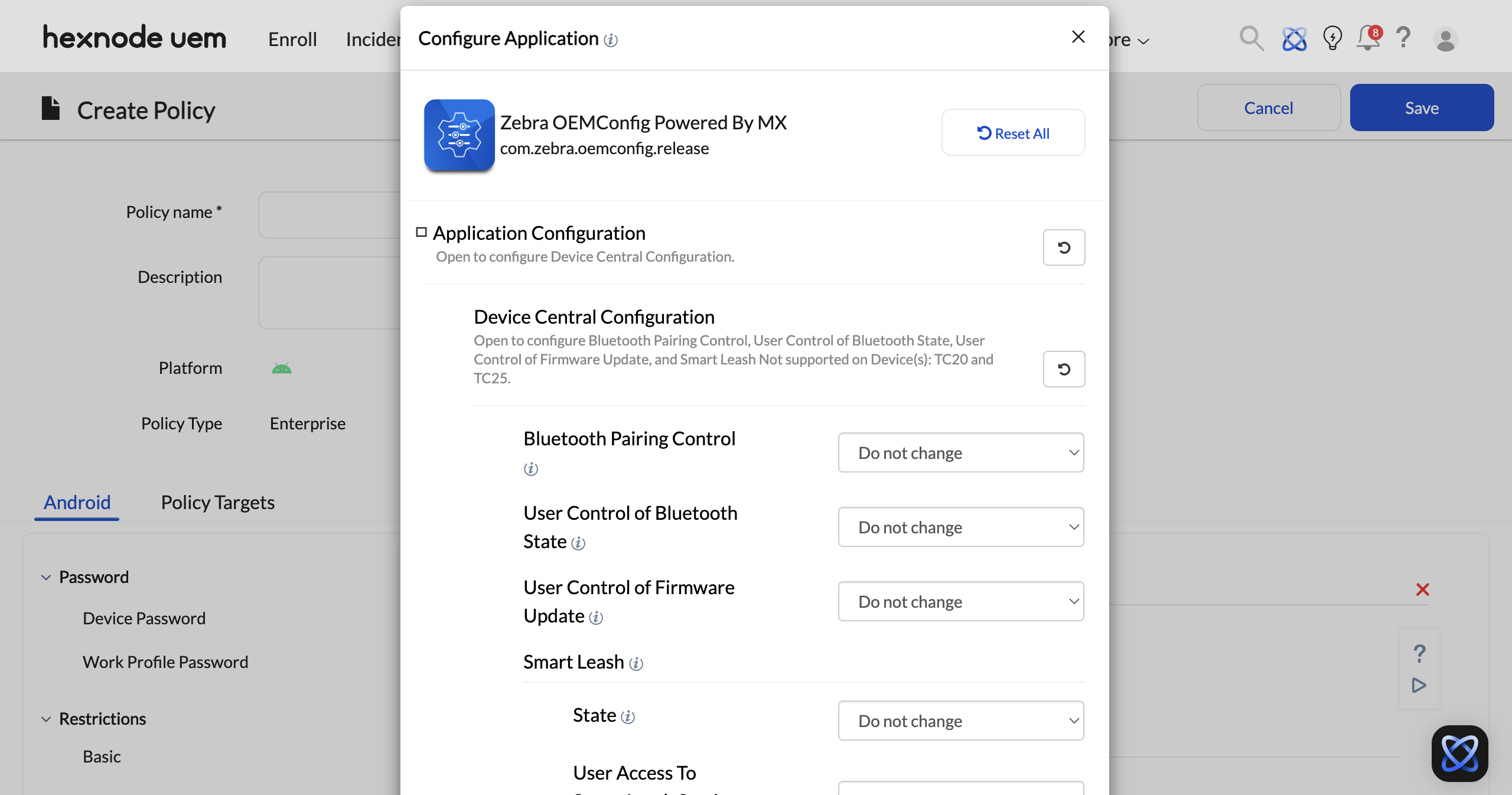
Zebra MX (Mobility Extensions): The Zebra OEMConfig (Powered by MX) application interfaces with the Zebra MX Management System, acting as a robust abstraction layer for hardware-level control.
By utilizing the managed configurations supported by the Zebra OEMConfig, specific hardware settings available via the Hexnode console include:
- Programmatic Button Remapping: Administrators can remap Push-to-Talk (PTT) and other hardware buttons by submitting custom XML strings.
- Bluetooth Pairing Control: Manage how the device handles peripheral connections, including the ability to restrict or prevent unauthorized pairings.
- Smart Leash Management: Configure Smart Leash states to enhance device security and tracking.
- OTA Update Governance: Strictly control Zebra LifeGuard OTA update windows to ensure OS stability.
- Firmware Update Restrictions: Toggle the Firmware Update Button to prevent unauthorized, user-initiated version jumps.
Honeywell Enterprise: By employing OEMConfig as the interface for Honeywell Enterprise,the Honeywell UEMConnect agent (including Honeywell OEMConfig for ScanPal) enables granular hardware orchestration through the following configurable settings:
- Key Remapping and Wakeup Settings: Administrators can remap device keys and configure specific wakeup triggers.
- Ezconfig Parameters: Remotely manage Ezconfiguration settings to standardize device setups.
- USB Mode Orchestration: Lock the device to specific USB Modes, such as charging, MTP, or PTP, and disable initial prompts.
- Storage Restrictions: Regulate hardware functionality by enabling or disabling SD card access.
- Managed App Configurations: Deploy symbology-specific logic and application-level settings through the Managed Google Play framework.
- Warehouse Network Optimization: Fine-tune Network Settings by restricting Roaming Data and Network Location Providers to maintain persistent connectivity.
Enterprise-Scale Ruggedized Workflows: Mission-Critical Handheld Security and Remote Support Integration
- Mission-Critical Kiosk Mode: Hexnode locks handhelds into a high-performance Single-App or Multi-App Kiosk. This ensures the scanning or ERP application remains the primary interface, preventing accidental Android OS navigation or “settings-tampering” by floor staff.
- MQTT-Powered Remote Troubleshooting: Utilizing an MQTT socket connection, IT support can remotely view and control the screens of Zebra or Honeywell units globally. This allows for instant troubleshooting in remote distribution centers, minimizing downtime.
Rapid Endpoint Onboarding: Automated Device Owner Provisioning and Managed OEMConfig Deployment for Zebra and Honeywell Fleets
Scaling to a 500-man technician team for a 10,000-unit rollout requires automated, “out-of-the-box” provisioning.
- The Process: For high-scale industrial deployments, endpoints are enrolled via Android Enterprise (AE) Zero-Touch Enrollment (ZTE) or high-speed QR Code provisioning, which automatically establishes the Device Owner (DO) management mode. This state grants Hexnode deep-level administrative permissions, allowing the device to automatically connect to Warehouse Wi-Fi via pre-configured payloads. Once connectivity is established, the device undergoes automated enrollment into the Hexnode UEM console, triggering the silent installation of mission-critical applications and the immediate enforcement of Kiosk Mode lockdowns.
- Managed OEM Configuration Deployment: Administrators can deploy Zebra OEMConfig and Honeywell UEMConnect as Managed Google Play apps directly from the Hexnode console.This Over-the-Air (OTA) orchestration model centralizes the lifecycle management of ruggedized Android hardware, enabling IT teams to enforce uniform device behavior and security protocols across global fleets without manual, on-site intervention.
Technical Comparison: Standard Android Enterprise vs. Hexnode Ruggedized Orchestration via OEMConfig
While standard Android Enterprise (AE) provides a foundational management layer, Hexnode Ruggedized Orchestration leverages OEMConfig to unlock proprietary hardware capabilities, as detailed in the technical comparison below.
| Feature | Standard Android Enterprise | Hexnode Ruggedized (OEMConfig) |
|---|---|---|
| Scanner Precision | Basic Camera Support | Native Scan Engine Tuning (Aiming/Symbology) |
| Button Mapping | Default Only | Fully Programmable (PTT, Scan, Emergency) |
| Firmware Control | General OS Updates | Firmware Pinning & Managed Lifeguard OTA |
Deployment Roadmap: Orchestrating Zebra and Honeywell Fleets via Hexnode UEM
- OEM Integration: Approve and host the Zebra/Honeywell OEMConfig apps within Hexnode UEM, under the Managed Store Apps.
- Profile Architecture: Design App Configuration Profiles through the App Configuration policy for the hosted OEMConfig apps via Hexnode UEM, specifically for warehouse-specific Device Groups.
- Unified Provisioning Distribution: Administrators generate Android Enterprise (AE) QR codes or configure Zero-Touch Enrollment (ZTE) profiles within the Hexnode console to establish the Device Owner (DO) state; these enrollment assets which embed pre-configured Warehouse Wi-Fi payloads are distributed to regional logistics managers to facilitate the immediate, silent installation of mission-critical applications and Kiosk Mode lockdowns upon initial device boot.


