


Category filter
Advanced macOS Management: System Extensions and ESF Deep-Dive
Managing macOS at an enterprise scale requires surpassing the limitations of standard MDM protocols. While basic MDM relies heavily on Apple Push Notification Service (APNS), Hexnode’s advanced macOS management utilizes a “Hybrid Orchestration” model.
This model combines the native authority of Apple’s Declarative Device Management (DDM) and Endpoint Security Framework (ESF) with the high-concurrency velocity of the Hexnode MQTT Triple-Channel Engine. This ensures that any number of technician teams can manage macOS fleets with the same sub-second responsiveness expected in Windows environments, despite the rigidity of Apple’s walled garden.
Core Architecture: Hexnode Mac Agent (HMA) + Native Stack
1. Declarative Device Management (DDM)
The Paradigm Shift: Transitioning from server-centric polling to device-centric autonomy.
- Legacy Model: Server constantly polls: “Are you compliant?”, Device responds. (High Latency/Load).
- DDM Model: Hexnode deploys Declarations (Configurations, Assets, Activations). The Mac natively monitors its own state.
- Scale Benefit: Distributes logic to the edge, significantly reducing processing load on the Dedicated Cluster.
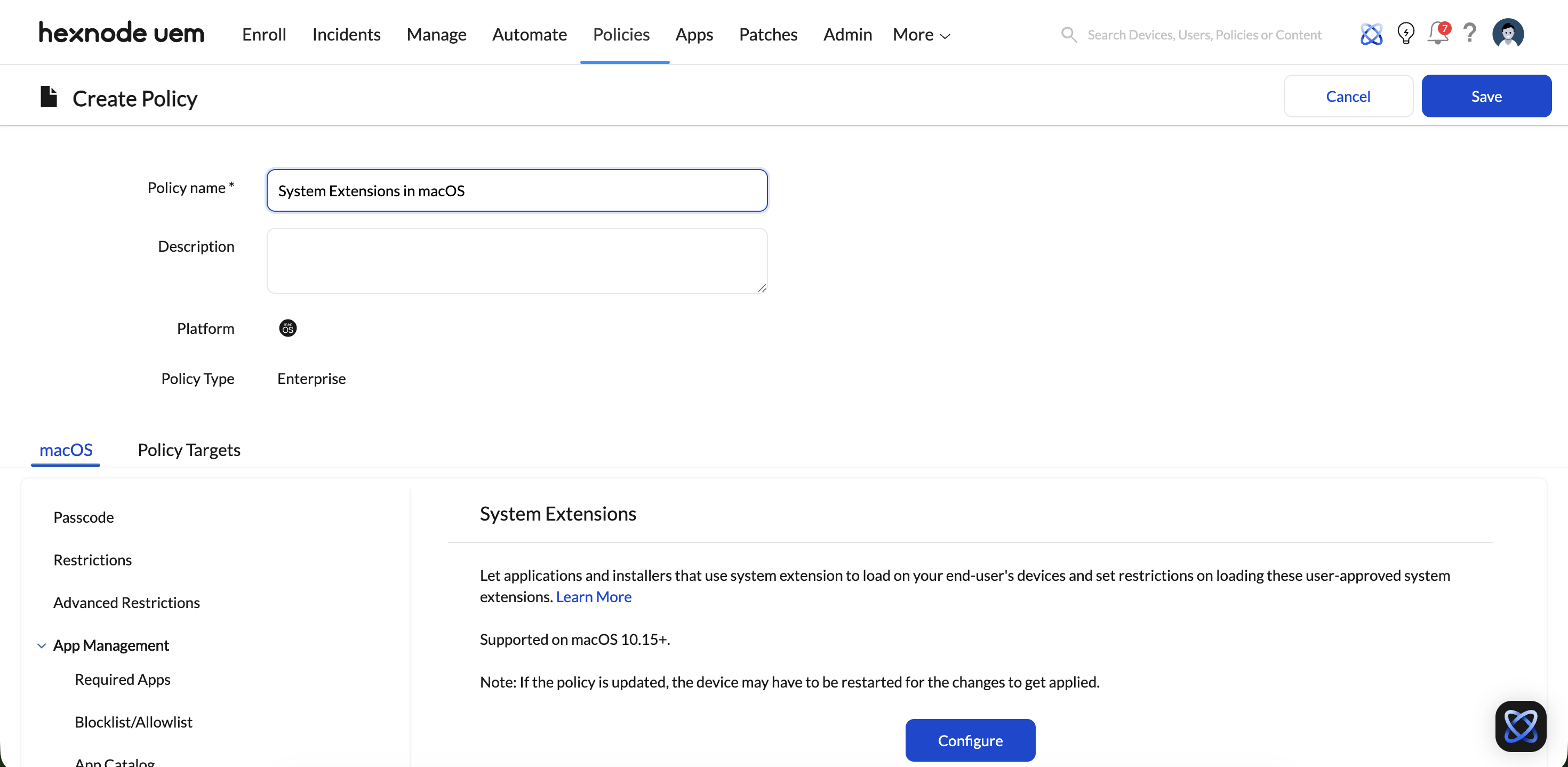
2. System Extensions & Content Filtering
Modernization: Legacy Kernel Extensions (KEXTs) are deprecated. Hexnode orchestrates System Extensions running in user space to maintain stability.
- Network Extensions: Transparent proxy configurations and content filters operate at the system stack level.
- Outcome: 100% compliance without third-party VPN clients; traffic is filtered before it leaves the network interface.
Endpoint Security Framework (ESF) Deep-Dive
Purpose: Real-time visibility and threat remediation.
Workflow:
- Monitor: The Hexnode Mac Agent (HMA) subscribes to ESF events (Process Execution, File System Changes, Socket Connections).
- Detect: HMA compares events against a local “Blocklist” or behavioral signature.
- Remediate:
- Action: process.kill() executed immediately by the agent.
- Alert: Sub-second notification sent to VPC Core via MQTT.
- Forensics: Aggregate telemetry is streamed to the SIEM for fleet-wide analysis.
High-Scale Enterprise Workflows
1. Bootstrap Token & Secure Token Management
Challenge: Apple Silicon (M1/M2/M3) architecture requires a Secure Token to authorize sensitive operations (Disk Encryption, OS Updates).
Hexnode Solution:
- Escrow: Bootstrap Token is automatically escrowed to the Hexnode Cluster during Automated Device Enrollment (ADE).
- Grant: Technicians can programmatically grant Secure Token status to local user accounts using the escrowed key.
- Benefit: Eliminates “Admin Lockout” scenarios where IT cannot update a device because the token is tied to a departed user.
2. Platform SSO (Single Sign-On)
Integration: Hexnode Access -> Apple Platform SSO.
User Experience:
- User signs in to Mac lock screen with Entra ID (Azure AD) or Okta credentials.
- Sync: Local account password automatically synchronizes with Cloud IdP password.
3. Zero-Touch Deployment (ABM Integration)
The “Warm” Enrollment Flow:
- Ship: Device shipped directly from Apple to End User.
- ABM Trigger: Device serial number recognized in Apple Business Manager; redirects to Hexnode Server.
- HMA Activation: Agent installs and opens MQTT Socket.
- Content Pull: Device immediately identifies nearest DAFS Node and pulls 10GB+ creative suites (Adobe/Autodesk) via local HTTPS.
Comparative Analysis: Standard MDM vs. Hexnode Orchestration
| Feature | Standard Apple MDM | Hexnode macOS (HMA + DDM) |
|---|---|---|
| Command Delivery | APNS Only (Variable Latency) | MQTT + APNS (Sub-second) |
| Configuration Model | Imperative (Profiles) | Declarative (DDM) (Autonomous) |
| Security Monitoring | Static Policies | Dynamic ESF Monitoring (Real-time) |
| App Deployment | VPP Only | VPP + DAFS (Resilient PKG/DMG) |
| Shell/Scripting | Delayed Execution | Live Terminal (Instant/Interactive) |
Implementation Checklist: macOS Phase
- APNS Cert: Upload valid Apple Push Notification Service certificate to Dedicated Cluster.
- DDM Activation: Enable Declarative Device Management for all macOS 14+ endpoints.
- Token Escrow: Configure policy to automatically escrow Bootstrap Token during enrollment.
- Extension Allowlisting: Define Team IDs and Bundle IDs for critical security tools (CrowdStrike, SentinelOne) to prevent user prompts.
- DAFS Verification: Ensure local DAFS nodes are caching macOS .dmg and .pkg installers effectively.
Frequently Asked Questions (FAQs)
- Why is the Hexnode Mac Agent needed if Apple MDM already exists?
Apple MDM relies on APNs, which does not guarantee instant command delivery or execution. The Hexnode Mac Agent (HMA) supplements Apple MDM by adding an MQTT-based real-time communication channel for actions such as Live Terminal and Process Kill. It also leverages the Endpoint Security Framework (ESF) for active threat monitoring capabilities that standard MDM does not provide.
- How are M3 MacBooks updated if the primary user leaves the company?
Updates are handled using the Bootstrap Token. Because the token is escrowed to Hexnode during enrollment, administrators can authorize volume ownership changes or perform OS updates without requiring the original user’s password or Secure Token.
- Can a specific app be blocked from running on macOS?
Yes. With ESF integration, a blocklist policy can be configured. The Hexnode Mac Agent monitors process execution events in real time and immediately terminates any process that matches the blocklist, while also logging the incident to the console.


