Zero Trust Security Framework for Kiosks
A guide to securing public kiosks through continuous device verification.

Get fresh insights, pro tips, and thought starters–only the best of posts for you.
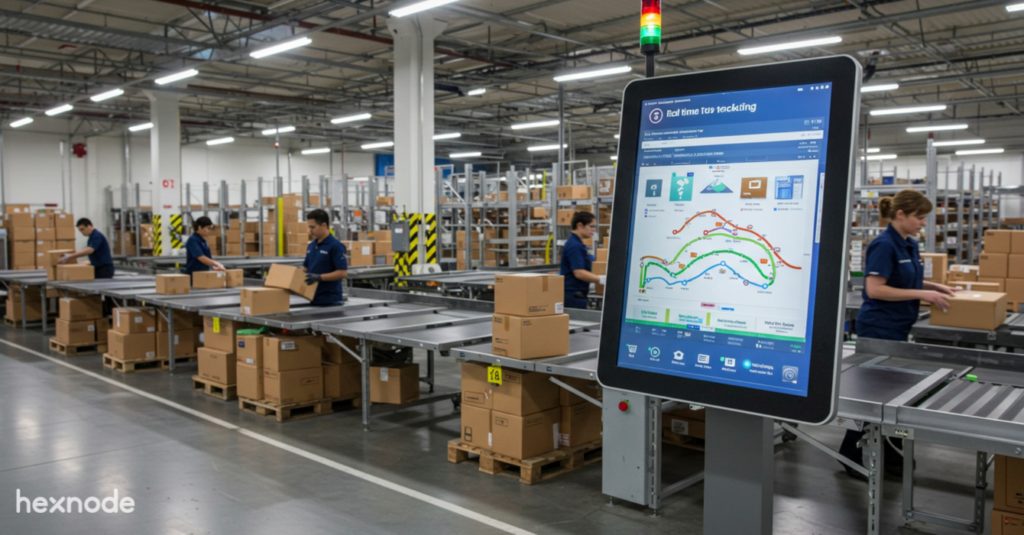
As enterprises move toward unattended and automated operations, the supply chain kiosk has become a vital endpoint for driver check-ins, inventory visibility, and automated fulfillment workflows. These kiosks now function as distributed enterprise endpoints, making logistics endpoint security a critical priority. Deploying kiosks at scale significantly expands the attack surface and increases operational complexity. Without a centralized Unified Endpoint Management (UEM) strategy, organizations risk turning high-value infrastructure into isolated, hard-to-secure endpoints instead of reliable operational assets.
Enterprise IT architects must balance strict security requirements with the need for continuous, 24/7 availability across widely distributed locations. Effective supply chain kiosk management moves beyond basic device management to deliver a policy-driven orchestration framework built for scale. With built-in support for rugged device management, Hexnode enables comprehensive control, allowing IT teams to secure, provision, and manage kiosks deployed in demanding warehouse, yard, and transit environments. This guide explores how IT teams implement tracking, dispatch, and lockdown protocols to secure the supply chain kiosk ecosystem, reduce operational risk, and deliver consistent, enterprise-grade performance.
In fragmented supply chain environments, visibility gaps trigger operational breakdowns. When an unmanaged supply chain kiosk goes offline or drifts from its approved configuration, the disruption quickly tumbles down—delaying shipments, increasing downtime, and driving labor costs.
IT teams eliminate these gaps by enforcing a unified security baseline. Hexnode UEM achieves this by treating every kiosk as a managed node within a centralized security fabric. Instead of configuring devices individually, IT teams apply global policies that ensure every supply chain kiosk meets compliance requirements from the moment it powers on.
By replacing manual provisioning with automated endpoint orchestration, organizations streamline the entire device lifecycle. This approach accelerates deployment while strengthening logistics endpoint security, removing human error from configuration workflows, and ensuring consistent outcomes at scale.
In warehouse yards and logistics hubs, location data needs more variation than simple GPS coordinates. Indoor environments, mobile assets, and dense infrastructure demand higher visibility.
Hexnode transforms location tracking into a proactive security and diagnostic capability, strengthening logistics endpoint security by ensuring kiosks operate only within approved physical and network boundaries. This visibility helps IT teams detect anomalies early and prevent unauthorized access before it impacts supply chain operations.
Hexnode allows administrators to define virtual perimeters around facilities such as distribution centers and transit hubs. When a supply chain kiosk crosses one of these boundaries, Hexnode automatically responds without manual intervention. Possible actions include:
This level of automated response is critical for supply chain operations, where lost, stolen, or misplaced devices disrupt workflows and expose sensitive logistics data. By enforcing location-based controls, organizations protect shipment information, prevent unauthorized access, and ensure every supply chain kiosk remains operational only within approved environments.
For kiosks mounted on carts or forklifts, Hexnode creates a detailed movement history. This data supports smarter warehouse optimization by identifying high-traffic bottlenecks in the distribution hub. Instead of relying on assumptions, IT and operations teams distribute assets based on real-world usage patterns.
Effective tracking extends beyond physical location. Hexnode continuously monitors signal strength, battery health, and data consumption. If a supply chain kiosk in a remote shipyard corner shows declining connectivity, IT teams investigate before driver check-ins fail—protecting workflow continuity and minimizing disruption.
Device dispatch often represents the highest operational cost for IT teams. Manually unboxing, configuring, and shipping kiosks does not scale—especially in large, geographically distributed supply chain environments.
Hexnode eliminates this friction through seamless integration with vendor deployment programs and advanced rugged device management, enabling organizations to securely deploy kiosks built for harsh warehouse floors, outdoor yards, and transit environments. This approach ensures durability, consistency, and compliance across large-scale logistics deployments.
Hexnode supports Android Zero-Touch, Apple Business Manager, and Windows Autopilot. Enterprises ship hardware directly from the OEM to the deployment site. Once the supply chain kiosk connects to the internet, Hexnode blocks the setup process and applies predefined configurations automatically. This ensures that no device ever operates in an unmanaged state.
Logistics environments vary widely, and kiosks often serve different roles. Hexnode’s dynamic groups and tagging allow IT teams to tailor configurations based on context, including:

Ultimate guide to secure, streamlined kiosk management for modern businesses.
Download the WhitepaperModern rugged devices rely on OEM-specific capabilities for advanced control. Hexnode supports OEMConfig and the Android Management API, allowing IT teams to configure deep hardware-level settings without custom scripts. Through OEMConfig, administrators manage device-specific features such as barcode scanners, battery optimization, and hardware buttons directly from the console.
By leveraging the Android Management API and robust rugged device management, Hexnode ensures secure, scalable, and future-ready management of Android-based kiosks. This approach enables consistent policy enforcement across diverse hardware models while maintaining compatibility with the latest standards.
Downtime is not an option for 24/7 logistics operations. Hexnode supports silent installation and updates for EXEs, MSIs, and PKGs. IT teams schedule updates during low-traffic periods or push them without user interaction, ensuring kiosks always run the latest software without interrupting operations.
Because supply chain kiosks are physically accessible, they represent a critical layer of logistics endpoint security. Hexnode’s OS-level lockdown ensures that kiosks remain restricted to approved workflows, protecting enterprise systems from both accidental misuse and deliberate tampering.
By restricting access to a verified set of applications, organizations eliminate unauthorized browsing and configuration changes. Key controls include:
Every physical port introduces risk. Hexnode allows IT teams to disable USB data transfer, protecting against data exfiltration and malware injection. Administrators also restrict Bluetooth, Wi-Fi tethering, and external storage, ensuring each kiosk remains a closed and secure environment.
When kiosks require web access for ERP systems or logistics portals, standard browsers introduce unnecessary risk. The Hexnode Secure Browser enables IT teams to:
This approach protects sensitive driver and shipment information without sacrificing usability.
Deployment marks the beginning of supply chain kiosk management. Hexnode continuously monitors every device to ensure it remains compliant and secure.
The strength of an automated supply chain depends on the reliability and security of its endpoints. A supply chain kiosk is not just a terminal; it is a gateway to enterprise systems and a critical component of logistics operations. By combining Zero-Touch deployment, advanced kiosk lockdown, and enterprise-grade rugged device management, Hexnode UEM delivers consistent logistics endpoint security across globally distributed environments.
Secure, deploy, and manage supply chain kiosks at scale with centralized policies and enterprise-grade endpoint control.
Start your 14-day Free Trial Today!