Essential features of a remote monitoring system
A guide to the critical metrics every remote monitoring system must track.

Get fresh insights, pro tips, and thought starters–only the best of posts for you.
Mar 3, 2026
6 min read
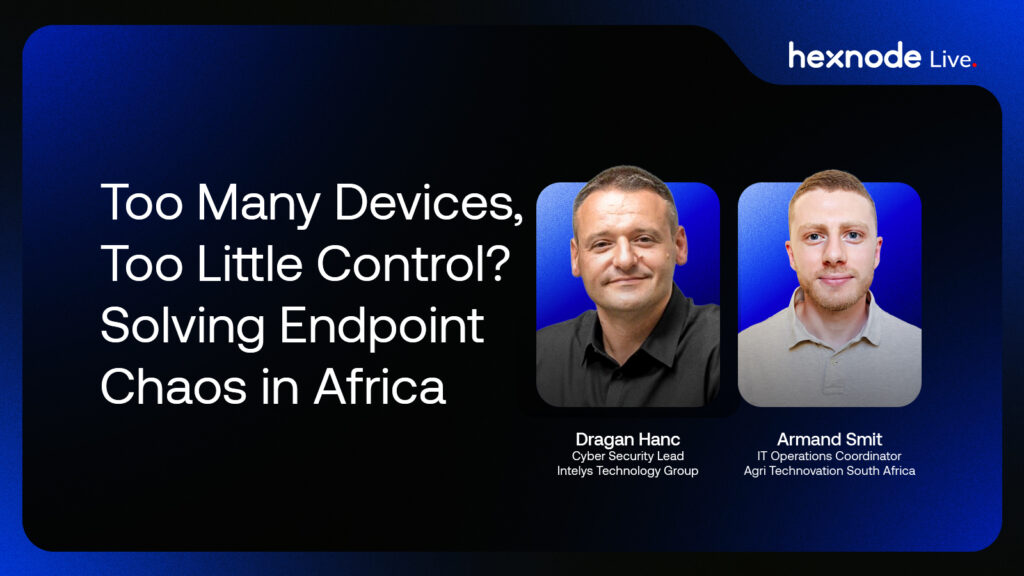
Enterprise IT teams across Africa are confronting a growing reality: more devices, more mobility, and significantly more complexity. During a recent Hexnode Live session, Dragan Hanc (Cybersecurity Lead, Intelys Technology Group) and Armand Smit (IT Operations Coordinator, Agri Technovation South Africa), shared how organizations are navigating expanding device fleets amid infrastructure constraints and mobile-first work models.
Drawing from their own experiences, Hanc and Smit explained that the challenge is no longer just recognizing “device sprawl,” but building systems that operate reliably when the connection drops and the environment get tough.
Africa’s enterprise environment has moved decisively away from traditional PC-centric models. According to Hanc, mobile endpoints now dominate enterprise workflows. “Edge devices dominate,” he observed, noting that business apps and collaboration are now mobile-first by default.
With mobile technology contributing an estimated $220 billion to the regional economy, adoption continues to accelerate. While laptops remain essential for corporate work, Android devices account for the majority of handhelds due to affordability and broader manufacturer choice. For IT teams, this hybrid environment, spanning smartphones, tablets, kiosks, and rugged devices, demands a more unified approach. Widespread bring your own device (BYOD) policies further complicate oversight, requiring consistent policy enforcement without disrupting productivity. Hanc emphasized that “without a centralized, cloud-driven unified endpoint management (UEM) solution, security and compliance simply don’t scale.”
For organizations operating outside of major corporate hubs, IT teams face unique hurdles: geographically dispersed teams, inconsistent LTE stability, and “load shedding” power cuts.
Armand Smit, who oversees a fleet of rugged devices for field technicians in rural agricultural regions argues that real-time device management is a constant struggle. To maintain a secure perimeter, a management platform must be capable of persistent queuing. This ensures that even if a device is offline for hours, any pushed policy, security patch, or configuration sits in a ready state, waiting to deploy when the connection is re-established.
“The wonderful thing is that, using an MDM (mobile device management) tool, we can queue policies, and they get pushed when the device reconnects,” he said, a feature that eliminates the “update gap” that otherwise leaves remote devices vulnerable.
However, the challenge isn’t just invisible signals; it’s physical destruction.
In industries like agriculture or mining, rugged hardware is the standard, yet physical failure is a matter of “when,” not “if.” While software cannot prevent environmental damage, MDMs provide a critical digital safety net against data exposure and “redeployment lag”—the costly downtime between a device breaking and a technician returning to productivity.
To mitigate these risks, administrators use centralized management to secure both the data and the recovery process. If a device is lost or destroyed in the field, IT can instantly initiate a remote wipe to protect sensitive information. Simultaneously, Zero-Touch Enrollment simplifies the replacement logistics; new units are pre-configured so that the moment they power on, they automatically pull predefined settings and business apps. This automation ensures that even when hardware fails, the transition to a new device is seamless, shifting the focus from manual troubleshooting back to core operations.
Beyond standard handhelds, Africa is seeing a boom in digital kiosks — a market projected to reach $5.3 billion by 2035. From self-help terminals to solar-powered hubs, these devices often operate where infrastructure is thin and the ability to manage remote installations without constant travel is a significant operational advantage.
Hanc suggests that the key to this efficiency is the strategic use of “Kiosk Mode.” By locking devices into a dedicated business environment, IT teams can remotely provision, update, or wipe terminals across vast geographies from a single central dashboard. This shift to an autonomous maintenance model ensures high uptime and prevents unauthorized tampering without requiring manual intervention.
“By utilizing this dedicated lockdown approach, IT teams can ensure that devices remain secure and productive regardless of their location,” Hanc explained. He notes that in the African context—where travel and logistics are notoriously difficult—eliminating the need for on-site visits is “a serious win.”
The session concluded with a fundamental truth: in a landscape of constant disruption, the goal of every IT admin is not a static state of security, but a culture of autonomous resilience. As fleets expand into “endpoint chaos,” human-led monitoring can no longer keep pace.
The focus for IT teams has shifted from constant manual supervision to total system reliability. For Smit, the ultimate metric of success is a system that enforces its own rules. “The most important thing is having a system you don’t need to check every day,” he concluded. By automating the “desired state,” businesses can finally stop reacting to “endpoint chaos” and start scaling with confidence.
1. How does an MDM help my business prove we are following POPIA?
Accountability under POPIA means you must be able to prove your security measures actually work, not just that you have a policy on paper. An MDM serves as your digital “paper trail” by automatically generating reports that show every device in your fleet is encrypted and password-protected. If a device is ever lost or stolen, the system provides timestamped logs proving you wiped the data immediately to prevent a breach. This continuous monitoring allows you to demonstrate to authorities that you are actively protecting personal information 24/7. By automating these security checks, you move from simply claiming to be compliant to having the verifiable data to prove it.
2. Why is the shift toward autonomous device management becoming a survival requirement?
Manual gaps occur during connectivity drops or hardware failures. And As device fleets expand into “endpoint chaos,” human-led monitoring can no longer keep pace with the speed of modern workflows or security threats. An autonomous system ensures that policies “stick” and self-execute, keeping the enterprise resilient and compliant by default without needing a 1:1 ratio of IT staff to devices.