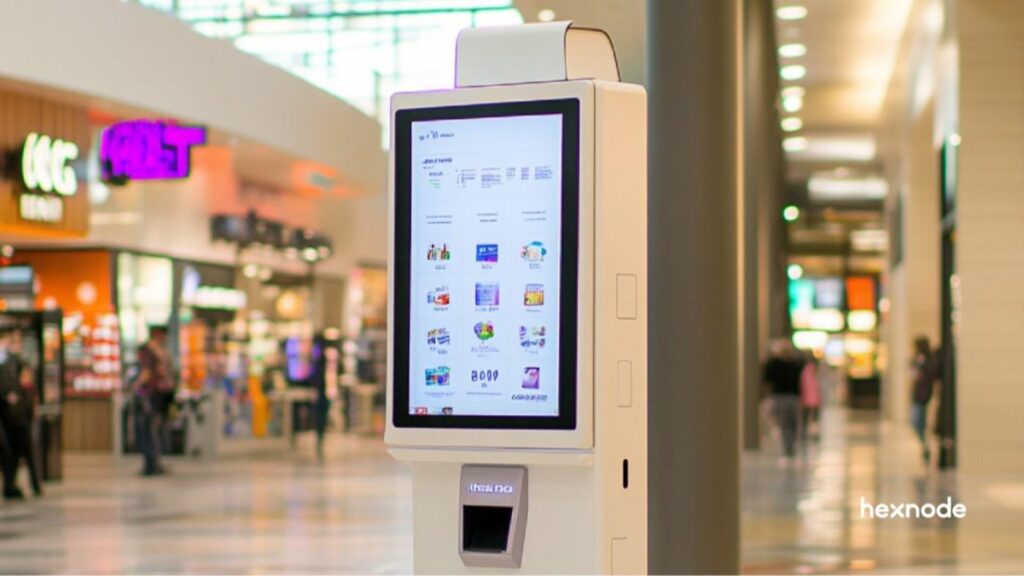
Unmanaged digital signage becomes a cybersecurity liability when it operates outside centralized IT control.
This typically happens when:
Devices are not patched or monitored
They are connected to corporate networks without segmentation
Physical or remote access is not restricted
Content delivery is not centrally controlled
At this point, signage is no longer just a display. It becomes an exposed endpoint that can be exploited for lateral movement, unauthorized access, or visible disruption on public-facing screens.
With Hexnode, organizations can regain control by enforcing kiosk lockdown, automating updates, maintaining device visibility, and enabling timely response actions. This comprehensive approach turns signage back into a managed and secure asset.
Introduction: When a Screen Turns into a Security Liability
A digital display in a corporate lobby, airport, or retail store is designed to grab attention. Now imagine that same screen showing unauthorized or inappropriate content. The impact is immediate and public. This is rarely just a display issue. It usually points to a deeper problem, which is an unmanaged digital signage. The device is not under proper control.
Digital signage today runs operating systems, applications, and network-based content delivery. It behaves like any other endpoint. Yet many organizations still treat it as passive hardware.
That gap between capability and control creates risk.
Unmanaged digital signage becomes a cybersecurity liability when it operates outside IT governance. At that point, it becomes a network-connected endpoint with gaps in patching, access control, and visibility.
To reduce this risk, organizations need to manage signage like any other endpoint. Platforms like Hexnode help enforce policies, maintain visibility, and bring these devices back under control.
Unmanaged digital signage refers to display systems that operate without centralized IT oversight, policy enforcement, or security monitoring.
In enterprise environments, these systems typically include:
Media players or system-on-chip (SoC) devices
Operating systems such as Android, Windows, Fire OS, or tvOS
Content management systems (CMS)
Network interfaces for content delivery and remote access
On the surface, these components work together to deliver content. The problem starts when they operate without unified control.
Without centralized management, IT teams lose visibility into device health, patch status, and access controls. Teams may miss updates, allow configurations to drift, and overlook unauthorized access.
At that point, the device no longer functions as a controlled communication channel. It becomes an unmonitored endpoint within the enterprise network, introducing risk where none was expected.
When does an Unmanaged Digital Signage become a Cybersecurity Liability?
Digital signage does not become a risk by default. It becomes a cybersecurity liability when key control mechanisms fail. When visibility drops and defenses weaken, the device becomes easier to exploit.
Below is one of the most common points where unmanaged digital signage crosses that threshold.
1. When Patch Management is not Enforced
A signage device becomes vulnerable when it falls out of a structured update cycle.
Attackers may be able to use publicly available or known exploited vulnerabilities that target unpatched weaknesses.
Why it matters:
Unpatched signage devices create a low-effort entry point, increasing the risk of compromise within the network.
2. When the Device Connects to the Network without Segmentation
A signage device becomes a security concern when it connects to the same network as critical systems without proper segmentation.
In this state:
There is no VLAN or network isolation
Communication is not restricted by firewall rules or policies
The device has unrestricted access to internal services
If the device is compromised, it no longer remains isolated. It can act as a foothold inside the network, allowing attackers to move laterally and probe other systems.
Why it matters:
The risk is no longer limited to the device itself. What was meant to be a display endpoint becomes an internal access point, increasing the potential impact of a breach.
3. When Physical Access is Possible but not Controlled
Many signage devices are deployed in public or semi-public spaces. Without proper restrictions, physical access becomes a direct security risk.
In such cases:
USB ports remain enabled
Debugging modes or developer options are accessible
BIOS or boot settings are not locked
Even brief physical access can be enough. An attacker can connect to external media, introduce malicious files, or alter system configurations.
Why it matters:
Physical access can bypass many software-based controls. Once that barrier is broken, the device can be compromised without triggering traditional security mechanisms.
4. When the Device is not Locked to its Intended Function
A signage device is meant to operate within a controlled environment. Typically, this means displaying approved content through a specific application. Without enforcement, that boundary breaks down.
In this state:
Users can exit the signage application
System settings become accessible
Unauthorized apps can be opened or installed
This shifts the device from a restricted system to a general-purpose one, increasing the risk of misuse and unauthorized changes.
Why it matters:
Without kiosk lockdown, the device is no longer controlled. It behaves like an open endpoint, making it easier to tamper with configurations or introduce unwanted activity.
How to choose a UEM solution that fits all your digital signage needs?
Learn how to choose the right UEM to secure, manage, and scale your digital signage.
5. When Content Control is Decentralized or Weak
Content delivery for digital signage often involves multiple teams and systems. Without centralized control, this creates a clear risk area.
In such cases:
Access to the CMS is not properly restricted
Content sources are not validated
Changes are not tracked or audited
If access is compromised or misused, unauthorized content can be published to the displays.
Why it matters:
Unlike backend systems, signage is public facing. Any unauthorized change is visible immediately. This can disrupt operations and lead to reputational impact before IT teams have time to respond.
6. When Default Credentials and Open Ports Persist
Many signage deployments continue to run with factory settings long after installation. This creates avoidable security gaps.
In such cases:
Default usernames and passwords are still active
Unnecessary services and ports remain open
Remote access is not properly secured
These weaknesses are well known and often targeted by attackers using automated methods.
Why it matters:
This is one of the most common and preventable vulnerabilities. Without basic configuration changes, signage devices become easy targets, increasing the risk of unauthorized access and compromise.
7. When there is no Monitoring or Incident Response Capability
A signage device becomes a liability when there is no way to detect or contain issues.
In this state:
There is no visibility into device status or behavior
No alerts are triggered for unusual activity
There is no way to investigate or respond remotely
Without these controls, problems do not surface until they cause visible impact.
Why it matters:
The risk is not just that a device may be compromised. It is that the compromise can go unnoticed. Without monitoring and response, even minor issues can escalate, increasing both the impact and the time required to resolve them.
The Inflection Point
Unmanaged digital signage becomes a cybersecurity liability when control, visibility, and response are all missing at the same time.
Each gap introduces risk on its own. Combined, they create a highly exposed endpoint that:
Is more easily compromised
Can provide access to internal systems
Can cause immediate disruption on public-facing screens
At this stage, the risk is no longer theoretical. The device is no longer operating within defined boundaries or under active oversight.
Why it matters:
This is the point where signage stops functioning as a controlled communication tool and starts behaving like a security risk within the network.
Securing Digital Signage at scale with Hexnode
Once digital signage becomes a liability, the focus shifts from identifying risk to enforcing control. The goal is to restore governance, define clear boundaries, and maintain continuous visibility across all devices.
Each of these plays a specific role. Device management enforces policies and configurations. Detection and response help identify and contain issues on supported endpoints. Identity controls ensure only authorized users can access and manage devices.
Together, these capabilities close the gaps that allow unmanaged digital signage to become a security risk.
Enforcing Device Boundaries with Kiosk Lockdown
The first step in securing digital signage is restricting what the device can do.
With Hexnode kiosk lockdown, administrators can define clear operational boundaries:
Lock the device to a single application, such as a signage CMS using single app mode
Restrict access to specific URLs for browser-based deployments with web app kiosk
Block access to system navigation, settings, and other applications
These controls restrict device usage and reduce the risk of misuse or unauthorized changes.
Impact:
The device stays focused on its intended purpose. Instead of behaving like a general-use system, it operates as a controlled display endpoint with minimal exposure.
Bringing all Devices under One Console with UEM
Digital signage deployments rarely run on a single platform. Most environments include a mix of Android players, Windows systems, and tvOS-based devices. Managing them separately creates inconsistency and limits visibility.
With Hexnode UEM, IT teams can manage all signage devices from a single console across:
From this centralized interface, administrators can:
Apply policies consistently across devices
Configure network settings such as Wi-Fi and VPN
Track device inventory, status, and activity
Impact:
Centralized management reduces fragmentation and improves operational consistency, making it easier to maintain control across the entire signage fleet.
Closing Vulnerability Gaps with Automated Patching and Compliance
Patch management plays a key role in keeping signage devices secure over time. Without it, systems fall behind and become exposed to known vulnerabilities.
With Hexnode patch management, administrators can:
Automatically identify and flag non-compliant devices
These controls help maintain consistent security baselines across the device fleet. Instead of relying on manual updates, policies ensure devices stay aligned with defined standards.
Impact:
This reduces exposure to known exploits and prevents devices from gradually drifting into vulnerable states due to missed updates or inconsistent configurations.
Featured resource
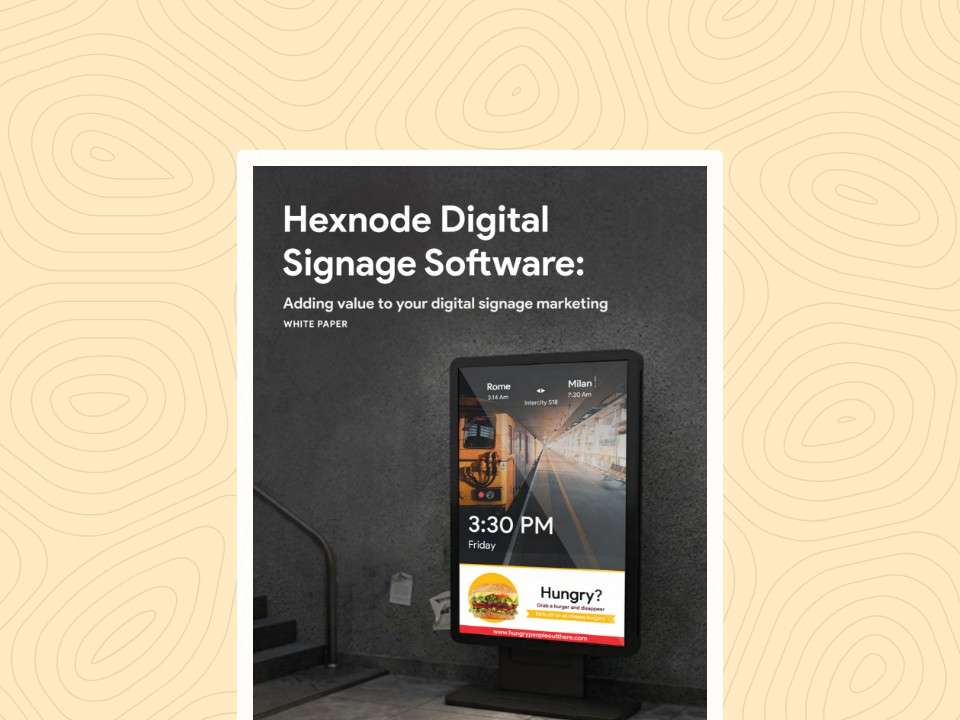
Hexnode digital signage software: Adding value to your digital signage marketing
Discover how Hexnode provides an affordable, state-of-the-art solution to optimize digital signage marketing and TCO.
Restricting access based on device compliance through conditional access checks
These controls help restrict Hexnode console access and configuration changes to authorized technicians, while compliance-based access enforcement depends on the configured external IdP.
Impact:
Reduces the risk of unauthorized changes and strengthens overall control over signage policies and settings.
Securing Network Communication and Device Context
Signage devices should operate within clearly defined network boundaries to reduce exposure.
With Hexnode, administrators can apply controls such as:
Configuring secure Wi-Fi profiles for trusted network access
Routing traffic through VPN configurations
Applying geofencing policies to restrict where devices can operate
These controls help ensure devices connect through approved networks and function within expected locations.
Impact:
Limits exposure to external threats and reduces the risk of unauthorized access by keeping device communication within controlled environments.
From Risk to Control: How Each Gap Is Addressed
Every security gap in unmanaged digital signage maps to a specific control. The key is not just identifying these gaps but applying the right controls consistently across all devices.
With Hexnode, organizations can address each risk condition through centralized policies and management capabilities, ensuring complete oversight across the signage environment.
Liability condition
Hexnode control
No patch enforcement
Automated patch management and compliance policies
By applying these controls across the environment, organizations can reduce risk and bring signage devices back under management.
Impact:
Digital signage shifts from an exposed endpoint to a controlled and secure part of the enterprise infrastructure.
Operationalizing Digital Signage Security
After identifying risk conditions, organizations should implement security measures consistently across all devices. Hexnode helps secure digital signage through a structured approach:
Enroll devices into a centralized console
Bring all endpoints under visibility using Hexnode device enrollment methods.
Apply kiosk lockdown policies
Restrict devices to approved apps or content sources with kiosk lockdown.
Configure secure network access
Ensure devices connect only through trusted Wi-Fi and VPN configurations.
Enforce compliance and patching policies
Maintain OS and security baselines using patch management and compliance.
Monitor device activity
Use centralized visibility to track status and identify unusual behavior.
This approach applies security consistently across the entire signage environment rather than treating it as a collection of isolated controls.
Conclusion: The Point of No Control is the Point of Risk
Digital signage becomes a security concern when it operates without proper control. What starts as a simple display can quickly turn into an exposed endpoint when patching, access restrictions, and monitoring are not in place.
This is the point where unmanaged digital signage shifts from an operational oversight to a real security risk.
Organizations should not limit how they use these devices. Instead, they should manage them effectively. With the right controls in place, they can keep digital signage a reliable communication channel and prevent it from becoming a potential entry point into the network.
If your signage devices operate without centralized oversight, it is time to bring them under control with a unified endpoint management solution that enforces policies and maintains visibility.
Take control of your digital signage with Hexnode
Secure every screen in your environment to be visible and fully managed with Hexnode's Kiosk Lockdown
Does Hexnode support multiple platforms for digital signage?
Yes. With Hexnode UEM, organizations can manage Android, Windows, and tvOS-based signage devices from a single, unified console.
What are the primary risks of unmanaged digital signage?
The main risks include network compromise and visible disruption. A single device can display unauthorized content while also acting as a foothold for deeper access within the environment.
I write at the intersection of technology, process, and people, focusing on explaining complex products with clarity. I break down tools, systems, and workflows without any noise, jargon, or the hype.