Hexnode UEM MSP: All you need to know
Hexnode UEM MSP simplifies multi-client management, security, and license control.

Get fresh insights, pro tips, and thought starters–only the best of posts for you.

Managed Service Providers operate in a business environment where operational efficiency directly determines profitability. Most MSPs rely on a wide range of tools to manage client environments, including monitoring systems, endpoint management platforms, security tools, and automation software. Over time, these tools collectively form the MSP tech stack that powers daily service delivery.
However, as service offerings expand and client requirements evolve, MSPs frequently add new platforms without retiring older ones. This gradual expansion often creates tool sprawl, where the number of tools grows beyond what is operationally efficient.
What initially appears to be a capability upgrade can slowly become a margin problem. Each additional tool introduces licensing costs, operational overhead, integration complexity, and training requirements. When these costs accumulate, they begin to erode MSP profitability. Understanding how an overloaded MSP tech stack affects margins is essential for MSP leaders who want to scale sustainably.
The growth of an MSP software stack rarely follows a structured strategy. Instead, it evolves through incremental decisions driven by operational needs.
Common factors that lead to tool sprawl include:
Each new platform may solve a specific operational problem. However, the cumulative effect can create a fragmented MSP tech stack where multiple tools perform similar functions.
Over time, MSP teams begin to operate across multiple dashboards, workflows, and data sources. This fragmentation introduces inefficiencies that quietly reduce operational performance and limit the ability to improve MSP margins.
The impact of MSP tool sprawl is not always immediately visible. Most MSPs recognize the problem only after operational complexity begins affecting service delivery. Several underlying challenges emerge as the MSP software stack expands.
Each new platform introduces additional management layers. Technicians must constantly navigate between systems to perform tasks such as:
Instead of operating within a unified workflow, technicians split their attention across multiple systems. This complexity increases response times and reduces productivity.
Every additional tool increases recurring software costs. Typical MSP stacks include platforms for:
When these tools overlap in functionality, MSPs often pay for duplicate capabilities. Over time, the cost of maintaining a fragmented MSP software stack can significantly reduce MSP profitability.
An expanded MSP tech stack also fragments operational data. Different tools generate separate reports, alerts, and metrics. This fragmentation makes it difficult for MSP leaders to maintain a clear operational overview. Without centralized visibility, identifying inefficiencies and opportunities to improve MSP margins becomes more challenging.
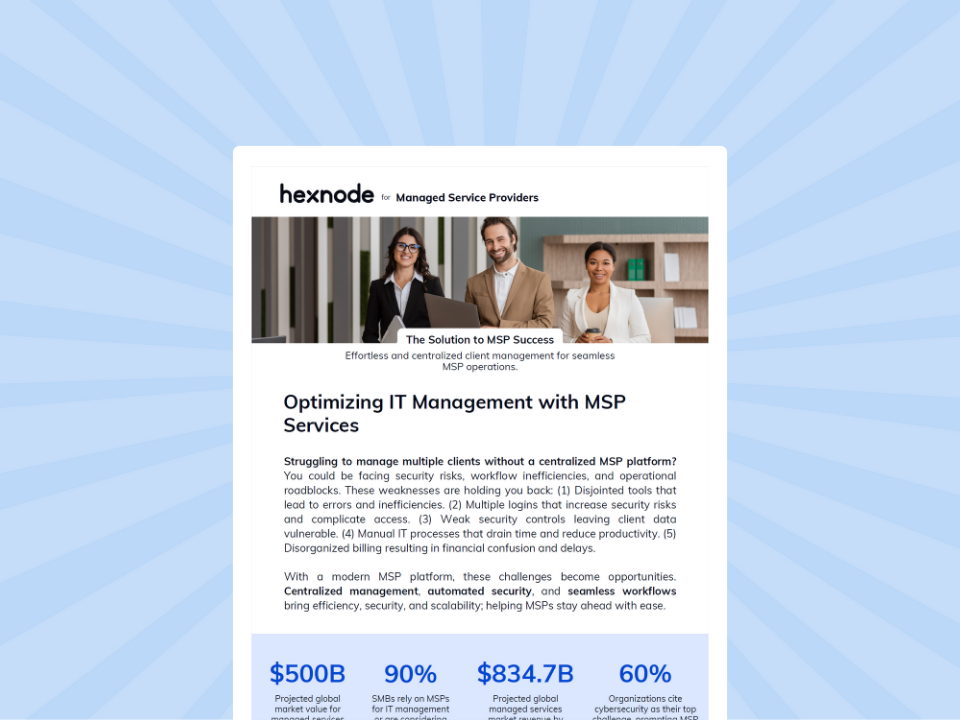
Simplify MSP operations with Hexnode UEM MSP; centralized management, automation, and security across all client environments.
DOWNLOAD THE DATASHEETThe effects of MSP tool sprawl appear in several operational areas. These issues often emerge gradually but have a measurable impact on profitability.
Many MSPs accumulate tools with overlapping capabilities. Examples include:
Each platform introduces additional subscription costs. When duplication occurs across dozens or hundreds of devices, expenses rise without delivering proportional value.
Reducing duplication within the MSP tech stack is often one of the fastest ways to improve MSP margins.
Technician productivity plays a central role in MSP profitability. A fragmented MSP software stack forces technicians to switch between multiple dashboards while troubleshooting issues.
Instead of accessing all relevant information within a single environment, they must gather data from several platforms. This process increases resolution time and reduces the number of clients each technician can efficiently support.
Most MSP platforms rely on integrations to connect different tools. As the MSP tech stack grows, these integrations become increasingly complex. Maintaining them requires ongoing monitoring and configuration.
Integration failures can disrupt automation workflows, forcing technicians to perform tasks manually. These interruptions add operational friction and increase support overhead.
Every new platform requires training. MSPs must educate technicians on:
As the MSP software stack expands, onboarding new technicians becomes more time-consuming. Training costs rise while operational consistency becomes harder to maintain.
An overloaded MSP tech stack limits an MSP’s ability to scale efficiently. As new clients are onboarded, technicians must configure multiple systems for each environment. Managing these processes across dozens of tools increases operational complexity.
Instead of supporting growth, the stack begins to slow it down. This makes it difficult for MSP leaders to improve MSP margins while expanding their client base consistently.
Improving MSP profitability requires more than simply increasing revenue. Operational efficiency plays an equally important role in maintaining healthy margins. Reducing tool sprawl and optimizing the MSP tech stack can significantly improve cost efficiency and service delivery. Several strategic initiatives can help MSP leaders strengthen their operations.
Tool consolidation is one of the most effective ways to reduce operational complexity. A streamlined MSP tech stack enables teams to manage client environments more efficiently while lowering operational overhead.
Platforms that unify multiple capabilities can significantly reduce tool sprawl. Unified Endpoint Management (UEM) solutions allow MSPs to manage devices, enforce security policies, deploy applications, and maintain compliance from a centralized platform.
Solutions such as Hexnode UEM MSP help service providers consolidate endpoint management tasks across multiple client environments without relying on multiple disconnected tools.
A streamlined MSP tech stack enables teams to:
Reducing the number of tools technicians interact with improves efficiency and helps improve MSP margins.
Standardization simplifies service delivery and helps MSPs maintain operational consistency across clients. When environments follow different configurations, technicians spend more time diagnosing issues and adapting workflows.
MSPs can establish consistent policies across client environments, including:
Standardized environments allow technicians to troubleshoot issues faster and maintain predictable operational processes. This consistency improves efficiency while supporting long-term MSP profitability.
Automation plays a critical role in scaling MSP operations efficiently. Without automation, technicians must perform repetitive administrative tasks that consume valuable time.
MSPs can automate several routine operational processes, such as:
Automation ensures these tasks occur consistently across client environments while reducing manual effort. By minimizing repetitive work, MSP teams can support more endpoints and improve service efficiency, helping improve MSP margins.
A simplified MSP software stack reduces operational friction and lowers ongoing management costs. When MSPs rely on too many disconnected platforms, integrations become harder to maintain, and workflows become fragmented.
Instead of maintaining multiple specialized tools, MSPs can adopt platforms that combine multiple capabilities within a unified environment. This approach reduces integration complexity and improves operational visibility.
A streamlined MSP software stack allows MSP teams to focus on service delivery rather than managing tool complexity. Over time, this simplification strengthens operational efficiency and improves overall MSP profitability.
Hexnode UEM provides a unified endpoint management platform designed specifically for Managed Service Providers. The platform enables MSP teams to manage devices across multiple client environments through a centralized management console.
With support for multi-tenant management, technicians can monitor and configure endpoints for different clients without switching between separate systems. This allows MSP teams to manage device policies, application deployments, and security configurations from a single interface.
By centralizing endpoint management functions, Hexnode helps service providers maintain better operational visibility across client environments while supporting scalable device management operations.
Hexnode UEM MSP supports multi-tenant management, enabling MSPs to manage devices across multiple client organizations from a single platform. Each client environment remains logically isolated, allowing MSP administrators to maintain security and separation between tenants. At the same time, technicians can access all managed environments without switching between systems. This reduces operational friction within the MSP tech stack.
Modern MSPs must manage a wide range of devices, including:
Hexnode UEM MSP allows MSP teams to manage these endpoints through a unified interface. This capability simplifies the MSP software stack by reducing the need for multiple device management platforms.
Security and compliance policies can be deployed centrally using Hexnode UEM MSP.
Examples include:
Centralized policy management reduces manual configuration efforts and ensures devices remain compliant across client environments.
A unified management platform provides better operational insight into device health and compliance status. By consolidating device data within a single platform, MSP leaders gain clearer visibility into the performance of their MSP tech stack. This visibility allows organizations to identify inefficiencies and implement strategies to improve MSP margins.
The structure of an MSP tech stack directly influences operational performance. Managed Service Providers that prioritize consolidation and automation create a more scalable operational model. Simplifying the software stack allows technicians to focus on delivering services instead of managing fragmented tools. These improvements strengthen MSP profitability while enabling long-term growth.
Tool sprawl often develops gradually as MSPs expand their service offerings and adopt new technologies. Without careful oversight, the MSP tech stack can become fragmented and difficult to manage. This fragmentation increases operational overhead, raises software costs, and reduces technician productivity. Over time, these factors erode MSP profitability.
By consolidating tools, automating workflows, and simplifying the MSP software stack, MSP leaders can regain operational efficiency and improve MSP margins. Platforms such as Hexnode UEM MSP help support this strategy by enabling centralized endpoint management across multiple client environments.
Start your 14-free trial and simplify MSP device management today
SIGN UP NOWAn MSP tech stack is the collection of tools and platforms used by Managed Service Providers to manage clients’ IT environments. This includes monitoring systems, security tools, endpoint management platforms, and automation solutions.
Tool sprawl occurs when MSPs accumulate too many overlapping tools within their technology stack. This fragmentation increases operational complexity and reduces efficiency.
MSP tool sprawl increases licensing costs, slows technician workflows, and introduces integration challenges. These issues raise operational expenses and reduce MSP profitability.
MSPs can improve MSP margins by consolidating their MSP tech stack, automating workflows, standardizing client environments, and reducing duplicate tools.
Hexnode UEM MSP is a unified endpoint management platform designed for Managed Service Providers. It allows MSPs to manage devices across multiple clients through a centralized multi-tenant management system.