Over-provisioning MSP technician permissions creates a massive security blast radius, turning isolated compromises into multi-client incidents.
The Risk: Blanket “Super Admin” access causes privilege creep, SLA violations, and compliance audit failures across client tenants.
The Solution: Implement multi-tenant Role-Based Access Control (RBAC) to separate global tenant visibility from functional, least-privilege permissions based on support tiers.
Hexnode Fit: Hexnode UEM MSP secures this workflow by sandboxing clients into standalone Nodes and enforcing Custom Technician Roles, restricting cross-tenant visibility and administrative actions.
Why Do Flat Technician Permissions Fail Growing MSPs?
Flat technician permissions fail growing Managed Service Providers (MSPs) because blanket administrative access scales risk exponentially with every new client tenant and staff hire. Without structured MSP technician role design, every engineer inherits unrestricted visibility and modification rights across all customer environments, turning routine ticket resolution into a multi-tenant liability.
For many MSP owners and IT service managers, flat permissions start as a practical shortcut. During rapid client onboarding or high-volume SLA crunches, assigning default “Super Admin” privileges unblocks ticket queues immediately without forcing leads to configure granular access policies upfront.
As client portfolios expand, however, undifferentiated access creates immediate operational friction across service tiers:
L1 helpdesk technicians gain unrestricted access to destructive endpoint actions, global configuration profiles, and unrelated client portals.
L2 and L3 escalation engineers must navigate cluttered, unsegmented tenant lists, slowing down incident response and increasing the chance of applying policy changes to the wrong customer.
Billing and administrative staff receive unnecessary technical control over production endpoints simply to view license counts and subscription usage.
What Happens When MSP User Roles and Permissions Are Over-Provisioned?
Multi-tenant privilege creep occurs when MSP staff gradually accumulate excess administrative permissions across multiple client environments without corresponding revocation or role realignment. When user roles are over-provisioned, a lack of intentional MSP technician role design turns isolated endpoint errors and credential compromises into systemic, multi-client incidents.
The most immediate technical threat is an unrestricted security blast radius. If an attacker compromises or phishes a single over-provisioned L1 technician account, they bypass tenant boundaries entirely. That single foothold exposes every managed customer environment to unauthorized policy modifications, sensitive data exposure, or mass remote device wipes. Even without malicious intent, an unvetted technician can accidentally push a broken configuration profile across unrelated client fleets.
Beyond direct security breaches, over-provisioned access creates severe operational and commercial liabilities for the MSP:
SLA violations: Unapproved policy edits and misdirected remote actions trigger avoidable client downtime, directly breaching response and uptime commitments.
Compliance audit failures: Blanket administrative access and unsegmented cross-tenant visibility violate SOC 2 logical access criteria, the HIPAA Minimum Necessary Standard, and GDPR integrity and confidentiality mandates.
Erosion of client trust: Failing to demonstrate strict internal access governance undermines customer confidence during security reviews and contract renewals.
How Should MSPs Structure Role-Based Access Control Across Multi-Tenant Environments?
Multi-tenant Role-Based Access Control (RBAC) is a governance framework that regulates technician access by separating client tenant visibility from granular functional privileges. Isolating which customer portals a staff member can view—and which actions they can execute inside them—protects service delivery at scale. Effective MSP technician role design shifts access control away from ad-hoc, user-by-user overrides toward standardized, responsibility-driven role tiers.
Separating Global Tenant Scope from Granular Functional Permissions
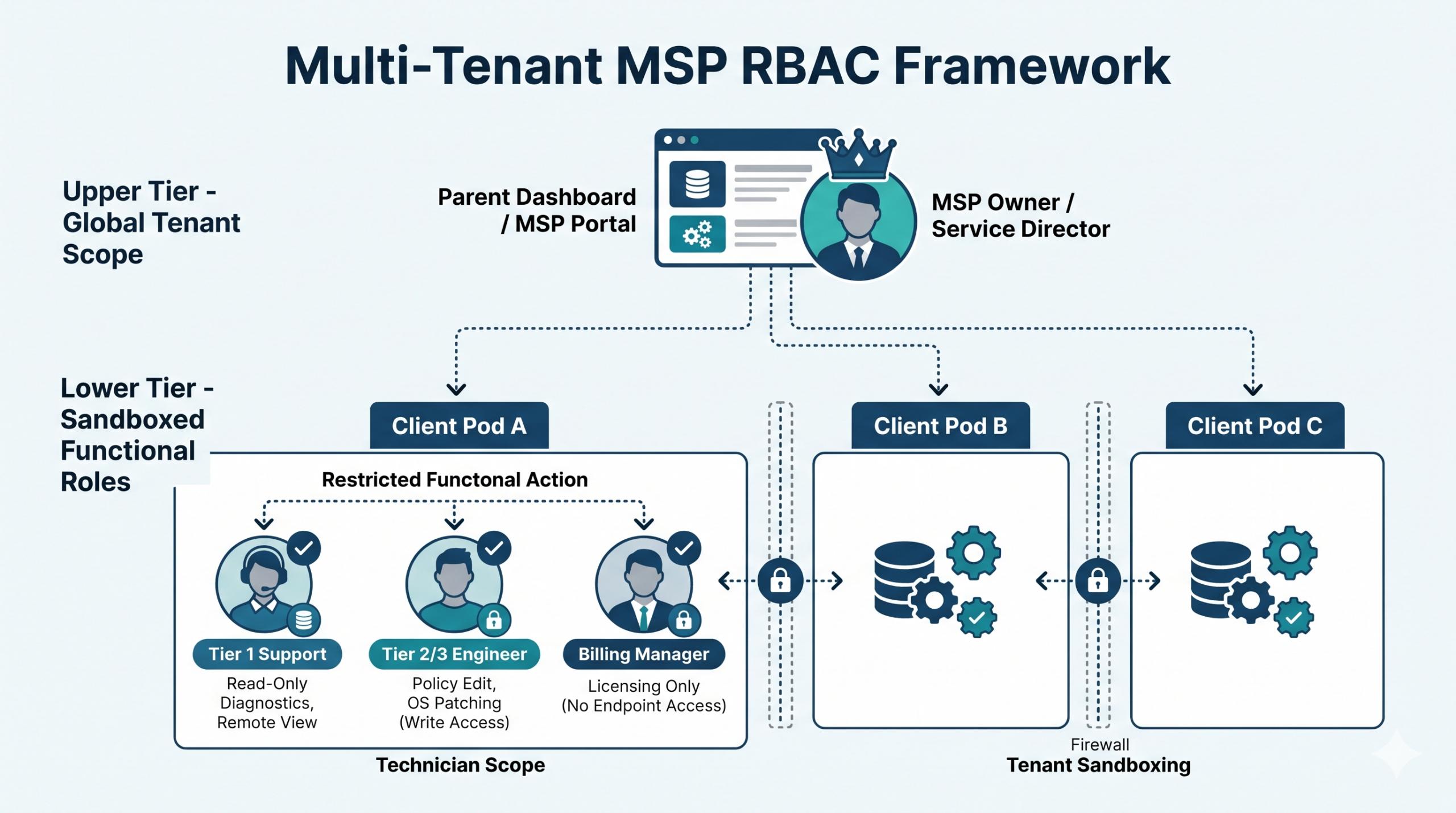
Effective MSP technician role design relies on decoupling access governance into two independent axes:
Tenant scope: Defines which managed customer environments a technician can view and authenticate into from the parent management console.
Functional permissions: Dictates what specific read, write, or remote execution actions a technician can perform inside an authorized client portal.
Separating these two layers allows IT service managers to align visibility with operational responsibility. MSP owners and service directors require top-down parent visibility across every tenant to monitor SLA performance, audit global policies, and oversee aggregate licensing. Conversely, pod-based service desk teams require strict tenant sandboxing, restricting technicians exclusively to the specific client accounts they support. Isolating tenant visibility from functional privileges prevents accidental cross-client interference while preserving unified oversight for executive leadership.
Multi-tenant MSP RBAC
Multi-Tenant Device Management for MSPs Explained
Learn how multi-tenant UEM isolates client environments while centralizing technician oversight in one console.
Mapping Core MSP Roles to the Principle of Least Privilege (PoLP)
Once tenant scopes are defined, IT service managers must map functional permissions to specific operational personas under the Principle of Least Privilege (PoLP):
Tier 1 Support: Restricted to read-only device diagnostics, attended remote view and troubleshooting, and basic device syncs, blocking access to destructive commands or global policies.
Tier 2 Support: Permitted to deploy approved applications, manage OS patch schedules, and associate existing configuration policies within their assigned client Nodes.
Tier 3 Escalation Engineers: Granted full administrative control within assigned client Nodes to create net-new configuration policies, execute custom scripts, and perform high-risk remote actions (such as remote wipes or Live Terminal sessions).
Compliance and Audit Leads: Provided reporting-only visibility across compliance dashboards and audit logs without permission to modify endpoint configurations.
Billing Managers: Limited strictly to license allocation and subscription tracking, completely isolated from endpoint management consoles.
Standardizing MSP technician role design around these predefined personas accelerates technician onboarding by replacing manual permission assignments with repeatable role templates. Simultaneously, stripping unnecessary write privileges eliminates accidental cross-client misconfigurations before they impact production environments.
How Do You Design and Implement Technician Roles Around Service Desk Responsibilities?
IT service managers can transition from ad-hoc permissions to structured RBAC without disrupting active ticket queues by executing a repeatable, three-step operational workflow. Effective MSP technician role design starts with auditing existing ticket escalation paths, deploying standardized role templates across client pods, and enforcing quarterly access reviews—allowing teams to tighten multi-tenant governance while maintaining uninterrupted SLA resolution.
Step 1: Audit Existing Service Desk Workflows and Ticket Escalation Paths
Start your MSP technician role design by mapping actual ticket resolution patterns across every support tier. IT service managers should inventory routine actions executed within L1, L2, and L3 queues to establish clear capability boundaries:
Flag high-risk operations: Identify destructive or wide-impact tasks—such as remote device wipes, custom script execution, and global policy overrides—and lock them behind formal L2/L3 escalation gates.
Execute a baseline permission audit: Review existing directory accounts to immediately revoke dormant technician logins, orphaned contractor credentials, and legacy cross-tenant access.
Establishing this clean baseline ensures new role definitions reflect real operational needs rather than inherited privilege bloat.
Step 2: Build Standardized Role Templates and Client Pod Scopes
Transitioning from the audit phase, IT service managers must build reusable role templates mapped strictly to job functions rather than individual staff members. By decoupling access from specific users, MSP technician role design scales predictably as engineering headcount grows. A new support hire simply inherits the predefined template for their tier, eliminating ad-hoc permission creep.
Next, group client environments into dedicated service pods and align them with these functional templates to sandbox visibility. To harden these boundaries, pair every role assignment with mandatory identity and access controls:
Single Sign-On (SSO) and Multi-Factor Authentication (MFA) to secure credential authentication.
IP allowlisting to restrict administrative access to approved corporate networks or VPNs.
Session expiration rules to prevent unattended console hijacking.
Step 3: Establish Quarterly Access Reviews and Lifecycle Checklists
To sustain secure MSP technician role design, IT service managers must institutionalize lifecycle checklists for onboarding and offboarding. Standardizing these processes guarantees new hires receive fully scoped, least-privilege profiles on day one, while ensuring departing technicians are immediately severed from all multi-tenant portals, active sessions, and directory groups.
Beyond point-in-time provisioning, teams must schedule mandatory quarterly access reviews. These audits require service managers to validate and adjust technician scopes following promotions, support-tier shifts, or client contract changes. Continuous recalibration prevents privilege stagnation and maintains strict compliance.
How Does Hexnode UEM MSP Align Technician Roles with Multi-Tenant Scalability?
Hexnode UEM isolates every customer environment into a standalone Node. This architecture equips MSP owners with centralized, hierarchical role governance from a single parent console.
At the global level, IT service managers delegate oversight across the Hexnode MSP Portal using two core controls:
Built-in MSP roles: Assign predefined global responsibilities—Admin, Billing Manager, Apps and Reports Manager, and Reports Manager—to separate administrative, security, and compliance workflows.
Administrative Sandboxing via Scope: Configure technician assignments under Admin > Technicians to restrict visibility exclusively to authorized client Nodes, containing the security blast radius.
Custom Technician Roles enforce strict least-privilege boundaries within individual customer portals. Managers granularly restrict access across tabs, sub-tabs, and high-risk remote actions including Remote View, Remote Control, and Live Terminal. Technician Profiles standardize onboarding with reusable configuration templates. Each profile enforces predefined role permissions, device scope, password policies, IP restrictions, and 2FA/SSO rules.
Featured Resource
Hexnode UEM for MSPs
Discover how Hexnode UEM simplifies multi-tenant management, streamlines operations, and secures client fleets.
How does multi-tenant role-based access control (RBAC) support SOC 2 compliance?
Multi-tenant RBAC satisfies SOC 2 logical access criteria by strictly enforcing the Principle of Least Privilege. It proves to auditors that technicians only hold the minimum permissions required for their tier, preventing unauthorized cross-tenant changes.
How often should an MSP review technician access permissions?
IT service managers must conduct quarterly access reviews to prevent privilege creep. Regular audits realign technician permissions after staff promotions or client contract updates. They also identify dormant accounts for immediate revocation.
Can an MSP technician have different access levels for different client tenants in Hexnode?
Hexnode UEM enforces MSP tenant isolation by scoping access to Authorized Customer Tenants (Nodes) in the MSP portal. Within individual customer portals, Custom Technician Roles govern granular operational permissions. Service managers grant write access for one client Node while blocking visibility into others, confining engineers to assigned pods.
Scale Multi-Tenant Endpoint Management Without Sacrificing Security
Clear operational boundaries form the foundation of scalable MSP technician role design. This structure accelerates client and engineer onboarding while eliminating privilege creep. Enforce strict least-privilege governance across every client environment. Book a personalized demo or start a free trial of Hexnode UEM MSP to experience multi-tenant role scoping firsthand.
Scale Multi-Tenant Management with Granular Role Control
Try Hexnode UEM free for 14 days to isolate client tenants and enforce least-privilege technician roles.
Associate Product Marketer at Hexnode focused on SaaS content marketing. I craft blogs that translate complex device management concepts into content rooted in real IT workflows and product realities.