Choosing a Chrome OS management platform requires evaluating more than basic device management. IT teams should prioritize integration, scalability, multi-OS management, and granular security enforcement to avoid vendor lock-in, tool sprawl, and operational bottlenecks. Validate shortlisted platforms through real-world workflows and a controlled POC, while also assessing support, pricing, and documentation. Hexnode UEM addresses these requirements through Google Workspace integration, centralized endpoint management, kiosk controls, network configuration, and remote security actions.
Selecting an inadequate endpoint management vendor creates problems that extend well beyond missing features. The wrong platform can constrain future architecture decisions, weaken security controls, and increase the operational cost of managing a heterogeneous endpoint estate.
Vendor lock-in is one of the most significant long-term risks. A platform may work adequately for the current environment but become difficult to replace once device configurations, compliance policies, integrations, automation workflows, and operational processes are built around it. If the vendor later fails to support new operating systems, security requirements, or deployment models, migration becomes a costly project rather than a straightforward procurement decision.
Limited device health visibility creates a different risk. IT and security teams need reliable telemetry on configuration state, compliance, encryption, patch levels, and other indicators that determine whether a device should be trusted. Gaps in that visibility can leave teams making access decisions using incomplete or stale information.
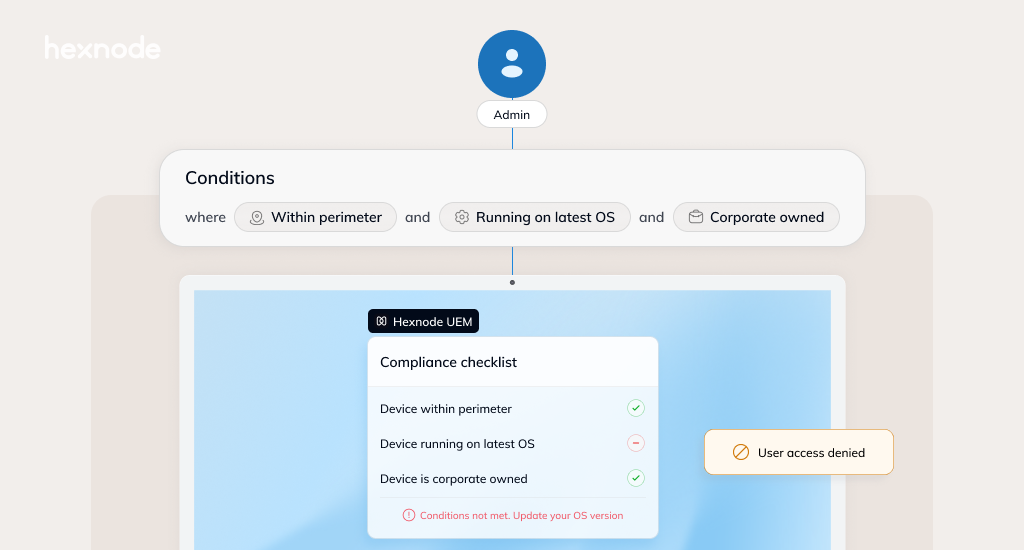
This becomes especially problematic in a Zero Trust architecture. If the management platform cannot continuously assess device posture or integrate that posture with identity and access controls, organizations may struggle to enforce policies such as blocking access from non-compliant, unmanaged, or compromised devices.
A mismatched platform also introduces operational overhead across multi-OS environments. Common consequences include:
Separate administrative consoles and workflows for different operating systems.
Manual handoffs between endpoint, identity, and security teams.
Increased administrative bottlenecks when policies cannot be applied consistently.
Additional spending on overlapping tools to compensate for missing management or security capabilities.
The result is tool sprawl without equivalent gains in control. Instead of reducing complexity, the management layer becomes another source of fragmentation—raising total cost of ownership while making consistent security enforcement harder to achieve.
What Questions Should You Ask Before Choosing a Chrome OS Management Solution?
Before choosing a Chrome OS management solution, IT admins should evaluate its integration with existing identity and productivity systems, support for zero-touch and bulk enrollment, multi-OS scalability, and ability to enforce granular security controls remotely.
The objective is not simply to determine whether a platform can manage Chromebooks today. IT teams need to establish whether it can fit into the existing technology stack, scale without adding administrative overhead, and maintain the required security posture as the endpoint environment evolves.
Integration: Will It Work With the Existing IT Stack?
Start by examining how the solution integrates with the organization’s existing identity, directory, and productivity infrastructure. Chrome OS rarely operates in isolation, particularly in enterprises managing Windows, macOS, Android, or iOS alongside Chromebooks.
Key questions include:
Does the platform integrate with Google Workspace and synchronize relevant users, organizational structures, and device information?
Can it work with existing Active Directory or cloud identity infrastructure?
Can identity and device context be incorporated into access and compliance workflows?
Does the platform provide APIs or integrations for existing IT service management and security tools?
Can Chrome OS be managed alongside other operating systems from a unified console?
Weak integration often creates duplicate administrative work. IT teams may be forced to maintain separate directories, manually reconcile device information, or switch between management consoles to perform routine tasks.
Scalability: Can It Handle Deployment at Enterprise Scale?
Enrollment processes that depend heavily on manual administrator intervention can become operational bottlenecks as the ChromeOS fleet grows. IT teams should therefore evaluate how much manual intervention is required when devices are purchased, provisioned, reassigned, or retired.
Ask whether the solution supports:
Bulk device provisioning without repetitive administrator actions.
Zero-touch or automated enrollment for supported deployment workflows.
Over-the-air configuration and policy changes for geographically distributed endpoints.
Group-based management that allows policies to scale across departments, locations, or device roles.
Centralized multi-OS management if the endpoint estate extends beyond Chrome OS.
Scalability should also account for organizational change. Acquisitions, remote work, new offices, and device refresh cycles can rapidly increase management volume. A platform that depends heavily on manual configuration will translate that growth directly into additional IT workload.
Guide to Scaling Enterprise Endpoint Management
Learn how automation and unified management can reduce tool sprawl as enterprise endpoint fleets scale.
Security: Can It Enforce the Required Controls Remotely?
Chrome OS provides a strong security foundation, but enterprise security depends on how effectively administrators can configure, monitor, and enforce controls across managed devices.
Evaluate whether the solution provides granular policy enforcement for different users, groups, and device contexts. IT teams should also examine capabilities such as web filtering, application restrictions, device compliance monitoring, remote actions, and lockdown controls for lost or high-risk endpoints.
More importantly, determine whether device posture can contribute to broader Zero Trust decisions. A management platform should help administrators identify non-compliant devices and take appropriate action before those endpoints become an unnecessary access risk.
Asking these questions early prevents organizations from discovering critical limitations after deployment. It reduces the likelihood of manual workarounds, additional point solutions, and disruptive migrations while ensuring the chosen platform can support both current operational requirements and the organization’s long-term endpoint security strategy.
How to Evaluate and Select the Right Management Platform
A Chrome OS management platform should be evaluated against documented operational and security requirements, not feature lists alone. A structured evaluation helps IT teams distinguish capabilities that work in a controlled demo from those that will remain effective across the production environment.
1. Map requirements before engaging vendors
Start by documenting the current environment and expected growth. This establishes a consistent baseline against which every shortlisted platform can be assessed.
Capture requirements such as:
Current Chrome OS fleet size and projected device growth.
Other operating systems that may require centralized management.
Existing identity, directory, networking, and security integrations.
Applicable compliance mandates and internal security policies.
Enrollment, configuration, patching, application, and remote-support workflows.
Administrative roles and required role-based access controls (RBAC).
Classify requirements as mandatory, desirable, or optional. This prevents an impressive vendor demo from outweighing a missing capability that is essential in production.
2. Use vendor demos to validate specific workflows
Provide shortlisted vendors with predefined use cases rather than relying entirely on their standard demonstrations. Ask them to show how the platform handles the workflows administrators will perform regularly, including enrollment, policy assignment, compliance monitoring, reporting, and troubleshooting.
The goal is to expose workflow complexity early. A capability that requires several consoles, manual steps, or custom workarounds should be factored into the platform’s operational cost.
3. Run a controlled proof of concept
Before committing to a platform, deploy a POC across a representative batch of Chrome OS devices. Include different device models, user profiles, network conditions, and locations where practical.
During the POC, verify essential workflows such as:
Enrolling and provisioning devices at scale.
Pushing Wi-Fi, VPN, certificate, and other network profiles.
Applying and modifying security policies.
Retrieving device inventory and compliance information.
Locking, deprovisioning, or performing a remote wipe where supported.
Evaluate the administrative UI at the same time. Common operations should be discoverable and repeatable without excessive navigation or specialist knowledge. Reporting quality, policy deployment speed, error visibility, and troubleshooting information should also be tested.
4. Evaluate the vendor behind the platform
Technical capability is only part of the decision. Review customer support SLAs, escalation procedures, support availability, and expected response times for critical incidents. Examine whether pricing remains predictable as device counts increase and whether licensing can accommodate changing fleet requirements without unnecessary commitments.
Finally, assess the quality of product documentation, implementation guidance, release notes, knowledge bases, and community forums where available. Score each vendor against the same technical, operational, support, and commercial criteria. This creates a defensible selection process based on measurable fit rather than feature volume or sales positioning.
Featured Resource
The Complete Picture of Unified Endpoint Management
See how UEM centralizes endpoint onboarding, management, security, and kiosk deployment across device fleets.
For organizations evaluating Chrome OS management against integration, scalability, and security requirements, Hexnode UEM brings device administration into the same unified management framework used for the broader endpoint estate. This helps IT teams avoid building a Chrome-specific management silo as device requirements evolve.
A key component is Google Workspace integration. Hexnode integrates with Google Workspace to sync users and user groups, while automatically fetching Organizational Units (OUs) for ChromeOS management. For IT teams already structuring access and administration around Google Workspace, this reduces duplicate directory administration and makes it easier to apply management workflows to established organizational structures.
For dedicated-purpose Chromebooks, Hexnode provides granular kiosk management capabilities. Administrators can configure:
Single App Kiosk Mode to restrict a Chromebook to a designated application for focused use cases such as digital signage, assessments, or frontline workflows.
Multi-App Kiosk Mode when users require access to a controlled set of approved applications while the rest of the device remains restricted.
Hexnode also extends control to network configuration and remote administration. Remote Wi-Fi configuration for ChromeOS and ChromeOS Flex devices enables seamless, password-free network connectivity.
When a managed Chromebook is lost, stolen, or otherwise needs to be securely decommissioned, administrators can remotely wipe it from the Hexnode console by navigating to Manage > select the device > Actions > Security > Wipe Device.
Together, these capabilities give IT teams centralized control over identity integration, device configuration, kiosk deployments, network access, and remote security actions—key considerations when selecting a Chrome OS management platform intended to scale with long-term endpoint requirements.
FAQs
When should an organization consider UEM instead of relying only on Chrome OS-specific management?
UEM becomes particularly relevant when Chromebooks are part of a multi-OS environment that also includes Windows, macOS, Android, or iOS. Centralized management can reduce separate administrative workflows and make it easier to apply consistent management and security processes across the endpoint estate.
How can IT teams tell whether a Chrome OS management platform will scale effectively?
Look beyond the maximum number of supported devices and examine how much administrator intervention routine operations require. Bulk provisioning, automated enrollment, group policies, and over-the-air configurations ensure fleet management overhead scales sustainably.
What should IT teams test during a Chrome OS management POC?
Test the workflows administrators will depend on in production, including enrollment, policy deployment, network profile configuration, compliance visibility, and supported remote security actions. The POC should also expose how easily administrators can navigate the console, identify errors, retrieve reports, and troubleshoot devices.
Why does device health visibility matter for Zero Trust?
Zero Trust access decisions depend partly on knowing whether a device meets required security and compliance conditions. If the management platform provides incomplete or outdated posture information, IT teams may have difficulty identifying and restricting non-compliant, unmanaged, or compromised devices.
How can organizations reduce the risk of vendor lock-in when selecting a management platform?
Evaluate whether the platform can accommodate projected fleet growth, additional operating systems, changing security requirements, and existing integrations before deployment. Organizations should also consider licensing flexibility, documentation, support, and migration implications, rather than basing the decision solely on current feature requirements.
What vendor factors should be evaluated beyond technical capabilities?
Review support SLAs, escalation processes, pricing flexibility, product documentation, implementation resources, and available knowledge bases or community forums. These factors can materially affect the cost and effort of operating the platform after deployment.
Conclusion
Choosing the right Chrome OS management solution is ultimately an architecture and operational decision, not just a device-management purchase. The platform needs to fit the existing identity and security stack, scale without creating administrative bottlenecks, and provide sufficient visibility and control to support long-term endpoint security requirements.
That makes structured evaluation critical. Define requirements before engaging vendors, validate essential workflows during demonstrations, and use a proof of concept to test how the platform performs under realistic conditions. Support quality, licensing flexibility, documentation, and multi-OS capabilities should carry weight alongside individual product features.
For organizations managing Chromebooks as part of a broader endpoint estate, Hexnode UEM provides a unified approach with Google Workspace integration, kiosk management, network configuration, and remote security controls. The priority, however, remains the same: select a platform that meets today’s Chrome OS requirements without introducing the management silos, security gaps, or migration challenges of tomorrow.
Put Your ChromeOS Management Checklist to the Test
Test ChromeOS management, security, and multi-OS workflows with Hexnode UEM before making your decision.
Associate Product Marketer at Hexnode focused on SaaS content marketing. I craft blogs that translate complex device management concepts into content rooted in real IT workflows and product realities.