How UEMs help in device health monitoring and alerting
Master proactive IT: Use UEM for real-time health insights and automated alerts to stop downtime before it starts.

Get fresh insights, pro tips, and thought starters–only the best of posts for you.
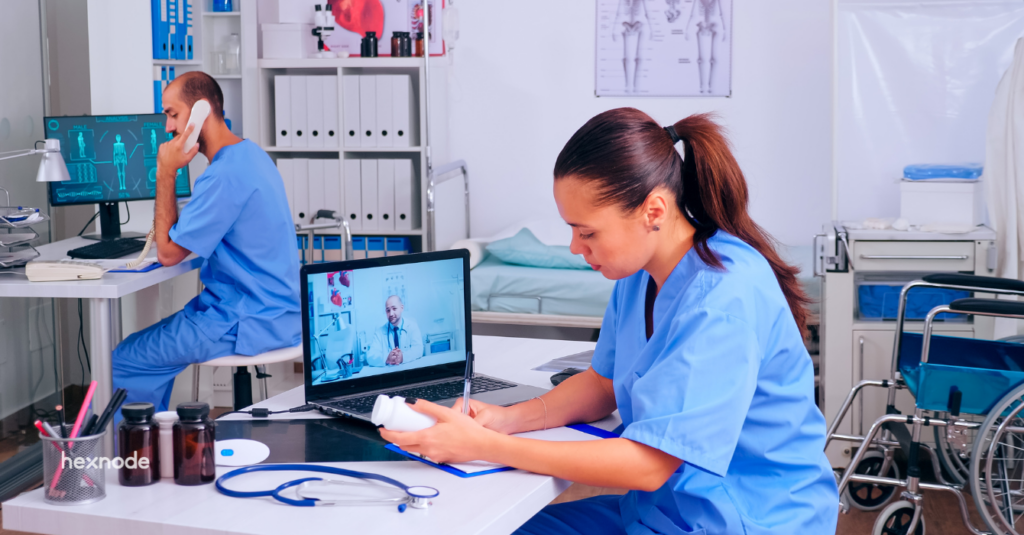
Fragmented device fleets create massive security gaps in modern hospitals. Hexnode UEM solves this by centralizing healthcare IT management, automating HIPAA compliance, and securing remote patient devices, turning complex digital infrastructure into a streamlined, high-performance care delivery engine.
By 2026, healthcare IT management has moved from the background to the front lines. As we shift toward AI diagnostics and remote care, hospitals are no longer defined by four walls, but by the digital network that connects patients and providers everywhere. Doctors now consult through high-definition tablets from their homes, nurses update charts on ruggedized handhelds in high-traffic wards, and patients recover in hospital-at-home programs monitored by a web of connected sensors.
While this digital revolution improves outcomes, it creates a massive conflict for IT leaders. Managing a fragmented fleet of iPads, Android workstations, and specialized medical hardware while maintaining strict regulatory standards is a logistical nightmare. Every unmanaged endpoint is a potential entry point for ransomware, and every manual configuration error is a HIPAA violation waiting to happen.
To bridge this gap between clinical innovation and technical vulnerability, organizations must first address the most critical vulnerability in the network: the point where hardware meets human health data.
Patient data is most vulnerable at the last mile, the point where a clinician interacts with a device. To secure the Protected Health Information (PHI), a HIPAA compliant device management strategy must move beyond simple password protection.
Hexnode eliminates manual configuration risks by enforcing Encryption-at-Rest and In-Transit across the entire fleet. By mandating FIPS 140-2 validated encryption modules such as FileVault for macOS and BitLocker for Windows, IT ensures that even if a drive is physically pulled from a workstation, the data remains encrypted.
We have moved beyond the vulnerability of static passwords. Hexnode integrates directly with Identity Providers (IdPs) like Okta and Azure AD to implement a zero trust framework for healthcare IT management that relies on identity rather than just hardware. Access to medical applications is tied to verified biometric or multi-factor authentication (MFA), ensuring only the right clinician touches the right PHI at the right time.
To meet HIPAA’s “Information System Activity Review” standard, Hexnode maintains granular audit logs. Every administrative change, device enrollment, and policy update is timestamped and attributed to a specific user. This provides a definitive, tamper-proof trail for compliance officers during a HIPAA audit, turning weeks of evidence gathering into a few clicks.
Human error remains the leading cause of healthcare data breaches. Hexnode utilizes dynamic grouping to automate compliance. If a device fails a security check such as a user disabling a passcode or an OS version falling behind, Hexnode automatically triggers a remediation workflow. The system can revoke access to clinical apps or quarantine the device until it returns to a compliant state.
Minimize your internal threat surface by applying the principle of least privilege. Use Hexnode’s RBAC to segment administrative permissions, a technician in the radiology department should not have the same global sweep as a CISO. This ensures operational efficiency without granting over-privileged access to sensitive systems.
In an ER environment, devices could go missing. Hexnode provides IT with absolute authority via remote wipe, lock, and lost mode. If a tablet containing patient records vanishes, IT can neutralize the threat in seconds, effectively killing the data before it can be exploited.
A modern hospital is a complex mix of different hardware generations. Healthcare IT management requires a solution that bridges the gap between a legacy Windows workstation and a brand-new iPad Pro.
Efficiency in the IT department translates directly to better patient care. When technology just works, clinicians can focus on patients rather than logins.
Eliminate manual setup entirely with zero-touch deployment in hospitals. Devices move from the box directly to the clinician’s hand, fully configured via Apple Business Manager or Android zero-touch. Hexnode automatically pushes essential medical apps, Wi-Fi profiles, and security certificates the moment the device powers on. This removes the IT bottleneck and allows for rapid scaling during seasonal surges or new wing openings.
Maintain a real-time view of your clinical fleet. Hexnode provides automated asset tracking, monitoring everything from device location and battery health to storage levels. This prevents ghost assets from vanishing into linen closets and ensures every piece of hardware is accounted for in your annual audit.
Healthcare systems cannot afford the downtime of a mid-shift OS update. Hexnode allows IT to schedule critical security patches and app updates during off-peak, inactive hours. This ensures zero disruption to frontline patient care while keeping the facility defended against the latest zero-day vulnerabilities.
Leverage the power of AI to predict and resolve failures. Hexnode Genie analyzes device context and error patterns to offer instant troubleshooting remediations. It can resolve issues in a surgical suite or a telehealth session before they escalate, using real-time telemetry and automated scripts to detect and resolve performance triggers like low bandwidth or app lag before they interrupt critical care, often before the user even realizes a problem exists.
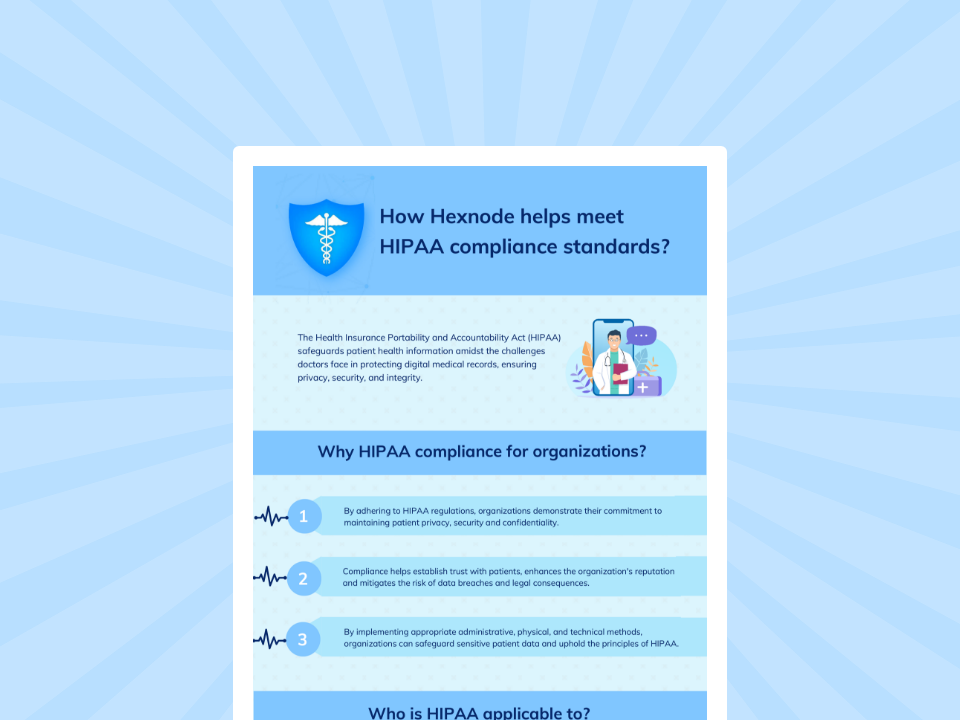
Hexnode UEM simplifies HIPAA compliance by securing patient data through encryption, strict access controls, and remote wipe. Protect your healthcare endpoints and focus on patient care.
Download InfographicThe hospital is no longer confined to four walls. As remote care becomes the standard, remote patient monitoring security becomes the new frontline of defense.
You can automatically restrict access to sensitive medical apps or trigger a full device lockdown the moment a tablet leaves the hospital grounds. This strict location-based boundaries with Hexnode’s geofencing ensures that PHI stays within authorized physical zones, mitigating the risk of data exposure in public spaces.
Clinical delays can be life-threatening. When a specialist in another city encounters a technical hurdle during a remote consult, IT teams utilize Healthcare IT management tools like Hexnode’s remote view and control to diagnose and resolve issues in real-time. This high-speed intervention eliminates downtime, ensuring technology facilitates care rather than hindering it.
Not every clinician uses a hospital-issued device. Hexnode enables secure Bring Your Own Device (BYOD) workflows for visiting consultants. By utilizing containerization, IT can isolate hospital data from personal apps. This ensures that medical records are encrypted and manageable without infringing on the consultant’s personal privacy or accessing their private photos.
The quality of IT determines the quality of care. Choosing a UEM isn’t just a technical decision but a clinical one. Systems that are difficult to use or insecure lead to clinician burnout and patient distrust.
Effective healthcare IT management requires a foundation that is modern, secure, and efficient. By reducing the total cost of ownership (TCO) and automating the most tedious aspects of compliance, Hexnode UEM allows your IT team to stop being device managers and start being care enablers.
How does Hexnode help with HIPAA compliance?
Hexnode automates the technical safeguards required by HIPAA, including mandatory disk encryption, remote data wipe, and detailed audit logs. Its policy engine ensures that any device that falls out of compliance is automatically restricted from accessing PHI.
What is Zero-touch deployment in a hospital setting?
It is a process where devices are pre-registered with Hexnode. When a nurse or doctor unboxes the device and connects to Wi-Fi, the device automatically downloads all necessary clinical apps and security configurations without any manual intervention from the IT staff.
Is it possible to secure remote patient monitoring devices?
Absolutely. Hexnode provides Remote Patient Monitoring Security by using containerization to protect data on the device and geofencing to ensure the device is only used within authorized regions. Remote troubleshooting also ensures these life-critical devices stay operational.
Does Hexnode support a “mixed” environment of Android and iOS?
Yes, Hexnode is a platform-agnostic solution. It allows you to manage iOS, Android, Windows, macOS, and tvOS from a single centralized dashboard, providing a consistent security posture across the entire hospital.
Secure your clinical devices today. Start your 14-day free trial of Hexnode UEM and experience HIPAA-ready device management at no cost.
Signup now!