Top AI security risks every business should know in 2026
Essential strategies to mitigate the reputational and operational risks of AI integration in modern enterprises.

Get fresh insights, pro tips, and thought starters–only the best of posts for you.
Feb 19, 2026
5 min read
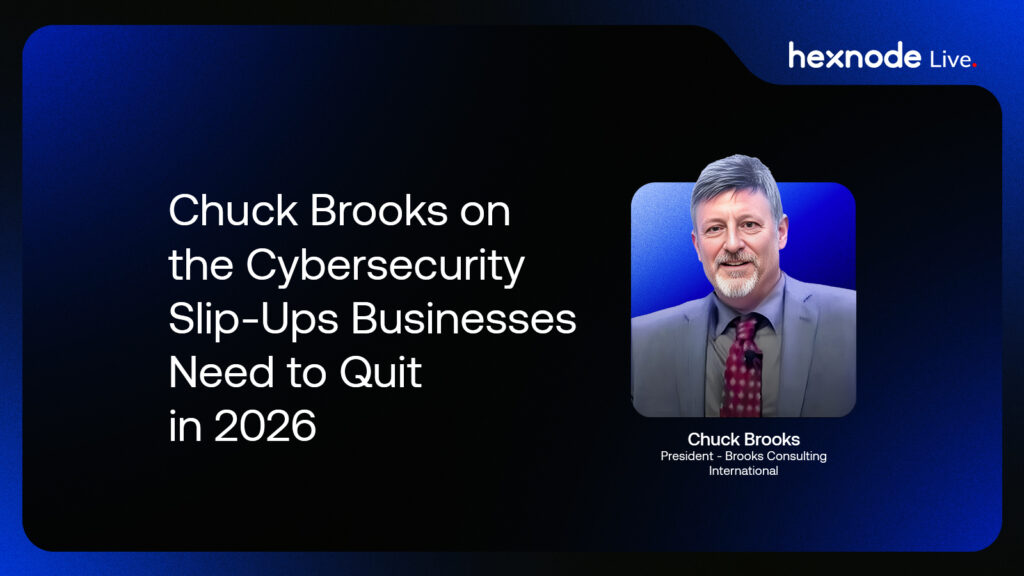
In the high-stakes theater of enterprise security, billions are spent on sophisticated tools, yet the same digital doors are being left unlocked. In one of our recent Hexnode Live discussion, cybersecurity expert Chuck Brooks offered a reality check: we are losing the battle not to masterminds, but to the basics.
“We often neglect the basics and the human element of cybersecurity,” Brooks observed, cutting through industry hype. The core issue is that the traditional defense playbook is failing because it ignores the most unpredictable variable in any network—the person behind the keyboard. To survive the evolving threats of 2026, organizations must radically redefine their cybersecurity best practices.
While IT departments hunt for sophisticated nation-state actors, the actual threat landscape is far more mundane. Brooks noted that most major breaches are “really caused by simple human error and lapses.” To illustrate the point, he referenced the “crazy” reality of current password hygiene.
With “1234” still ranking as one of the most common passwords, Brooks shared the story of a major surveillance system that sat vulnerable for a decade—not because of a zero-day exploit, but because the password was simply the name of the organization. This is not a technical failure; it is a failure of vigilance. “Basic mistakes still cause the majority of breaches,” he explained, identifying the human element as the industry’s most persistent blind spot. Effective cybersecurity requires closing the gap between advanced technology and basic behavior.
As we move toward 2026, the battlefield is shifting from manual scams to “asymmetrical” warfare. With AI and quantum computing on the horizon, the speed of attacks is outstripping human capability to respond.
“It’s really a fight using technology versus technology,” Brooks stated, warning of the coming “Q-Day.” He noted that “whoever gets hold of that superpower will have the ability to see all the information in the world.” In this new era, manual patching is a relic; survival now depends on automated capabilities to stay in the game. Real cybersecurity best practices in 2026 mean acknowledging that humans alone can no longer hold the line against automated threats.
One of the primary roadblocks to effective security is “tool fatigue.” Many enterprises operate with dozens of security products that do not communicate, creating more complexity than protection.
“The lack of integration and orchestration has been the key problem,” Brooks noted, pointing out that instead of a unified front, many businesses have “just bolted stuff on” over the years. This fragmented approach leaves IT teams overwhelmed and unable to see the full picture. True resilience requires a unified architecture where tools work in harmony rather than in isolation. Without this integration, the “maze” of remote work and IoT devices becomes impossible to secure.
The session concluded with a fundamental truth about our digital world: “We didn’t build the Internet for security. We built it for communication, and we’re not going to rebuild it.” Because we are operating on an inherently open infrastructure, our mindset must shift from “perfection” to “persistence.”
For the modern IT leader, the goal is not perfect security—which Brooks suggests is impossible unless you “destroy all the data.” Instead, the focus must shift to constant improvement. This requires moving away from seasonal awareness (like a single month of training) toward a culture where security is constant. “Every opportunity to remind people that they need to be vigilant, and they need to be prepared is a good opportunity,” he stated.
Ultimately, cybersecurity is not a static goal; “you have to continue improving.” By making security a core business function rather than an IT afterthought, businesses can finally stop repeating the same mistakes and start outpacing the opposition.
1. How do automated attacks affect businesses of all sizes?
In the current landscape, attackers use AI to “industrialize” cybercrime, launching thousands of automated, high-speed attacks simultaneously. No business is “too small” to be noticed; if you are connected to the internet, you are a target. To address these challenges, businesses must move beyond manual detection to automated response systems. Key strategies include:
2. Why are more security tools not necessarily making companies safer?
Most companies have bolted-on dozens of independent products over the years that don’t communicate. This creates “tool fatigue” and visibility gaps where threats can hide.
To address this, the shift must be toward integrated resilience. Instead of isolated tools, a unified platform allows identity management, endpoint protection, and network monitoring to share data. This provides a 360-degree view of the network, allowing teams to spot and stop complex threats that disconnected tools would miss.