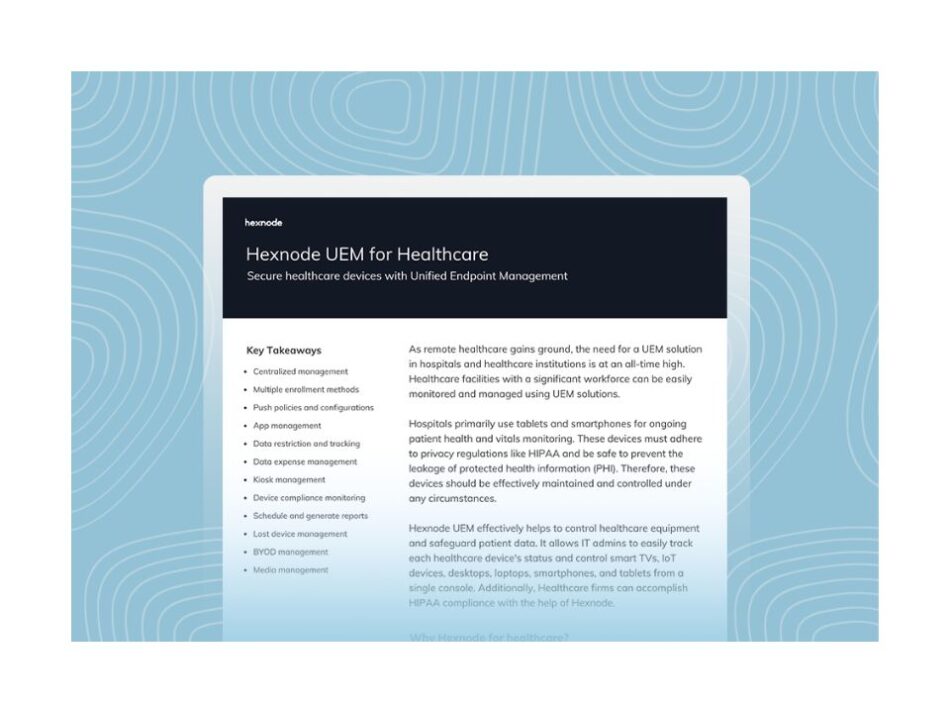
Modern healthcare requires HIPAA-compliant endpoint management to secure ePHI across mobile devices, desktops, and medical equipment. With Healthcare UEM automation, organizations can enforce encryption, restrict access, monitor compliance in real time, and respond to threats instantly. Solutions like Hexnode enable secure, scalable, and audit-ready environments without disrupting clinical workflows.
Healthcare delivery no longer operates within fixed boundaries. Clinicians move between hospital floors, remote clinics, and patient homes while accessing critical data from tablets, smartphones, shared workstations, and connected medical devices. This shift has dissolved the traditional perimeter, turning every endpoint into a potential risk surface.
In this environment, HIPAA-compliant endpoint management is not optional. It is the foundation of modern healthcare security. Organizations need a centralized system that enforces encryption, access control, and continuous compliance across every device without disrupting clinical workflows.
Hexnode delivers this control as a unified platform for hospital device security. By combining Healthcare UEM automation with real-time policy enforcement, Hexnode ensures that every endpoint remains secure, compliant, and audit-ready from the moment it is deployed.
HIPAA-compliant endpoint management is the centralized enforcement of security controls across all endpoints that access electronic protected health information.
Modern healthcare environments require more than basic device management. They demand Healthcare UEM automation to manage diverse operating systems and device types while maintaining strict healthcare compliance.
At the same time, organizations must ensure secure ePHI data orchestration, enabling safe data flow between applications, users, and systems without exposing sensitive information.
The Legacy Burden: Why Manual Compliance Fails
Healthcare organizations that rely on manual processes struggle to maintain consistent HIPAA-compliant endpoint management. As device ecosystems expand, manual oversight introduces risk, delays, and compliance gaps that are difficult to detect and even harder to remediate.
Where Manual Approaches Break Down
Shadow IT and Uncontrolled Access – Clinicians often use personal devices for quick access to patient data. Without centralized enforcement, these endpoints remain unmanaged, violating access control requirements and weakening hospital device security.
Fragmented Management Tools – Many organizations use separate tools for iOS, Android, and Windows devices. This leads to inconsistent policy enforcement, limited visibility, and gaps in healthcare compliance.
Human Error in Security Enforcement – Manual encryption checks, delayed patching, and incomplete audit logs fail to meet the rigor of HIPAA technical safeguards for mobile. These inconsistencies increase the likelihood of breaches.
Hexnode eliminates these challenges through Healthcare UEM automation, providing unified control, real-time compliance monitoring, and policy enforcement across every endpoint.
The conclusion is clear. Manual approaches cannot scale. Only automated, centralized HIPAA-compliant endpoint management can meet the demands of modern healthcare.
Healthcare IT Management made Simple with Hexnode UEM
Streamline clinical workflows and secure medical device fleets with Hexnode UEM.
Critical Features of HIPAA-Compliant Endpoint Management
Healthcare organizations must implement HIPAA-compliant endpoint management that enforces technical safeguards across every device handling ePHI. These safeguards align with the HIPAA Security Rule and are essential for maintaining healthcare compliance, ensuring secure ePHI data orchestration, and strengthening overall hospital device security.
What is ePHI?
ePHI (electronic Protected Health Information) refers to any patient health data that is created, stored, transmitted, or accessed in digital form. This includes:
Medical records and diagnoses
Lab results and prescriptions
Billing and insurance information
Any identifiable health data linked to a patient
Under HIPAA, ePHI must be protected through safeguards like encryption, access controls, and secure transmission to prevent unauthorized access or data breaches.
What Are the Critical Features of HIPAA-Compliant Endpoint Management?
A healthcare endpoint management solution must include the following core capabilities:
Automated full-disk encryption for data protection
Strong access control and authentication
Remote wipe and device lock for incident response
Secure content management and data loss prevention (DLP)
Network and transmission security, including VPN enforcement
Real-time compliance monitoring and automated remediation
Device integrity checks and threat detection
Audit logging and compliance reporting
Application management and usage control
Geofencing and context-aware policy enforcement
Medical device lifecycle management
Shared device access controls
Legal readiness, including Business Associate Agreement (BAA) support
These features form the foundation of effective HIPAA-compliant endpoint management.
How Hexnode Enables These Critical Features
Hexnode translates these requirements into enforceable controls through automation, giving IT teams centralized control, real-time visibility, and consistent policy enforcement across all endpoints.
1. Encryption and Secure Data Transmission
Encryption is a baseline requirement under HIPAA to protect ePHI both at rest and in transit. Without enforced encryption, sensitive healthcare data remains vulnerable to unauthorized access.
Hexnode addresses this by enforcing encryption policies across platforms:
It enables and verifies FileVault (macOS) and BitLocker (Windows) to ensure full-disk encryption.
It enforces native encryption on Android and iOS devices through policy controls.
It supports per-app VPN configurations, ensuring only authorized clinical apps can securely access backend systems.
It allows IT teams to configure secure Wi-Fi policies, preventing connections to unsafe networks.
As a result, organizations can meet HIPAA technical safeguards for mobile while strengthening hospital device security.
2. Access Control and Authentication
HIPAA requires strict access control to ensure that only authorized users can access ePHI. Weak authentication mechanisms can lead to unauthorized exposure to sensitive data.
Hexnode enforces strong access controls through:
Passcode policy enforcement, including complexity, expiration, and lock settings.
Role-Based Access Control (RBAC), which ensures that administrators and users only access what their role permits.
Integrations with identity providers such as Microsoft Entra ID, Google Workspace, and Okta, while also offering its own identity layer through Hexnode IdP for centralized authentication, access control, and device-aware security.
This ensures secure access while maintaining efficient ePHI data orchestration.
3. Remote Wipe and Device Lock
Lost or stolen devices are a major risk in healthcare environments. Organizations must be able to immediately secure or remove sensitive data.
Hexnode enables rapid incident response by providing:
Remote device wipe, which completely erases all data from compromised devices.
Corporate wipe, which selectively removes enterprise data while preserving personal data in BYOD scenarios.
Remote lock, which prevents unauthorized access until the device is recovered.
Lost Mode, which locks and tracks supervised devices for recovery.
This ensures continuous healthcare compliance even in high-risk situations.
4. Secure Content Management and Data Loss Prevention
Healthcare organizations must prevent both accidental and intentional data leakage. Uncontrolled sharing or copying data can lead to compliance violations.
This ensures consistent medical device lifecycle management and long-term compliance.
13. Shared Device Workflows
Healthcare environments frequently rely on shared devices, which require strict session control.
Hexnode enables secure shared usage by:
Using kiosk mode to restrict device functionality
Supporting controlled user sessions through app-level restrictions
Allowing quick reprovisioning for new users
This ensures efficiency without compromising security.
14. BAA Readiness
HIPAA compliance also requires legal alignment with vendors handling ePHI.
Hexnode supports this by:
Enabling organizations to operate under a Business Associate Agreement (BAA)
Ensuring platform capabilities align with HIPAA data protection requirements
This makes Hexnode a viable solution for organizations seeking complete HIPAA-compliant endpoint management.
By clearly defining critical features and mapping them to real, enforceable capabilities, Hexnode enables healthcare organizations to implement HIPAA-compliant endpoint management with confidence, scalability, and operational efficiency.
Conclusion: Secure Endpoints Power Modern Healthcare
Healthcare organizations must adapt to an increasingly complex and distributed environment. HIPAA-compliant endpoint management provides the foundation for securing devices, protecting ePHI, and maintaining regulatory compliance.
By combining encryption, access control, monitoring, and automation, organizations can build a resilient security posture. Platforms like Hexnode enable this transformation by integrating Healthcare UEM automation, ePHI data orchestration, and robust medical device lifecycle management into a single solution.
The result is a secure, scalable, and compliant healthcare ecosystem that supports both patient care and data protection.
Standardize Your HIPAA Compliance Today
Join Hexnode to automate endpoint security and ensure audit readiness across every device.
Does HIPAA compliant endpoint management support BYOD in healthcare?
Yes. It uses containerization to separate personal and work data, ensuring secure handling of ePHI while maintaining user privacy.
How does Healthcare UEM automation improve compliance?
Healthcare UEM automation enforces policies, monitors devices, and remediates issues in real time, ensuring continuous compliance with HIPAA requirements.
What happens if a healthcare device is lost or stolen?
With HIPAA-compliant endpoint management, IT teams can remotely lock or wipe the device, preventing unauthorized access to sensitive data.
Why is audit logging important for HIPAA compliance?
Audit logs provide detailed records of access and activity, which are required for regulatory audits and incident investigations.
What is the role of medical device lifecycle management?
Medical device lifecycle management ensures that devices remain secure from deployment to decommissioning, reducing risks throughout their lifespan.
Can HIPAA compliant endpoint management prevent data breaches?
While no system eliminates all risks, it significantly reduces them by enforcing encryption, access controls, and continuous monitoring, strengthening overall hospital device security.
I write at the intersection of technology, process, and people, focusing on explaining complex products with clarity. I break down tools, systems, and workflows without any noise, jargon, or the hype.