Modern enterprises struggle with limited visibility and control using agentless approaches. Agent-based endpoint management solves this with real-time monitoring and offline enforcement. Hexnode eliminates typical overhead with a lightweight agent, delivering deep control, continuous compliance, and seamless performance across distributed device fleets.
Managing endpoints in 2026 is no longer about tracking devices. It is about maintaining continuous control over a distributed, always-changing fleet. Yet many IT teams still rely on approaches that leave critical visibility gaps, especially when devices go offline or operate outside corporate networks.
This is where the debate around endpoint management becomes impossible to ignore. While agentless methods promise simplicity, they often fall short when enterprises need real-time insight, deeper control, and consistent policy enforcement.
The question is not which approach is easier. It is which one actually works at scale.
In this blog, we break down the pros and cons of agent-based endpoint management, compare it with agentless alternatives, and examine why modern enterprises are shifting toward agent-driven models. We also explore how Hexnode delivers this capability without the traditional trade-offs of performance, complexity, or deployment overhead.
Agent-based endpoint management refers to the deployment of a dedicated software component, known as an endpoint management agent, directly onto devices such as Windows PCs, macOS systems, Android devices, and Linux machines.
This agent operates locally on the endpoint and acts as a continuous execution layer between the device and the management console.
A useful way to understand this is through the “resident guard” analogy. In an agentless model, the management system interacts with devices intermittently, similar to calling them for updates. In contrast, an agent resides on the device at all times, observing, enforcing, and responding without waiting for instructions.
This architecture enables several critical capabilities:
Continuous monitoring of device state and activity
Immediate execution of commands and scripts
Real-time compliance enforcement
Local decision-making without server dependency
Because the agent operates independently of constant connectivity, it ensures that endpoint management policies remain active even when devices are offline.
How Agent-Based Endpoint Management Works
To understand why this model is effective, it is important to examine how agent-based endpoint management works in practice. Unlike traditional approaches, it combines periodic communication with local execution to maintain control across endpoints.
At a functional level, this model is built on four key components:
Communication Model
The endpoint management agent maintains a secure and periodic communication channel with the UEM console.
Devices do not require constant connectivity to remain managed
Communication happens at regular intervals or when triggered by events
Data exchange is encrypted to ensure secure transmission
As a result, this approach balances visibility and efficiency while avoiding unnecessary network usage or battery consumption.
Push and Pull Mechanism
Agent-based systems use a hybrid communication strategy:
Push: The server notifies devices of new commands or policy updates using platform services such as APNs, FCM, or WNS
Pull: The agent checks in with the server to fetch updates and report device status
Consequently, this combination enables:
Faster policy deployment
Timely status updates
Reliable command execution across distributed devices
Local Execution and Control
A key advantage of endpoint management agents is their ability to execute actions directly on the device.
With a local agent in place, IT teams can:
Run scripts such as PowerShell or Bash commands
Apply configuration changes instantly
Monitor system-level activity in detail
Because execution happens locally, actions are not delayed by network conditions or server availability.
Offline Behavior and Policy Enforcement
Agent-based endpoint management ensures that devices remain governed even when disconnected.
Policies that are already applied continue to be enforced
Devices retain their last known compliant state
Predefined actions can still be triggered based on local conditions
Therefore, this model reduces reliance on continuous connectivity and ensures consistent enforcement across remote or mobile environments.
Why This Model Matters
By combining periodic communication, local execution, and offline enforcement, agent-based endpoint management provides:
Continuous visibility into device state
Greater control over endpoint behavior
Improved reliability in real-world network conditions
Ultimately, this architecture forms the foundation for modern endpoint management strategies, especially in environments where devices frequently operate beyond traditional network boundaries.
Endpoint Patch Management: Reducing Security Risk Across Devices
Learn how patch management reduces vulnerabilities by prioritizing, automating, and securing updates across devices.
The Pros and Cons: An Unfiltered Look
The Pros: Why Enterprises Demand It
Granular Visibility
Agent-based endpoint management provides a level of insight that agentless systems cannot match. For instance, IT teams can access detailed telemetry such as CPU utilization, thermal performance, application behavior, and deep system configurations including registry or plist data.
As a result, this level of detail supports more effective troubleshooting, performance optimization, and security monitoring.
Offline Enforcement
One of the defining advantages of endpoint management agents is their ability to enforce policies without relying on network connectivity. Consequently, devices remain governed by organizational rules even in restricted or offline environments.
For example, if a device violates compliance conditions, the agent can trigger actions such as locking the device or restricting access.
Advanced Scripting and Automation
Agents enable execution of complex scripts using PowerShell, Bash, or shell scripting frameworks. This extends management capabilities beyond what native APIs allow.
In practice, IT teams can automate tasks such as:
Software installation and removal
Configuration changes
Security hardening procedures
Therefore, this reduces manual intervention and improves operational efficiency.
Real-Time Security Capabilities
While not a replacement for dedicated EDR platforms, agent-based endpoint management introduces a lightweight security layer. It can detect indicators such as rooting, jailbreaking, or unauthorized software installations with minimal delay.
This, in turn, enhances incident response and reduces the exposure window.
Featured resource
Hexnode UEM Capability Statement
Explore Hexnode UEM capabilities, including automation, security, and cross-platform management for enterprise device control.
The initial deployment of an agent across a large fleet can be complex. Organizations must ensure consistent installation across all devices.
Without automation, this process can become resource intensive.
Resource Overhead
There is a common perception that agents consume significant system resources and degrade performance. Poorly optimized agents can indeed impact CPU, memory, or battery life.
However, this concern largely depends on implementation quality rather than the model itself.
Ongoing Maintenance
Agents require periodic updates to remain compatible with operating systems and to introduce new features or security enhancements.
As a result, managing these updates across a distributed fleet can become challenging without centralized automation.
Pros and Cons of Agent-Based Endpoint Management at a Glance
Pros:
Real-time monitoring and visibility
Offline policy enforcement
Advanced automation and scripting
Immediate security response capabilities
Cons:
Initial deployment effort
Requires agent maintenance
Potential resource usage if not optimized
How Hexnode Perfects the Agent-Based Model
Hexnode addresses the traditional limitations of agent-based endpoint management through a carefully engineered approach.
The Lightweight Advantage
The Hexnode agent is designed with efficiency as a priority. It operates with minimal resource consumption, ensuring a negligible impact on system performance and battery life.
As a result, this directly addresses concerns around agent overhead.
Zero-Touch Deployment
Hexnode simplifies deployment through integrations with platform provisioning services:
These integrations enable automatic agent installation during device enrollment. Consequently, IT teams can onboard devices at scale without manual intervention.
Hybrid Flexibility
Hexnode combines agent-based capabilities with native OS management frameworks.
This hybrid model allows:
Fast execution of standard policies through native APIs
Deep control and monitoring through the agent
Therefore, organizations gain both efficiency and depth without compromise.
Hexnode Genie AI
Hexnode enhances automation through AI-assisted scripting. With Hexnode Genie, IT administrators can generate and deploy scripts more efficiently, reducing the complexity of managing large fleets.
This capability is particularly valuable for teams that need to implement advanced workflows without extensive scripting expertise.
IT teams need advanced automation and scripting capabilities
There is a need to monitor granular system-level data
In high-security environments, relying solely on agentless endpoint management introduces blind spots that can impact both compliance and incident response.
Conclusion
The debate between agent-based and agentless endpoint management ultimately comes down to control versus convenience.
Agentless approaches offer simplicity but fall short in delivering continuous visibility and enforcement. In contrast, agent-based provides the depth and responsiveness required for modern enterprise environments.
For organizations that prioritize security, compliance, and operational efficiency, the agent-based model is not optional. It is foundational.
Hexnode removes the traditional barriers associated with this approach. By minimizing resource overhead, automating deployment, and integrating intelligent automation, it amplifies the strengths of endpoint management while eliminating its drawbacks.
To understand the impact firsthand, organizations should evaluate how a modern UEM platform like Hexnode transforms endpoint management from a reactive process into a proactive, continuous system.
Deploy Smarter Endpoint Management
Get deep-process visibility and remote command-line control for every endpoint in your network.
What is agent-based endpoint management in simple terms?
Agent-based endpoint management is a method where a software agent is installed on each device to continuously monitor, manage, and enforce policies locally, even when the device is offline or outside the corporate network.
What is the difference between agent-based and agentless endpoint management?
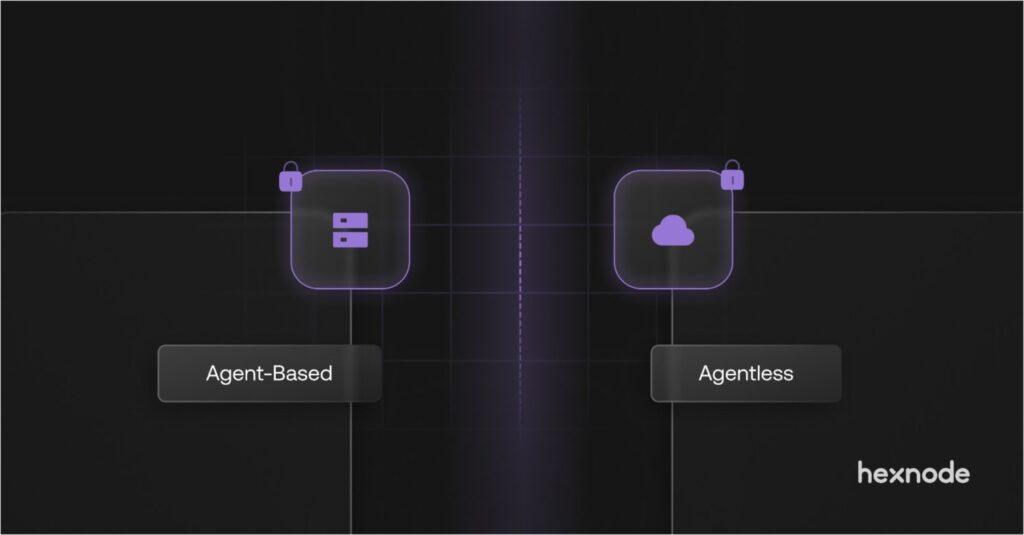
Agent-based endpoint management uses a locally installed agent for continuous control and real-time enforcement, while agentless endpoint management relies on OS-level APIs and periodic communication, offering limited visibility and control.
Why do enterprises prefer agent-based endpoint management?
Enterprises prefer agent-based endpoint management because it provides deeper visibility, offline policy enforcement, advanced automation, and faster response to security events compared to agentless approaches.
Can agent-based endpoint management replace EDR tools?
No. Agent-based endpoint management provides basic security monitoring and control but does not replace full EDR solutions, which offer advanced threat detection, correlation, and response capabilities.
I write at the intersection of technology, process, and people, focusing on explaining complex products with clarity. I break down tools, systems, and workflows without any noise, jargon, or the hype.