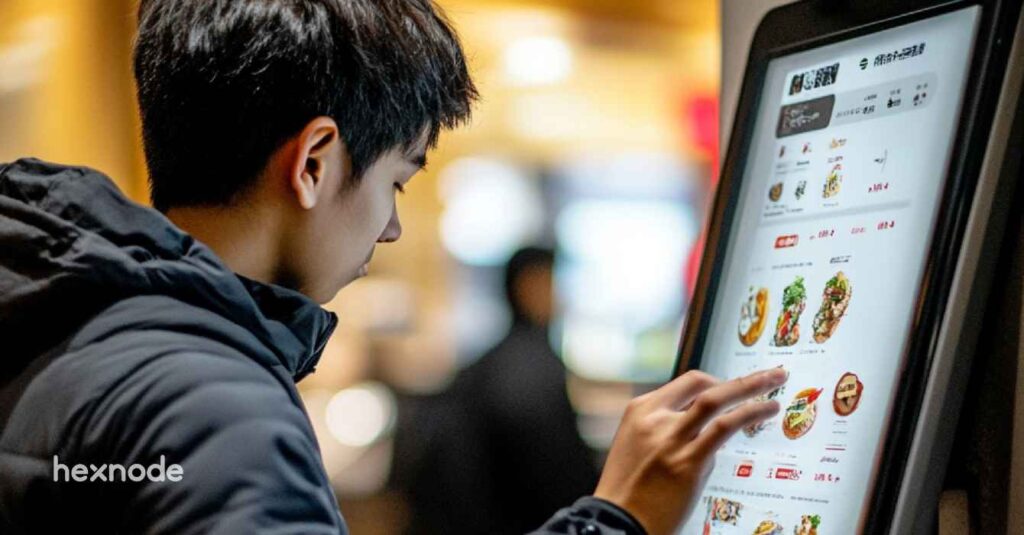
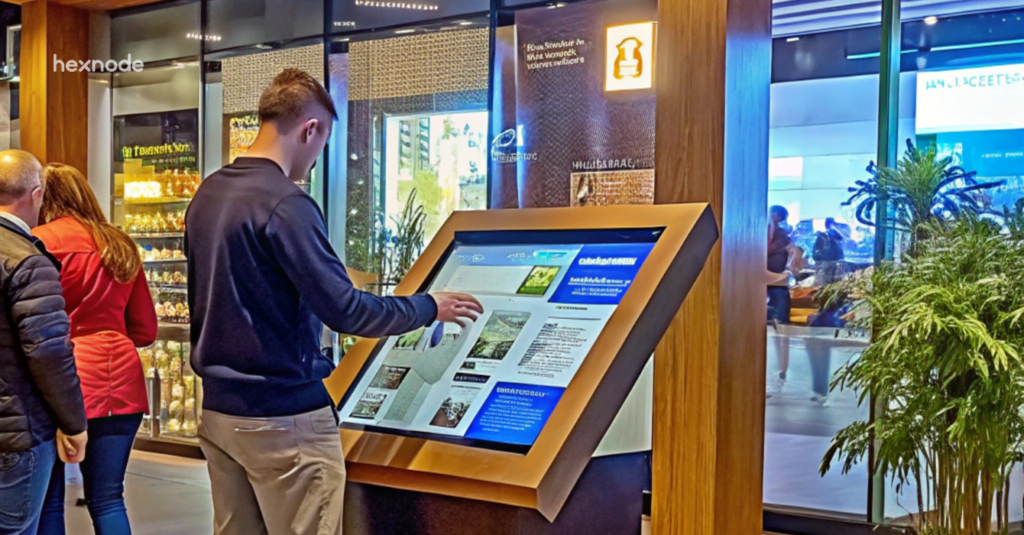
Protecting public-facing kiosks against data breaches, tampering, and unauthorized access is critical for maintaining brand integrity. While basic solutions offer simple lockdown, modern use cases demand a sophisticated kiosk management solution strategy. Hexnode UEM provides these advanced capabilities out of the box, offering multiple lockdown modes for a variety of OS, remote monitoring and control, thorough peripheral control, and brand-centric customization. These features transform your kiosks into unbreakable assets that function autonomously in any environment.
Whether serving as a self-service check-in at a busy hospital or an interactive digital catalog in a flagship retail store, a kiosk device stands at the front line of business operations. By streamlining workflows and automating high-volume transactions, kiosks provide a level of efficiency that 66% of customers now prefer over traditional, human-run checkouts. However, when not strictly managed, these devices can quickly shift from a high-value asset to a security and operational liability.
Though many UEM tools offer basic kiosk lockdown capabilities, in real-world deployments, they are rarely sufficient. Without granular control or centralized management, devices remain vulnerable to user tampering, unexpected downtime, and unauthorized data access. So, IT Directors and MSPs require a a strong kiosk management solution with essential features that provide focused use, control, and policy enforcement. This article identifies the 5 non-negotiable features for an ideal kiosk management solution and explains why a comprehensive platform like Hexnode sets the standard when managing kiosk devices.
To transform a standard mobile or desktop device into a purpose-built kiosk, a UEM solution must move beyond locking an app to the screen and implement a multi-layered security architecture. This requires complete integration between the UEM agent and the device, ensuring that every point, from the touchscreen interface and physical ports to background system processes, is governed centrally. The following are some must-have kiosk features in any kiosk management solution for optimal operational performance.
Feature 1: Flexible Multi-Mode Lockdown
One of the most important features of a kiosk lockdown solution isn’t just what it lets the user do, but how invisibly and effectively it prevents them from doing anything else. If a user can access the settings menu or a secondary app, the kiosk has failed its primary mission.
An ideal kiosk management solution must offer versatile lockdown modes for a variety of operating systems to restrict device functionality for specific authorized tasks. This granularity ensures that the device serves its true purpose while keeping the underlying OS inaccessible to the end-user. However, in a real-world environment, you cannot settle for a “one-size-fits-all” approach when your fleet spans multiple use cases. The kiosk lockdown solution must adapt to diverse operational requirements and offer modes and options such as:
Single-App Mode: Locks the device to one specific application for dedicated use.
Multi-App Mode: Permits switching between a curated set of approved applications.
Web Kiosk Mode: Restricts access to specific URLs via a secure, full-screen interface.
Digital Signage: Converts idle screens into high-impact, automated media displays.
This ability to toggle between different lockdown modes is critical in diverse environments like retail. For instance, a single kiosk management solution must be capable of securing a customer-facing web catalog in an aisle while simultaneously managing a multi-app inventory tool in the warehouse.
How Hexnode Makes Lockdown Simple
Hexnode UEM transforms these complex configurations into a few-click process, allowing you to deploy and switch modes across thousands of devices instantly from a single unified interface. Here are a few highlights of what Hexnode offers.
Cross-Platform and Application Lockdown: Hexnode supports kiosk management across Android, iOS/iPadOS, Windows, macOS, Linux, tvOS, and ChromeOS, but supported modes such as single-app, multi-app, web app kiosk, and digital signage vary by platform.
Flexible Browser Options: Hexnode UEM provides flexible options, allowing you to choose between standard browsers or the specialized Hexnode Kiosk Browser. This native tool helps transform web apps into unbreakable brand assets.
Background App Persistence: Hexnode allows you to run critical support services or enterprise apps in the background, even while the device remains locked to a single foreground interface.
By integrating these specialized modes into a single dashboard, Hexnode eliminates the need for multiple point solutions, providing a unified architecture for every kiosk use case in your organization.
What is kiosk mode?
Learn how kiosk mode locks a device to approved apps or websites and how managed kiosk controls helps businesses.
Software lockdown is only as strong as the hardware it sits on. In unmonitored environments like libraries or retail stores, curious or malicious users will inevitably attempt to use physical buttons or open ports to bypass software restrictions. Without deep hardware-level integration, your secure kiosk remains vulnerable to anyone with an external drive or a simple button-press sequence. An ideal kiosk management solution treats the device as a sealed unit. Every physical interaction should be controlled, including:
Hardware Buttons: Disable Power, Volume, and Navigation buttons (Home/Back/Recent Apps) to prevent system interrupts.
I/O Port Security: Restrict USB data transfers and SD card mounting to block unauthorized file injections or extraction of local data.
Touch & Interface Controls: Limit specific gestures, lock screen orientation, and hide the status bar to eliminate access to hidden system shortcuts.
Hexnode’s Advantage in Peripheral Control
Hexnode UEM provides one of the most granular peripheral management suites, moving beyond basic OS toggles to provide true hardware-level enforcement.
Granular Hardware and Navigation Control: With Hexnode, IT admins can programmatically disable external button controls like Volume or Power and hide the Status Bar or Notification Tray. This eliminates any backdoor access to hidden settings shortcuts. Furthermore, you can strictly govern the user experience by locking screen orientation, auto-adjusting brightness, and disabling specific touch gestures that could disrupt the intended application.
Peripheral & Port Lockdown: To halt physical vulnerabilities, Hexnode allows you to instantly restrict removable media, SD cards, and external peripherals. This ensures that unauthorized files cannot be introduced via USB and local data cannot be extracted, effectively sealing the device against hardware-based tampering.
Advanced Management Overlays: For high-security environments, admins can manage the device directly through the console. For on-site staff, customizable floating icons or gestures allow authorized personnel to access peripheral settings or exit lockdown without ever exposing these controls to the public.
A kiosk that loses its network connection becomes an operational dead end, causing immediate service disruptions and lost revenue. For a quick-service restaurant (QSR) chain, seamless network persistence is the backbone of the experience. A robust solution ensures that even if a guest’s smartphone creates a rogue hotspot nearby, the ordering kiosk is locked to the secure corporate Wi-Fi, preventing accidental disconnections that would halt payment processing and stall the rush.
Conversely, a device that connects to an unverified or rogue network represents a critical security vulnerability, potentially exposing sensitive corporate data to interception. To ensure a reliable and secure deployment, a kiosk management solution must maintain a secure network connection through:
Connectivity Lockdown: Complete suppression of network-related settings (Wi-Fi, Bluetooth, Hotspot, Airplane Mode, VPN, and any other network-related settings) from the kiosk interface to prevent users from manually altering the device’s online status.
Strict Network Whitelisting: The ability to restrict devices to specific, encrypted corporate networks while automatically blocking any attempt to join unverified public Wi-Fi or rogue hotspots.
Hexnode’s Advantage in Network Stability
Hexnode eliminates network tampering by providing complete connectivity persistence and control. Some key features of Hexnode’s network control capability include:
Strict SSID Enforcement & Certificate Management: Hexnode allows IT to lock kiosks to specific, authorized networks, preventing the hardware from jumping onto unencrypted or unauthorized networks. By silently pushing identity certificates and SCEP (Simple Certificate Enrollment Protocol) directly from the console, Hexnode ensures that kiosks remain authenticated and connected to secure corporate networks without any manual credential entry on-site.
Persistent VPN & Global Proxy Configuration: Hexnode supports VPN, Per-App VPN, and Global HTTP Proxy configurations where supported. Additionally, its Per-App VPN can route selected managed-app traffic through a VPN, while Global HTTP Proxy routes HTTP traffic through the configured proxy.
Zero-Touch Connectivity Lockdown: Hexnode provides the ability to completely suppress the system’s network settings. From the centralized console, admins can enforce Wi-Fi and cellular-data settings, control Airplane Mode, or modify hotspot settings, depending on the platform that supports them. This ensures the device remains manageable and visible 24/7.
Featured Resource
The Ultimate Guide to Kiosk Management: Everything your business needs to know
Download the whitepaper to learn how you can adopt the right kiosk management strategy for your business.
Feature 4: High-Availability Maintenance with Remote Support & Self-Healing
In a dedicated device deployment, physical access is your most significant expense. Imagine a self-service ticketing kiosk at a transit hub that stops responding during a peak commute hour. Every minute of downtime results in lost revenue and frustrated customers. When a device in a remote branch displays an unexpected system prompt or if an app hangs, the inability to access it remotely leads to a complete operational standstill.
To ensure an unbreakable experience, the kiosk software solution should function 24/7, identifying and neutralizing state deviations to maintain zero-downtime performance through:
Continuous App Monitoring: The kiosk management solution must monitor the foreground process. If the authorized kiosk app crashes or is closed, the system should instantly relaunch it to preserve the device’s locked state.
Remote View and Control: When automated fixes aren’t enough, admins need to see the screen and take full tactile control, navigating menus and clearing caches as if the device were in their hands.
Real-Time Status Alerts: Automated notifications for critical telemetry, such as low battery levels or unauthorized geofence exits, allow IT to intervene before a device goes offline.
How Hexnode Shifts from Reactive to Proactive Management
Hexnode UEM eliminates the distance and error gap by combining a persistent monitoring agent with high-performance remote assistance tools directly in the console.
Unattended Remote Access: Hexnode offers Remote Control (for Windows and Android) and secure Remote View (for Windows, Android, iOS, and Mac) ensuring your helpdesk has eyes and hands on the problem regardless of the location or hardware. This feature is particularly useful for kiosks in public spaces or remote branches where no staff members are present.
Automated Compliance & Self-Healing: In supported single-app kiosk configurations, the platform’s native kiosk framework can bring the kiosk app back to the foreground if it closes or crashes. Comprehensive app logs provide real-time visibility into system performance, allowing you to troubleshoot issues remotely and resolve potential failures. Furthermore, if a device leaves a designated geofence, Hexnode can automatically trigger “Lost Mode”, mark the device as non-compliant or wipe sensitive data.
Messenger for Instant Support: Troubleshooting isn’t always a solo job for IT. Hexnode includes a built-in messaging tool, Hexnode Messenger, that allows admins to broadcast instant, one-way messages directly to the kiosk screen.
Automated Patch & App Lifecycle Management: Hexnode supports platform-specific OS update, app update, patch management, and app installation workflows; availability and silent installation behavior depend on the device platform and management conditions. By scheduling updates during off-peak hours and utilizing automated distribution, you ensure that every kiosk remains compliant and secure without interrupting the customer experience.
Feature 5: Brand-Centric Customization
When a customer interacts with a kiosk, they shouldn’t feel like they are using a managed device. Whether in a retail showroom or a hospital lobby, a kiosk should never feel like a generic terminal. It must serve as an extension of your brand identity, reinforcing corporate trust with every interaction.
Strategic UI customization replaces the generic underlying operating system with a high-fidelity brand experience. By enabling custom launchers, branded wallpapers, and tailored layouts, businesses create a seamless, professional user experience that fosters consumer trust. Achieving a high-fidelity brand experience requires a kiosk management solution that allows for total control over the visual real estate of the device.
The Custom Launcher Requirement: Standard OS home screens are cluttered with system icons and distracting widgets. A kiosk solution must provide a clean slate where only approved, branded icons exist.
Visual Continuity: This includes the ability to set persistent, non-changeable wallpapers, brand logos during boot-up, and organized app clusters that guide the user toward a specific action.
Providing a Proprietary Brand Experience with Hexnode
Hexnode UEM transforms the look and feel of your fleet through specialized tools designed to customize the OS and highlight your brand.
Customizable Launcher: Hexnode allows IT admins to design a completely custom home screen by configuring the kiosk launcher directly from the console. You can adjust icon sizes (from small to extra-large or custom pixels), font colors, and title bar dimensions without writing a single line of code. For multi-app kiosks, Hexnode provides an Advanced View with a drag-and-drop grid editor, allowing you to position apps precisely for different screen orientations.
Dynamic Digital Signage: Hexnode transforms any screen into a powerful marketing tool. You can remotely push, schedule, and loop high-definition images and videos (including MP4, MKV, and PNG) to your fleet.
Sophisticated Layout Control: Beyond just branding, the launcher allows you to organize apps into clusters or collections. In Single-App mode, you can set an auto-launch delay, ensuring that if a user manages to navigate away or the device sits idle, it automatically returns to the designated branded app.
Therefore, Hexnode ensures that your brand remains front and center, turning every device into a powerful, professional ambassador for your business. In a UEM environment, this is managed by replacing the native OS launcher with a secure, restricted environment that intercepts system-level intents to prevent unauthorized navigation.
Don’t just Lockdown. Secure and Customize the Future of Your Digital Touchpoints
A successful kiosk deployment is one in which everything works perfectly, without the user even noticing the management layer beneath. By prioritizing hardware resilience, network persistence, and autonomous self-healing, you transform a fleet of vulnerable screens into a reliable cornerstone of your business operations. Hexnode UEM provides a powerful kiosk management solution with the specialized tools needed to bridge the gap between simple software lockdown and total environmental control. Whether you are managing ten devices or ten thousand, the goal is a seamless, secure, and persistent experience that reflects the strength of your brand.
Frequently Asked Questions (FAQ)
1: Can Hexnode manage kiosks across different operating systems?
Yes. Hexnode is a true cross-platform UEM kiosk solution, allowing you to manage Android, iOS, Windows, and even Apple TV kiosks from a single, unified dashboard.
2: What happens if a kiosk app crashes?
When an app crashes, the Hexnode agent detects that the application is no longer in the foreground and will automatically relaunch the specified kiosk app immediately, ensuring the device remains in a secure, locked-down state.
3: How does Hexnode prevent users from accessing the Android settings menu?
On supported Android devices and enrollment modes, Hexnode can apply kiosk restrictions such as hiding status or notification elements and disabling selected software or hardware buttons to help prevent access to system settings.
Secure Your Fleet with Hexnode’s Kiosk Lockdown
Enforce hardware-level security, customize your brand experience, and manage kiosks at scale with Hexnode UEM’s kiosk lockdown features.
Curious, constantly learning, and turning complex tech concepts into meaningful narratives through thoughtful storytelling. Here I write about endpoint security that are grounded in real IT use cases.