How to remove malware from your iPhone?
Learn practical steps to identify, remove, and prevent iPhone malware, ensuring your device stays secure.

Get fresh insights, pro tips, and thought starters–only the best of posts for you.

Privilege escalation is a cyberattack technique where a threat actor exploits privilege escalation vulnerabilities to gain higher-level permissions than originally intended. In practice, it usually falls into one of two patterns:
By moving from a standard user account to an administrative or root level, attackers bypass security barriers to exfiltrate data, deploy ransomware, or establish long-term persistence within a network.
In modern enterprises, privilege is the ultimate objective. While initial access gets an attacker through the door, it rarely provides the permissions needed to fulfill a malicious mission. This comprehensive guide explores the mechanics of a privilege escalation attack, its enterprise-wide impact, and how IT administrators can leverage Hexnode to enforce a zero-trust architecture and mitigate these risks.
| Escalation Type | What it means | Typical control failure |
| Vertical | A user gains access to higher-privilege functionality (e.g., executing admin-only actions). | Missing or weak authorization checks for privileged functions/endpoints. |
| Horizontal | A user accesses another user’s resources at the same privilege level. | Broken object-level authorization (e.g., Insecure Direct Object Reference or IDOR). |
In modern web and SaaS environments, the OWASP Top 10 identifies authorization failures as a primary driver for horizontal privilege escalation (accessing data of users with similar permissions) and vertical privilege escalation (bypassing role boundaries to gain administrative power).
The distinction between local and remote escalation fundamentally changes how a security team must respond to an incident:
This occurs when an attacker who already has an initial foothold via a hijacked user session, active malware, or stolen credentials seeks to gain higher-level permissions on that specific machine.
In this scenario, you must treat the entire endpoint as compromised and assume the attacker has potentially established persistence or tampered with local security logs.
This involves an attacker gaining elevated rights through a network-accessible service or application vulnerability without requiring a prior local session.
In these cases, the primary focus is on the service or application boundary, suggesting a failure in how external requests are authorized or sanitized.
Privilege escalation applies wherever permissions define “who can do what.” For most organizations, that means four primary domains.
Common targets include local admin rights, privileged services, vulnerable drivers/components, and misconfigured permissions. MITRE’s tactic description explicitly includes elevating to SYSTEM/root or administrator-level access.
From an operational standpoint, your exposure depends directly on three factors: how quickly you patch endpoints, how well you maintain software inventory hygiene, and how strictly you design privileges regarding who holds admin rights and under what circumstances.
Privilege escalation shows up as broken access control, typically due to incomplete authorization enforcement or weak object-level checks.
Practical example (defensive): A user can view or modify records that should be scoped to another user or tenant because the system trusts a user-controlled identifier without re-checking authorization. OWASP calls this out as a common authorization flaw pattern.
Over-privileged roles, poorly scoped permissions, and weak separation of duties can allow privilege increases that are legitimate in the system but inappropriate for the job function. The principle of least privilege exists specifically to prevent this.
Service accounts, workload identity, and cluster permissions can create escalation paths if scope is broad by default or not routinely reviewed.
Transition: Once you know where privilege escalation occurs, the next step is understanding why it’s so damaging, especially in environments with thousands of endpoints and distributed identity.
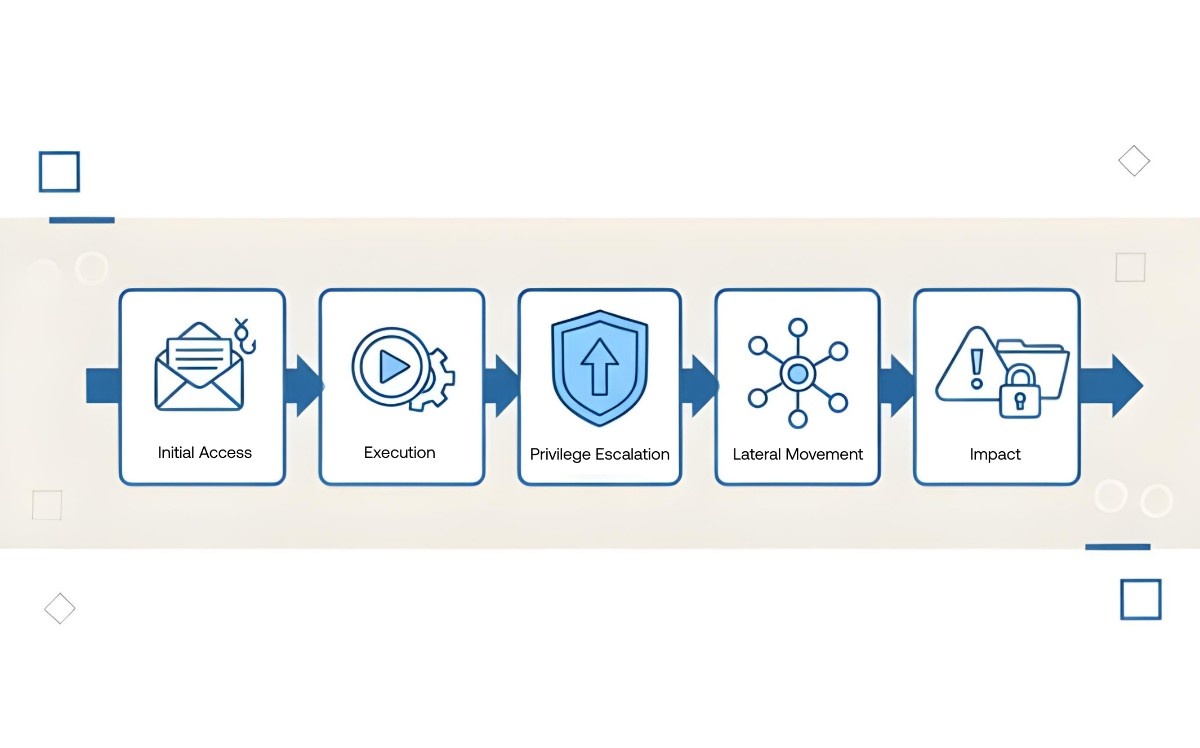
Privilege escalation changes the incident profile from localized to systemic.
With elevated privileges, attackers can more easily:
MITRE notes privilege escalation overlaps with persistence because mechanisms that persist can run in an elevated context.
Privilege escalation often implies unauthorized access. That matters for regulated data, access control attestations, and incident reporting obligations.
Most privilege escalation incidents are not mystery hacks. They are predictable outcomes of operational gaps.
Attackers routinely exploit known vulnerabilities soon after disclosure. Patch compliance is one of the highest leverage controls you have. Hexnode’s Patch and Update Management is designed to identify critical updates and support testing and approvals to reduce disruption risk.
The principle of least privilege (PoLP) is a formal security standard requiring that access rights be restricted to the absolute minimum necessary for a user to complete their specific tasks.
When organizations fall into the trap of over-permissioning, they effectively remove the safety buffers within their infrastructure. This lack of restriction converts minor security compromises, such as a single stolen password, into major, enterprise-wide events, as the attacker is immediately granted more power than the compromised role ever required.
Broken Object-Level Authorization (BOLA) occurs when an app fails to verify if a user has permission to access a specific resource. While the system knows who you are (authentication), it fails to restrict what you can do (authorization).
According to OWASP, these weaknesses facilitate two major attack patterns:
In short, without object-level checks, every unique resource becomes a potential entry point for unauthorized access.
If you can’t reliably detect privilege assignment events, new privileged persistence mechanisms, or unusual admin activity, escalation becomes a silent enabler.
Transition: Knowing the causes is useful, but response teams need a playbook. The next section provides a defensive troubleshooting workflow that scales enterprise fleets.
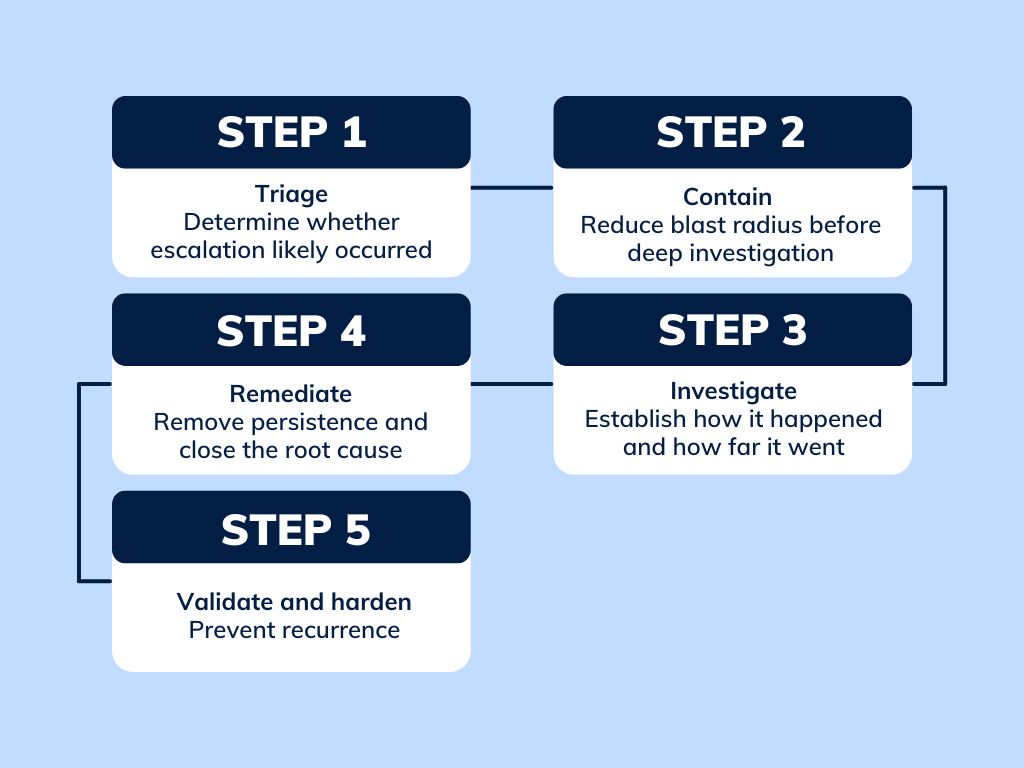
This workflow is intended for incident response and operational troubleshooting, not exploit development. Keep actions consistent with your IR runbooks and evidence of preservation requirements.

Discover how Hexnode UEM simplifies comprehensive device management, enhances enterprise security, and streamlines cross-platform oversight.
Download the brochurePrivilege escalation vulnerabilities are rarely solved by a single control. They are reduced by consistent patching, least-privilege enforcement, attack-surface reduction, and fast containment when something goes wrong.
Hexnode’s value proposition is operational: unify endpoint management and security workflows so teams can act faster with less tool sprawl from patch rollout to access governance to response execution.
Privilege escalation is frequently enabled by known vulnerabilities. The faster you can test and deploy updates, the smaller your exposure window.
Hexnode UEM’s Patch and Update Management emphasizes:
Hexnode also positions automated patching as cross-platform and operationally unified building automation rules for Windows and macOS in one dashboard and supporting third‑party application updates on Windows via integration.
Where this helps during a “privilege escalation bug” cycle:
When a new escalation CVE affects an OS or widely deployed app, your response is largely a patch and compliance problem. Hexnode’s patch workflows help you identify exposure, validate updates, deploy in controlled rings, and measure completion.
Privilege escalation is not only about endpoints. It also concerns who can do what is inside your management systems.
Hexnode documents its enterprise RBAC architecture as being engineered to support Principle of Least Privilege and describes a Triad Access Model in which access is granted only when identity, permission, and scope requirements are satisfied.
Why it matters: Granular administrative access reduces both accidental misconfiguration and the blast radius of compromised admin accounts.
Hexnode’s security management capabilities support hardening moves that reduce escalation opportunities and limit impact, including:
Practical effect: These controls reduce the value of elevated access and limit the attacker’s capabilities even if escalation occurs.
Shared devices in retail, healthcare, frontline operations, and customer-facing kiosks benefit from strict modes that prevent access to system settings and non-required apps.
Hexnode’s Kiosk Lockdown is designed to configure devices into restricted, purpose-specific modes across Android, iOS, Windows, and Apple TV, limiting users to only approved apps or websites.
When you suspect escalation, response speed matters.
Hexnode XDR is positioned to unify endpoints, alerts, and vulnerabilities into a single view and support response actions such as process kill, file quarantine/deletion, and device isolation along with a complete audit trail.
It also integrates with Hexnode UEM to reduce tool sprawl and shorten response time through a connected management and security ecosystem.
Security teams lose valuable time hunting for context across dashboards and filters during escalation investigations.
Hexnode’s Genie AI introduces a conversational interface within the UEM console to retrieve real-time insights, execute commands, and automate troubleshooting via natural language plus root-cause identification and remediation guidance when actions fail.
Where this helps in practice:
Secure your enterprise against privilege escalation. Get expert security insights and the latest endpoint protection strategies.
Try Hexnode NowNo. While software vulnerabilities (like kernel exploits) are common enablers, privilege escalation attacks are frequently caused by administrative misconfigurations, over-privileged user roles, and broken authorization checks in applications.
Common indicators of local privilege escalation include unexpected changes to privileged group memberships, the creation of new system services or tasks without a change request, security software being disabled, and unauthorized modifications to system configuration files.
The fastest way to achieve privilege escalation mitigation is to remove unnecessary local administrator rights, promptly patch critical OS vulnerabilities, and strictly enforce the principle of least privilege (PoLP) across all user and admin accounts.
Yes. A UEM solution like Hexnode reduces the likelihood and impact of an attack by hardening endpoint configurations, automating patch compliance, and enforcing secure baselines that restrict a standard user’s ability to execute unauthorized scripts or binaries.