




Enterprise IT has changed dramatically over the past five years. Applications have moved to the cloud, employees work from anywhere, and identity has effectively replaced the traditional network perimeter.
For IT managers, directors, and CISOs, this shift presents a clear challenge: access control has become the primary security control plane.
Today’s organizations rely on dozens – often hundreds of SaaS applications to run daily operations. According to the Okta Businesses at Work Report, companies use an average of 89 different applications, with large enterprises relying significantly more.
For modern IT leadership, the implications are clear:
- SaaS adoption continues to expand.
- Identity-based attacks are increasing.
- Zero Trust strategies require stronger authentication and access to enforcement.
This is where a modern Identity Provider (IdP) becomes foundational.
- What is an Identity Provider (IdP)?
- Why Identity Providers Are Critical Today
- How Identity Providers Work
- Identity Provider Protocols Explained
- Identity Provider vs IAM vs SSO vs Active Directory vs Service Provider
- Types of Identity Providers
- Conditional Access in Identity Providers
- Key Benefits of Using an Identity Provider
- How to Evaluate an Identity Provider
- How Does the Hexnode Identity Provider Help?
- Frequently Asked Questions About Identity Providers
What is an Identity Provider (IdP)?
An Identity Provider (IdP) is a system that authenticates users and verifies their identity before granting access to applications, services, or systems.
In simple terms, an Identity Provider answers one critical question:
“Is this user who they claim to be and should they be allowed access?”
A Real-World Example
Consider an employee trying to access Microsoft 365.
1. The user attempts to log in to the application.
2. The application redirects the user to the organization’s Identity Provider.
3. The IdP validates credentials (password, MFA, device trust, location policies).
4. Once authentication succeeds, the IdP issues a secure token (SAML or OIDC).
5. The application trusts the token and grants access.
Why Identity Providers Are Critical Today
For modern IT leadership, three major shifts make Identity Providers mission critical.
1. Remote and Hybrid Work
The corporate network is no longer the primary security boundary. Employees access enterprise systems from:
- Home networks
- Public Wi-Fi
- Personal devices
In this environment, location alone cannot determine trust. Security teams must validate who the user is, what device they are using, and under what conditions they are accessing resources.
An Identity Provider centralizes this validation, enforcing consistent authentication policies regardless of where the user connects from.
2. SaaS Sprawl
Organizations now operate across dozens – often hundreds of SaaS applications. Each application represents:
- A potential access point
- A potential credential store
- A potential attack surface
Without centralized identity control, credentials become fragmented, policy enforcement becomes inconsistent, and visibility across login activity is lost.
An Identity Provider consolidates authentication across all applications, enabling:
- Single Sign-On (SSO)
- Centralized policy enforcement
- Unified audit logging
For security leaders, this reduces both operational overhead and risk exposure.
3. BYOD and Unmanaged Devices
Bring Your Own Device (BYOD) policies are common, but unmanaged endpoints introduce uncertainty.
Security teams must answer:
- Is this device compliant?
- Is it managed?
- Is it trusted?
- Should access be restricted or limited?
Modern Identity Providers integrate device context into access decisions. Rather than granting blanket access, they can enforce conditional access based on device posture, compliance status, or network trust.
How Identity Providers Work
At a high level, an Identity Provider (IdP) acts as the central authority that verifies user identity and issues trusted authentication tokens to applications.
But under the hood, the process follows a secure and standardized flow.
Let’s break it down.
The Authentication Flow
The authentication process begins when a user attempts to access an application.
Here’s what happens step by step:
1. The user opens an enterprise application (e.g., Microsoft 365, Salesforce, internal portal).
2. The application does not authenticate the user directly.
3. Instead, it redirects the user to the organization’s Identity Provider.
4. The IdP prompts for credentials and enforces configured policies:
- Password validation
- Multi-factor authentication (MFA)
- Device trust checks
- Location or IP restrictions
- Risk evaluation (if enabled)
5. Once the user successfully authenticates, the IdP confirms identity.
The key principle:
Authentication is centralized. Applications delegate trust to the Identity Provider.
This ensures consistent policy enforcement across all systems.
The Redirection Model
Identity Providers use a secure redirection model.
When a user attempts to log in:
- The application redirects the user’s browser to the IdP.
- The IdP performs authentication.
- After successful authentication, the IdP redirects the user back to the application with a signed token.
This model ensures:
- The application never directly handles user credentials.
- Trust is established through cryptographic validation.
- Authentication logic remains centralized.
For security teams, this reduces credential sprawl and limits exposure points.
Token Issuance
Once identity is verified, the IdP generates a secure token.
This token contains:
- User identity details
- Authentication status
- Timestamp and expiration
- Signed cryptographic proof
Depending on the protocol used, this token may be:
- SAML assertion
- OpenID Connect (OIDC) ID token
- OAuth access token
The application validates the token’s signature and trusts the IdP’s verification.
Single Sign-On (SSO) Flow
Single Sign-On is a natural extension of centralized identity.
Once a user is authenticated through the IdP:
- The session remains active.
- Additional applications trust the existing authenticated session.
- The user does not need to log in again.
This works because:
- The IdP maintains the session.
- Tokens are issued to each trusted application.
- Applications rely on the IdP rather than local credential checks.
From a security perspective, it ensures authentication happens once – but policy enforcement happens everywhere.
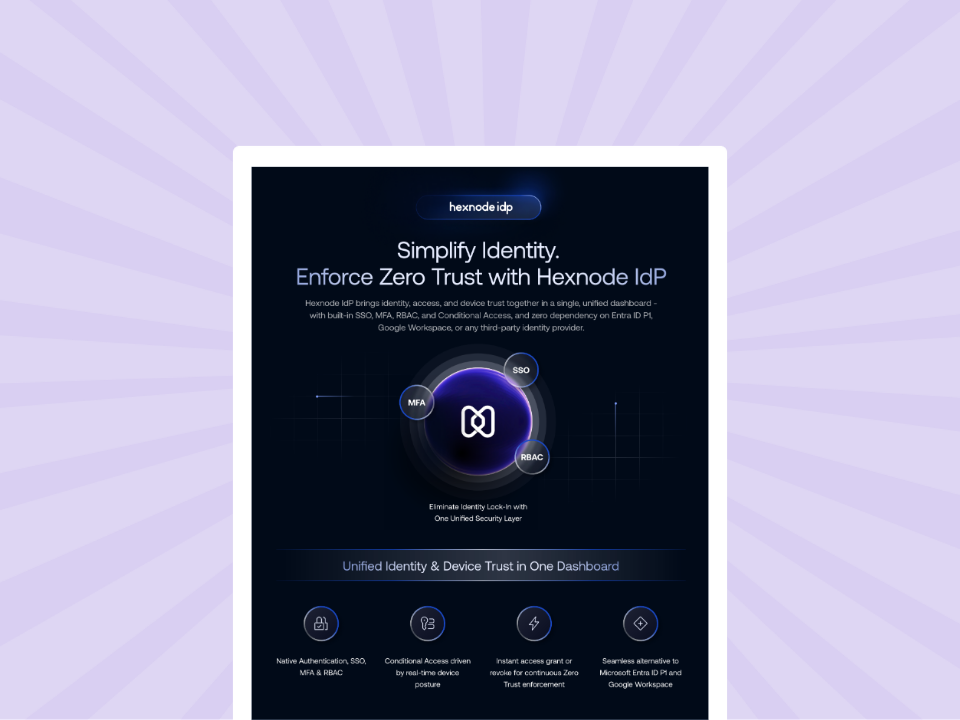
Featured Resource
Hexnode Identity Provider
Get a concise overview of Hexnode Identity Provider - features, capabilities, and how it strengthens access security in your organization.
Download Info SheetIdentity Provider Protocols Explained
Identity Providers rely on standardized protocols to securely authenticate users and grant access to applications. These protocols ensure interoperability between your IdP and hundreds of enterprise and SaaS applications.
Let’s break down the most important ones.
SAML (Security Assertion Markup Language)
SAML is one of the oldest and most widely adopted identity federation standards. It is XML-based and primarily used for enterprise Single Sign-On (SSO).
How it works:
- The user attempts to access an application.
- The application redirects the user to the Identity Provider.
- The IdP authenticates the user.
- The IdP sends back a SAML assertion (an XML token) containing authentication details.
- The application validates the assertion and grants access.
Why it matters:
- Widely supported across enterprise software.
- Ideal for legacy and traditional web applications.
- Strong fit for internal corporate systems and older SaaS platforms.
Considerations:
- XML-based structures can be heavier than newer protocols.
- Primarily browser-based use cases.
For many enterprises, SAML remains foundational for internal and legacy integrations.
OpenID Connect (OIDC)
OpenID Connect (OIDC) is a modern identity protocol built on top of OAuth 2.0. It uses lightweight JSON-based tokens (JWTs) and is optimized for cloud-native environments.
How it works:
- The application redirects the user to the IdP.
- The IdP authenticates the user.
- The IdP issues an ID token (JWT).
- The application validates the token and grants access.
Why it matters:
- Designed for modern SaaS applications.
- Works seamlessly with APIs and mobile apps.
- Lightweight and scalable.
OIDC is increasingly the standard for cloud applications and modern enterprise environments.
OAuth 2.0
OAuth 2.0 is not an authentication protocol – it is an authorization framework.
It allows one application to access resources in another application on behalf of a user without exposing credentials.
Example:
- A reporting tool accesses Microsoft 365 data using delegated permissions.
- A third-party app connects to Google Workspace APIs.
OAuth issues access tokens, not identity tokens. It determines what an application is allowed to do – not who the user is.
In most modern identity architectures:
- OIDC handles authentication
- OAuth handles authorization
Protocol Comparison Overview
| Protocol | Primary Use Case | Token Type | Best For |
|---|---|---|---|
| SAML | Enterprise SSO | XML Assertion | Legacy enterprise web apps |
| OIDC | Modern authentication | JWT (ID Token) | SaaS applications & cloud-native apps |
| OAuth 2.0 | Authorization | Access Token | API access & delegated permissions |
Identity Provider vs IAM vs SSO vs Active Directory vs Service Provider
In enterprise security discussions, terms like Identity Provider, IAM, SSO, and Active Directory are often used interchangeably. However, they serve different roles in the identity and access ecosystem.
Identity Provider (IdP) vs IAM (Identity and Access Management)
Identity and Access Management (IAM) is a broad discipline and framework that governs how users are identified, authenticated, authorized, and managed throughout their lifecycle.
An Identity Provider (IdP) is a component within the IAM ecosystem specifically responsible for authentication and issuing identity tokens.
Key Difference:
- IAM = Strategy + Governance + Lifecycle + Policies
- IdP = Authentication engine within IAM
Comparison: IdP vs IAM
| Feature | Identity Provider (IdP) | IAM |
|---|---|---|
| Primary Function | Authentication & token issuance | Identity governance & access management |
| User Lifecycle Management | Limited | Comprehensive |
| Access Policies | Enforces authentication policies | Defines and manages access rules |
| Scope | Component | Framework / umbrella system |
| Example Role | Validates login | Manages identities from hire to exit |
Identity Provider (IdP) vs SSO (Single Sign-On)
Single Sign-On (SSO) is a feature, not a system.
An Identity Provider enables SSO, but SSO itself is simply the user experience outcome of centralized authentication.
Key Difference:
- SSO = Ability to log in once and access multiple applications
- IdP = System that makes SSO possible
Comparison: IdP vs SSO
| Feature | Identity Provider (IdP) | Single Sign-On (SSO) |
|---|---|---|
| What It Is | Authentication system | Authentication feature |
| Issues Tokens | Yes | No |
| Enforces MFA | Yes | No |
| Manages Authentication Policies | Yes | No |
| User Benefit | Centralized login control | Login once, access multiple apps |
Identity Provider (IdP) vs Active Directory (AD)
Active Directory (AD) is a directory service developed by Microsoft that stores user accounts, groups, and domain information traditionally in on-premises environments.
An Identity Provider handles authentication and federation across applications, especially in cloud environments.
Key Difference:
- Active Directory stores identities.
- Identity Provider verifies identities and issues authentication tokens.
Comparison: IdP vs Active Directory
| Feature | Identity Provider (IdP) | Active Directory (AD) |
|---|---|---|
| Primary Role | Authentication & federation | Directory service |
| Cloud-Native | Yes | Primarily on-prem |
| Token Issuance | Yes (SAML, OIDC) | No |
| Stores User Accounts | Usually integrated source | Yes |
| Conditional Access | Yes | Limited |
Identity Provider (IdP) vs Service Provider (SP)
A Service Provider (SP) is the application or service that the user is trying to access.
In the identity model:
- The IdP authenticates the user.
- The SP trusts the IdP and grants access.
The Service Provider does not manage authentication logic – it relies on the IdP’s assertion.
Comparison: IdP vs Service Provider
| Feature | Identity Provider (IdP) | Service Provider (SP) |
|---|---|---|
| Role | Authenticates user | Grants access to resource |
| Issues Token | Yes | No |
| Stores Business Data | No | Yes |
| Trust Relationship | Trusted authority | Trusts IdP |
| Example | Enterprise IdP system | SaaS application |
Types of Identity Providers
Not all Identity Providers are built for the same purpose. Understanding these types helps IT leaders align identity strategies with business requirements.
1. Enterprise Identity Providers
Enterprise IdPs are designed for large organizations with complex infrastructure requirements.
Characteristics:
- Deep directory integration (AD, LDAP)
- SAML and OIDC support
- Federation capabilities
- Enterprise-grade MFA
- Granular policy controls
Ideal For:
- Large enterprises
- Regulated industries
- Hybrid on-prem + cloud environments
2. Social Identity Providers
Social IdPs allow users to log in using external accounts such as:
Characteristics:
- Lightweight authentication
- Designed for consumer apps
- OAuth-based authentication
- Limited enterprise-grade policy controls
Ideal For:
- Customer-facing apps
- Public SaaS platforms
- Low-risk environments
3. Cloud-Native Identity Providers
Cloud IdPs are built specifically for SaaS-first organizations.
Characteristics:
- API-first architecture
- OIDC-focused
- Strong SaaS integrations
- Scalable multi-tenant design
Ideal For:
- Cloud-first startups
- SaaS-heavy organizations
- Distributed teams
4. UEM-Integrated Identity Providers
Identity Providers that are tightly integrated with Unified Endpoint Management (UEM).
Characteristics:
- Device posture awareness
- Managed vs unmanaged device enforcement
- Compliance-based conditional access
- Session control linked to device state
- Identity + device policy convergence
Ideal For:
- BYOD environments
- Remote-first organizations
- Security teams implementing Zero Trust
- Enterprises seeking unified policy enforcement
Conditional Access in Identity Providers
Modern identity security requires context-aware access decisions evaluating not just who the user is, but how, where, and from what device they are accessing resources.
This is where Conditional Access becomes critical.
Conditional access allows an Identity Provider to enforce policies based on real-time signals such as:
- Device posture
- Compliance status
- Location
- Network
Device Trust
Device trust ensures that only recognized and authorized devices can access enterprise resources.
The Identity Provider evaluates whether:
- The device is enrolled in UEM
- The device is recognized
- The device meets security standards
This prevents unauthorized or rogue devices from accessing corporate applications – even if valid credentials are used.
Compliance Signals from UEM
When integrated with Unified Endpoint Management (UEM), identity decisions can incorporate device compliance posture.
For example:
- Is disk encryption enabled?
- Is the OS version up to date?
- Is the device jailbroken or rooted?
- Are required security policies enforced?
Instead of relying purely on authentication, the Identity Provider can consume compliance signals from UEM and make access decisions accordingly.
Geo Restrictions
Location-based policies allow organizations to:
- Restrict logins from specific countries
- Block high-risk regions
- Allow access only from approved geofences
If a login attempt originates from an unauthorized region, access can be blocked or require additional verification.
IP Restrictions
Network-based controls provide another layer of contextual enforcement.
Organizations can:
- Allow access only from corporate IP ranges
- Enforce VPN-only access
- Block public or anonymous proxy networks
This ensures that even if credentials are compromised, access remains limited to trusted network environments.
👉 See how Hexnode enforces device-aware conditional access
Key Benefits of Using an Identity Provider
A modern Identity Provider is not just an authentication tool – it is a strategic control layer that impacts security, compliance, and operational efficiency across the enterprise.
Centralized Authentication & Access Control
Without a centralized Identity Provider:
- Each application manages authentication separately.
- Policies are inconsistent.
- MFA enforcement varies.
- Visibility into login activity is fragmented.
With an IdP:
- Authentication is centralized.
- Policies are enforced uniformly.
- Access decisions are consistent across applications.
- Audit logs are consolidated.
For IT leadership, this means fewer configuration errors, faster policy rollouts, and stronger governance.
Reduced Security Breaches
A modern Identity Provider reduces breach exposure through:
- Multi-factor authentication enforcement
- Conditional access policies
- Device-aware access decisions
- IP and geo restrictions
- Session controls
- Risk-based authentication
Improved Compliance & Audit Readiness
Regulatory and security frameworks require:
- Strong authentication controls
- Access logging and monitoring
- Role-based access enforcement
- Timely deprovisioning
- Policy consistency
An Identity Provider provides:
- Centralized audit trails
- Policy enforcement documentation
- Access visibility across applications
- Standardized authentication controls
For CISOs, this simplifies compliance reporting and strengthens defensibility during audits.
How to Evaluate an Identity Provider
Below are the critical areas to evaluate before making a decision.
Protocol Support
An Identity Provider must support industry-standard protocols to ensure compatibility with your application ecosystem.
Look for support for:
- SAML (legacy and enterprise web applications)
- OpenID Connect (OIDC) (modern SaaS and APIs)
- OAuth 2.0 (authorization and API access)
Conditional Access Engine
Evaluate whether the IdP supports:
- Device-based access control
- Managed vs unmanaged device differentiation
- Compliance posture enforcement
- Geo and IP restrictions
- Session management controls
- Risk-based authentication
UEM Integration
Ask:
- Can the IdP integrate with Unified Endpoint Management (UEM)?
- Can it consume compliance signals?
- Can it restrict access based on device state?
Identity without device context leaves enforcement incomplete.
Reporting & Audit Capabilities
Evaluate whether the IdP provides:
- Centralized authentication logs
- MFA reports
- Conditional access block reports
- Session activity logs
- Exportable audit data
Scalability & Architecture
Identity systems must scale with organizational growth.
Consider:
- Multi-tenant architecture
- Directory sync performance
- Policy scalability
- High availability
- API extensibility
Cost & Licensing Model
When evaluating cost, consider:
- Conditional access licensing requirements
- Add-on pricing for advanced features
- Redundant tool overlap
- Per-user pricing scalability
- Infrastructure consolidation opportunities
Identity Provider Evaluation Checklist
| Criteria | Why It Matters |
|---|---|
| Protocol Support | Ensures compatibility with existing and future applications |
| Conditional Access | Strengthens contextual security enforcement |
| UEM Integration | Enables device-aware access control |
| Reporting | Supports compliance and audit readiness |
| Scalability | Supports enterprise growth and expansion |
| Pricing Model | Optimizes licensing and reduces redundancy |
How Does the Hexnode Identity Provider Help?
The Hexnode Identity Provider is built to address these needs, combining identity control with endpoint intelligence to strengthen enterprise security posture.
| Feature | Key Benefit |
|---|---|
| Conditional Access | Enforces dynamic access based on device trust, geo-location, IP network, and strict session management. |
| UEM Integration | Aligns closely with Zero Trust by factoring real-time device compliance and security posture into access decisions. |
| Modern Protocols | Ensures seamless, secure access to legacy and modern SaaS apps using industry standards like SAML and OIDC. |
| Directory Sync | Integrates with existing setups like Microsoft Entra (Google Workspace coming soon) to eliminate duplicate admin workflows. |
| Dedicated Dashboard | Centralizes visibility and governance for users, SSO, MFA, conditional access policies, and audit logs. |
See how device-aware conditional access and integrated identity enforcement can strengthen your organization’s security posture.
👉 Schedule a Demo of Hexnode IDP
Frequently Asked Questions About Identity Providers
Can an Identity Provider reduce password-related security risks?
Yes. By enforcing multi-factor authentication (MFA), Single Sign-On (SSO), and centralized password policies, an Identity Provider reduces:
- Password reuse
- Credential sprawl
- Phishing exposure
What happens if an employee leaves the organization?
With centralized identity management, disabling a user account in the Identity Provider automatically revokes access across integrated applications. This eliminates orphaned accounts and reduces insider threat exposure.
Can Identity Providers control access from personal (BYOD) devices?
Yes, if integrated with endpoint management or conditional access policies.
Access can be:
- Restricted to managed devices only
- Limited for unmanaged devices
- Granted conditionally based on device posture
This enables secure BYOD strategies without sacrificing control.
Do Identity Providers support API and third-party integrations?
Most modern Identity Providers support API-based integrations through standards such as OAuth 2.0 and OIDC.
This allows secure delegated access for:
- SaaS integrations
- Reporting tools
- Automation platforms
- Internal applications
How does an Identity Provider support Zero Trust architecture?
Identity Providers enforce Zero Trust principles by:
- Verifying every access request
- Applying contextual access policies
- Enforcing MFA
- Continuously evaluating session behavior
As SaaS adoption grows, remote work expands, and Zero Trust becomes the standard; organizations need more than basic login management.
If your organization is evaluating identity modernization, consolidating conditional access, or aligning identity with device posture, now is the time to act.
Speak with our team to explore how unified identity and endpoint intelligence can strengthen your security posture without adding complexity.
Ready to Modernize Your Identity Security?
See how Hexnode Identity Provider delivers device-aware conditional access and centralized authentication enforcement.
Schedule a Demo