Why is IT asset management important?
Learn how IT asset management is important and how it provides centralized visibility and control.

Get fresh insights, pro tips, and thought starters–only the best of posts for you.

The modern enterprise operates in a state of continuous digital expansion. Hybrid work models, cloud-first strategies, and IoT adoption have collectively transformed the technological landscape, so much so that global IT spending is projected to exceed $6 trillion for the first time in 2026, according to Gartner.
But expansion without coordination introduces complexity. As organizations deploy new software platforms and expand device fleets, their IT environments grow denser and more fragmented. Without centralized governance, this complexity compounds. Over time, the imbalance between growth and oversight crystallizes into a structural issue: IT sprawl.
This article explores what IT sprawl is, what drives it, the risks it creates, and how Unified Endpoint Management (UEM) serves as a centralized control layer to restore visibility and governance across distributed endpoint environments.
IT sprawl is the uncontrolled and uncoordinated expansion of an organization’s technology ecosystem. This includes infrastructure, applications, endpoints, data systems, and management tools which results in reduced visibility, fragmented governance, and increased operational and security risk.
While IT sprawl spans multiple domains, it frequently manifests most visibly at the endpoint layer, where devices, operating systems, and management tools proliferate across departments and geographies.
| Sprawl Type | Technical Focus | Primary Driver | Organizational Impact |
|---|---|---|---|
| Infrastructure | Cloud workloads, servers | Decentralized provisioning | Operational complexity |
| Tool/SaaS | Redundant software platforms | Departmental siloed purchasing | Data silos and license waste |
| Device | Proliferation of endpoints (IoT, Rugged, Laptops) | Hybrid work and IoT adoption | Expanded attack surface and visibility gaps |
| Data | Duplicated data across disparate systems | Lack of data lifecycle management | Regulatory non-compliance (GDPR/HIPAA) |
While UEM does not govern all dimensions of IT sprawl, it plays a critical role in addressing device sprawl and endpoint governance, which often represent the most immediate operational risk.
The consequences of IT sprawl represent a significant hidden tax on organizational agility:
The structural drivers and enterprise impact of IT sprawl, specifically in terms of endpoints, make one thing clear: the problem is not growth itself. It is fragmented oversight. And most organizations attempt to manage sprawl using a patchwork of point solutions:
This fragmentation creates visibility gaps, inconsistent policy enforcement, and operational duplication, ironically reinforcing the very IT sprawl they are meant to control.
What organizations need is a centralized control plane capable of standardizing oversight across device types, enforcing consistent security baselines, automating lifecycle workflows, and delivering real-time visibility across the endpoint ecosystem.
This is where Unified Endpoint Management (UEM) becomes strategically essential.

UEM solutions eliminate the blind spots where sprawl thrives by providing a real-time window into devices.
A Single Source of Truth: A UEM solution consolidates endpoints, operating systems, configurations, and ownership metadata into a centralized console. Instead of managing devices and policies across separate tools, administrators gain a single source of truth for endpoint visibility.
Identifying “Zombie” and Dormant Assets: UEM identifies “ghost” devices that haven’t synced in days. By surfacing these inactive assets, IT can immediately deprovision the devices, providing instant financial ROI.
Shadow IT Detection: By monitoring enrollment patterns and app installations, UEM helps uncover unsanctioned tools. With research showing Shadow IT accounts for up to 40% of enterprise spend, this visibility is critical for budget recovery.
UEM prevents IT sprawl from reemerging by enforcing structured oversight from procurement to retirement.
A UEM platform acts as a filter that narrows hardware and software variability, reducing operational entropy.
Cross-platform Consolidation: By supporting Windows, macOS, Linux, Android, and iOS from a single administrative interface, UEM eliminates the need for parallel management systems, directly reducing tool sprawl.
Standardizing OS Builds: By automating patch management, UEM simplifies the maintenance of “golden images,” reducing the support burden created by version drift and OS variability
In a dynamic environment, periodic audits aren’t enough. UEM provides the “always-on” oversight needed to sustain order.
While UEM provides the architectural model, its effectiveness depends on execution. Hexnode UEM delivers the operational capabilities required to translate governance strategy into enforceable control.
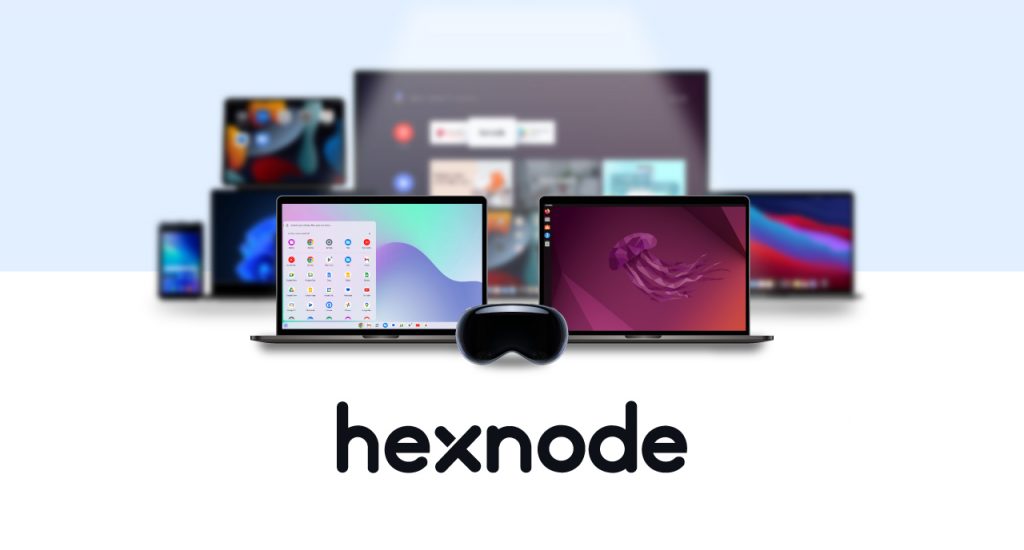
Hexnode eliminates IT sprawl by supporting Windows, macOS, Linux, Android, iOS, and niche platforms like Fire OS, tvOS, and visionOS under one policy framework. This removes the need for disparate management silos and ensures that policies for encryption or passwords are applied universally.
Modern IT sprawl frequently includes unmanaged personal devices accessing enterprise resources. Hexnode supports BYOD management with workspace separation, enabling secure corporate access without compromising user privacy. This prevents personal device usage from becoming uncontrolled infrastructure expansion.
Integration with Apple Business Manager (ABM) and Android Zero-Touch ensures hardware is enrolled and configured automatically before it reaches the end-user. This prevents unmanaged devices from ever entering your network.
Hexnode enables automated compliance enforcement through policy-based controls. If a device drifts from its defined security baseline, such as encryption being disabled or a blocklisted app being detected, the platform can mark the device as non-compliant, trigger predefined remediation actions, or notify the administrators.
Through its asset management functionalities, Hexnode provides real-time reports on hardware health, battery status, and sync activity. Administrators can automatically flag and deprovision ghost assets, ensuring that licenses are reclaimed and hardware is securely wiped before it becomes a security liability.
Hexnode automates OS and third-party application updates for Windows and macOS. This ensures that no orphaned or zombie devices miss critical security patches, closing the visibility gap.

Download the whitepaper to learn all about asset management and how Hexnode can simplify asset management in your organization.
Get the white paperIT sprawl has become a defining form of technical debt in the modern enterprise. Device sprawl is one of its most visible and operationally risky manifestations. As endpoints multiply across hybrid environments, gaps in oversight expand, creating security vulnerabilities, financial inefficiencies, and operational entropy that organizations can no longer afford to ignore.
Reversing this trend requires more than just better spreadsheets; it requires a structural shift toward Unified Endpoint Management. By leveraging a platform like Hexnode, organizations can transform a fragmented, uncoordinated infrastructure into a lean, secure, and highly visible ecosystem.
1. What is the difference between IT scaling and IT sprawl?
IT scaling is a planned, governed, and standardized expansion of technology to meet business growth. In contrast, IT sprawl is reactive and uncoordinated, occurring when technology adoption outpaces centralized oversight, leading to fragmentation.
2. What are “Zombie” assets in an IT environment?
“Zombie” or “Ghost” assets are devices or software licenses that remain provisioned on the books but show no user activity. These assets waste budget on unnecessary subscriptions and often lack the latest security patches, creating a liability.
3. Can we consolidate our management if we have a mix of legacy Windows and brand-new MacBooks?
Yes. Modern UEMs like Hexnode are platform-agnostic. They use a single policy framework, for example, you can set a “Device Encryption” policy that triggers BitLocker for your Windows fleet and FileVault for your Macs simultaneously from the same screen.
Consolidate endpoint visibility, enforce consistent security policies, and eliminate device fragmentation with Hexnode UEM.
SIGNUP NOW