A secure web gateway vs proxy server comparison comes down to purpose. A proxy server helps route, mask, cache, or control web traffic, while a secure web gateway focuses on inspecting web traffic, enforcing policies, and reducing exposure to threats like phishing, malware, and risky websites. For businesses, the right choice depends on whether the priority is traffic management, web security, or both. UEM adds another layer by extending web access control to managed endpoints.
In today’s distributed work environment, controlling internet access and securing corporate data are no longer just best practices. They are operational priorities. A proxy server and a secure web gateway may seem similar because both can sit between users and the internet, managing how web traffic flows. However, they are designed with different goals in mind.
As organizations adopt cloud applications, remote work, and distributed devices, the question is not which one is universally better. You need to know what each tool does, where they overlap, and when one better fits a specific business need.
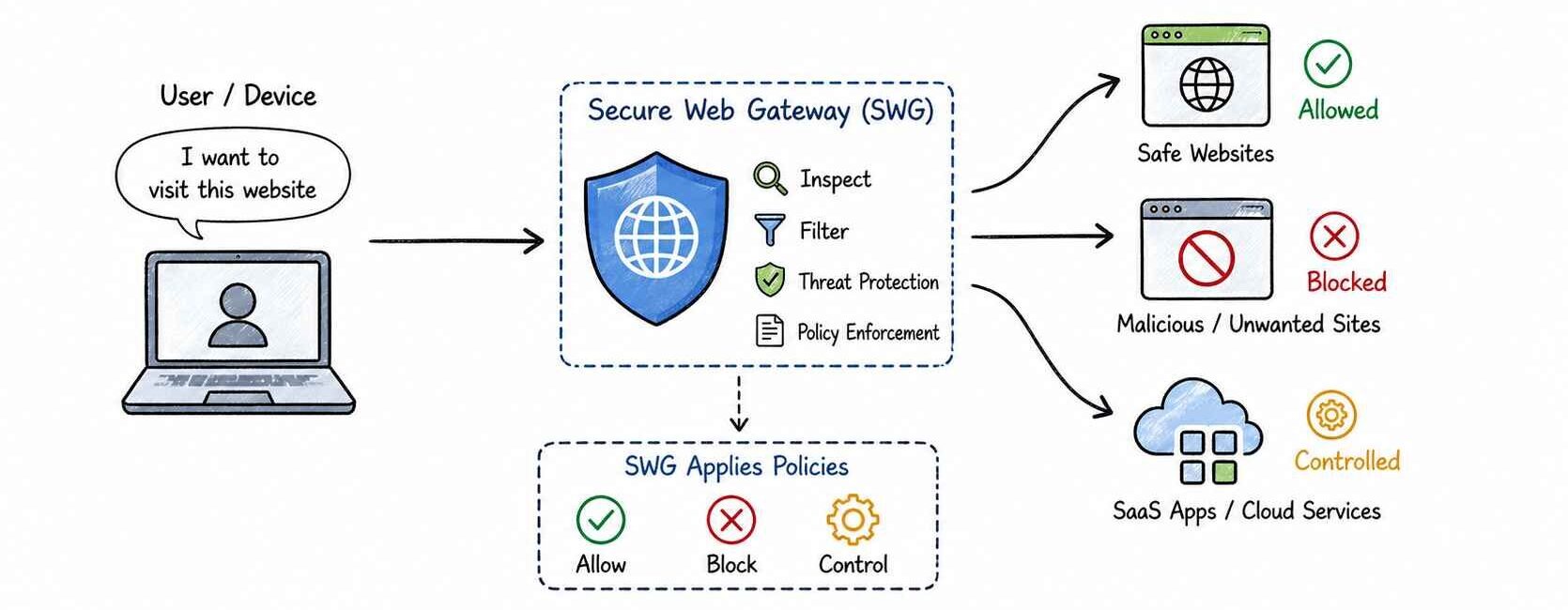
Secure Web Gateway explained with a simple illustration
A secure web gateway, or SWG, is a web security solution that sits between users and the internet to monitor, filter, and secure web traffic. Unlike a basic traffic-forwarding tool, SWG is designed to inspect internet-bound activity before users reach websites, cloud applications, or downloadable content. In simple terms, it helps the organization decide whether web traffic should be allowed, blocked, inspected, or controlled.
It typically reduces exposure to web-based threats and enforces corporate or regulatory policies across internet traffic. This distinction is critical in modern environments where employees access SaaS applications, cloud resources, and business tools from different locations and devices.
Instead of relying only on office-based network controls, an SWG helps apply web security policies more consistently across users, devices, and locations.
What is a Proxy Server?
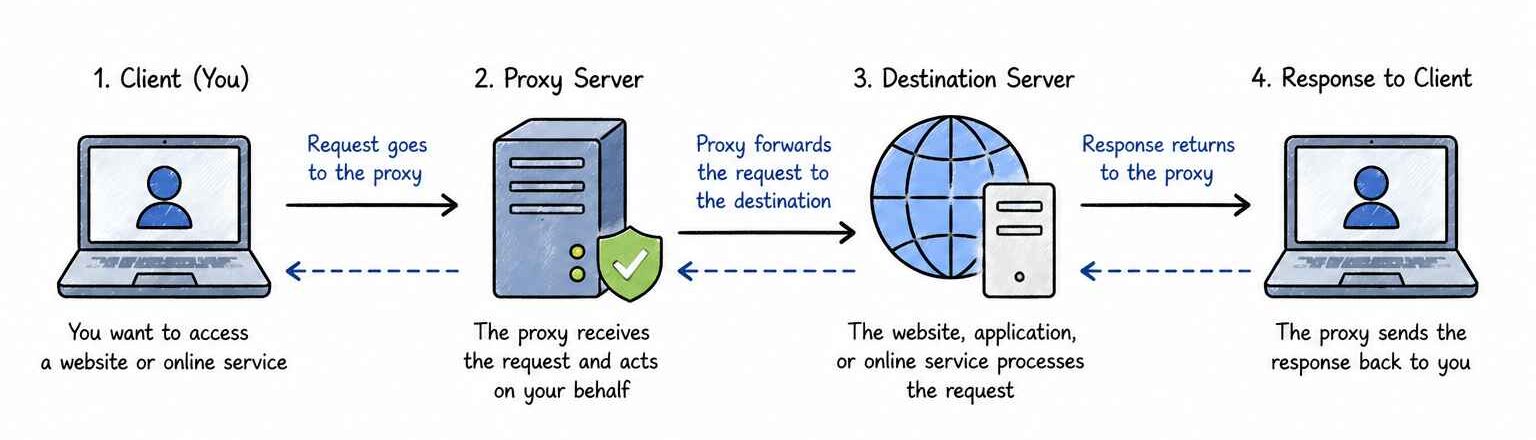
Proxy Server explained with a simple illustration
A proxy server is an intermediary system that sits between a client device and the website, application, or online service the user wants to access. Instead of connecting directly to the destination server, the request first goes to the proxy. The proxy then acts on behalf of the client by forwarding the request, modifying it, blocking it, or returning a response directly, depending on how it is configured. They can support access control, caching, routing, or privacy-related use cases, but they are not automatically complete web security solutions.
Proxy servers can be deployed in different ways depending on the direction of traffic and the business requirement. Common types include:
Forward proxy: Handles outbound requests from users to the internet.
Reverse proxy: Sits in front of web servers and manages incoming client requests.
Transparent proxy: Intercepts traffic without requiring users to manually configure proxy settings.
Anonymous proxy: Helps mask the user’s IP address from destination websites.
Secure Web Gateway vs. Proxy Server: The Core Difference
At a high level, both a proxy server and a secure web gateway can sit between users and the internet. The difference is in what they are mainly designed to do. A proxy server is primarily a traffic intermediary. A secure web gateway, on the other hand, is a security control point designed to inspect, filter, and enforce policies across web traffic.
Feature
Proxy Server
Secure Web Gateway
Primary purpose
Route, forward, mask, cache, or manage web traffic
Secure, inspect, and control web access
Main role
Traffic intermediary
Security control point
Threat protection
Limited or dependent on add-on tools
Built for web-based threat protection
URL filtering
Basic to moderate, depending on configuration
More policy-driven and security-focused
Malware protection
Usually limited unless paired with security tools
Common SWG capability
Phishing protection
Not a core function in basic proxies
Commonly included in SWG protection
SSL/TLS inspection
Sometimes available
Commonly supported where configured and permitted
Data loss prevention
Rare in basic proxy setups
Often included or integrated
User/device-based policies
Limited in many traditional deployments
Stronger support for identity, device, and context-based rules
Cloud app visibility
Limited
Often supported, especially in modern cloud-delivered SWGs
Deployment model
Can be on-premises, cloud-based, forward, reverse, or transparent
Can be on-premises, cloud-delivered, software-based, or part of SASE/SSE platforms
Where They Overlap
Both technologies may be used to:
Route web traffic through an intermediary system
Control access to certain websites or services
Log web activity for visibility or auditing
Apply filtering rules depending on configuration
Where They Diverge
The main distinction is depth and purpose. A proxy server usually focuses on traffic handling, privacy, caching, or basic access control. An SWG focuses on web security and policy enforcement, with capabilities such as web content filtering, malware protection, phishing protection, SSL/TLS inspection, data loss prevention, application control, and compliance support.
How UEM and Security Solution Control Web Apps and Browser Security
Read more about how UEM and security solutions help organizations control web app access across endpoints.
Which One Should Your Business Choose?
The right choice depends on what your business is trying to achieve. A proxy server is usually enough when the goal is to manage how traffic flows. A secure web gateway is the better fit when the goal is to secure web access, enforce policies, and reduce exposure to web-based threats.
Choose a Proxy Server When You Need Traffic Management
A proxy server may be suitable if your organization needs to:
Route web traffic through a controlled intermediary
Restrict access to specific websites
Mask internal IP addresses
Cache frequently accessed content to improve performance
Support reverse proxy use cases for web applications
Manage specific internal routing or legacy infrastructure needs
This makes proxies useful for basic access control, performance optimization, reverse proxy configurations, and environments with narrow traffic-handling requirements.
Choose a Secure Web Gateway When You Need Web Security
A secure web gateway better fits your organization if you need to:
Protect users from malicious websites, phishing pages, and malware
Inspect and filter internet-bound traffic
Enforce acceptable use policies across users and devices
Apply controls such as URL filtering, SSL/TLS inspection, and data loss prevention
Improve visibility into SaaS and cloud application usage
Support compliance, reporting, and auditing requirements
A Practical Way to Decide
For many businesses, the answer is not strictly one or the other. A secure web gateway may replace a traditional forward proxy for outbound web security, while proxy servers may still support application delivery, reverse proxy configurations, or legacy infrastructure needs. SASE and SSE frameworks also commonly include SWG capabilities as part of broader cloud-delivered security models for securing access to the web, cloud services, and private applications.
Can a secure web gateway replace a proxy server?
In some cases, yes. A secure web gateway can often replace a traditional forward proxy when the goal is outbound web filtering, traffic inspection, threat protection, and policy enforcement. However, it may not replace every proxy use case. Businesses may still need proxy servers for reverse proxy configurations, application delivery, load balancing, internal routing, or legacy infrastructure. The decision should depend on what the existing proxy is actually doing, not simply whether an SWG offers proxy-like functionality.
Why Endpoint-level Web Access Control Still Matters
Proxy servers and secure web gateways help organizations manage and secure web traffic, but web access control does not stop at the network layer. Businesses also need a way to apply policies directly to the devices employees use every day. This is where a unified endpoint management solution like Hexnode can support a broader web security strategy.
A UEM solution can help by allowing IT teams to:
Apply web access rules on managed devices so organizations can enforce website restrictions beyond a specific office network.
Enforce browser and app-level controls to reduce access to unauthorized or unnecessary web resources.
Support kiosk and single-purpose device use cases where users should only access approved websites or web apps.
Manage policies across distributed endpoints, including laptops, tablets, smartphones, and shared devices.
Maintain centralized visibility and control over device behavior, policy enforcement, and compliance status.
When used alongside network-layer tools, Hexnode helps extend web access control to the endpoint, giving IT teams a more consistent way to manage how users access the web across devices, locations, and work environments.
Featured Resource
Hexnode for data security: Protecting your business data with Hexnode
Download the whitepaper to learn all about data security and how Hexnode can ensure data security in your organization.
Final Thoughts: Choose the Right Layer for Web Access Control
A proxy server and a secure web gateway may both sit between users and the internet, but they solve different problems. A proxy server is useful for routing traffic, masking IP addresses, caching content, and supporting specific access or infrastructure needs. A secure web gateway goes further by inspecting web traffic, enforcing policies, and helping protect users from web-based threats. The right choice depends on whether your priority is traffic management or web security. For stronger control, businesses should also think beyond the gateway. Extending policies to managed endpoints through UEM adds another layer of consistency across users, devices, and locations.
Frequently Asked Questions (FAQs)
1. Is a proxy server the same as a VPN?
No. A proxy server forwards traffic on behalf of a user or device, often for web access, filtering, caching, or IP masking. A VPN creates an encrypted tunnel between the user’s device and a private network, helping protect traffic across the connection. In simple terms, a proxy handles selected traffic as an intermediary, while a VPN secures a broader network connection.
2. Can a secure web gateway inspect HTTPS traffic?
Yes, many secure web gateways can inspect HTTPS traffic, but only when SSL/TLS inspection is configured and allowed by the organization’s policy, privacy requirements, and local regulations. This matters because many modern websites and cloud apps use encrypted traffic, and threats can also hide inside encrypted sessions. SWGs commonly support HTTPS inspection as part of broader web security enforcement.
3. Do small businesses need a secure web gateway?
Not always. A small business with simple browsing needs and low risk exposure may start with basic controls such as DNS filtering, endpoint protection, browser policies, or proxy-based restrictions. However, an SWG becomes more relevant when the business has remote users, SaaS applications, compliance requirements, phishing risk, or a need for centralized web security policies. The decision should depend on risk, workforce model, and security needs rather than company size alone.
Bring Web Access Policies Closer to the Endpoint
Apply web content filtering, browser controls, and kiosk-based browsing restrictions across managed devices with Hexnode UEM
Curious, constantly learning, and turning complex tech concepts into meaningful narratives through thoughtful storytelling. Here I write about endpoint security that are grounded in real IT use cases.