




In 2026, many organizations favor “stack consolidation” to simplify infrastructure. While aligning with a single OS-native tool seems cost-effective, coupling your management plane to an operating system vendor creates strategic rigidity. This dependency limits future flexibility, as native vendors often prioritize ecosystem retention over the cross-platform interoperability required for an effective OS agnostic MDM strategy.
Achieving true agility requires a multi-platform MDM like Hexnode to secure heterogeneous environments of Windows, macOS, Android, and iOS. By decoupling the operating system from the management layer, you eliminate “walled garden” silos in favor of a vendor-neutral security posture. This approach ensures your architecture adapts to evolving fleet requirements without the operational burden of vendor lock-in.
The Core Conflict: Ecosystem Bias
To understand why decoupling is essential, you must recognize the primary motivations of major OS vendors. Their fundamental business goal is to drive the adoption of their own hardware, proprietary licenses, and service subscriptions.
When these vendors develop management tools, they are not building neutral platforms designed for universal flexibility. They are building Ecosystem Enforcers. These tools are engineered to prioritize the vendor’s own operating system, often treating other platforms as secondary priorities with limited functionality or delayed feature support.
Risk 1: The “Vendor Lock-In” Trap (Strategic Rigidity)
The most dangerous cost in IT isn’t the software license; it’s the Switching Cost. When your management plane is welded to a specific OS, you lose the ability to pivot during supply chain disruptions or shifts in hardware preference.
By decoupling OS from MDM, you ensure your organization remains agile. If a primary hardware vendor faces a recall or a geopolitical sanction, a decoupled architecture allows you to swap your fleet to a different platform without rebuilding your entire security stack. You enroll the new hardware into your existing portal and map your current compliance policies, such as encryption and password complexity, to the new devices. This is a vital step in building a resilient enterprise infrastructure and the most effective way to prevent vendor lock-in in IT.
Risk 2: The “Siloed Visibility” Gap
The inevitable result of choosing OS-native tools is fragmentation. To manage a diverse environment, organizations often end up with three or four different consoles. When a CISO asks for a real-time report on unpatched devices, the team is forced into hours of manual data normalization from conflicting sources.
Effective multi-OS device management eliminates these visibility gaps. A unified platform provides a single source of truth where a non-compliant laptop, tablet, and rugged scanner are listed side-by-side. This holistic view ensures that your risk posture is accurate and actionable, which is a core requirement when managing heterogeneous fleets effectively.
Risk 3: The “Zero-Day” Support Gap
It is a misconception that first-party OS vendors always provide the fastest support for new management features. Because large ecosystem providers often bundle UEM updates into massive, rigid release cycles, critical API support can be delayed.
In contrast, Hexnode operates with a dedicated engineering focus. When Apple or Google announces new specifications—such as Declarative Device Management, we begin integration immediately. For generalist vendors, UEM is a secondary value-add; for Hexnode, it is our core competency. We prioritize day-zero readiness so your vendor’s roadmap never holds your fleet back.
The financial model: Bundled licensing vs. TCO
We often hear: “It’s included in our license”. A bundled license may reduce license spend, but it doesn’t eliminate the operational cost of managing endpoints.
Operational cost drivers in a multi-tool setup
- Multiple consoles: Different tools for different platforms or device types
- Admin training: More time to learn, maintain, and switch between workflows
- Integration overhead: Separate integrations to systems like ServiceNow or Freshservice, plus ongoing maintenance
Operational efficiency with a unified platform
- Single platform coverage: Hexnode can manage devices across supported platforms from one place
- Consistent policy workflow: Similar steps to create and apply policies across platforms (with platform-specific controls where needed)
- Simplified integrations: One integration approach (centralized data + APIs) to support reporting and visibility across the fleet
Strategic pivot: Best-of-breed architecture for a mixed-device enterprise
Modern enterprises run a mixed fleet—different teams standardize on different devices and operating systems:
- Marketing: Macs
- Finance: Windows
- Developers: Linux
- Warehouse: Android devices
- Executives: iPads
Trying to manage this diversity with a single-OS-first tool often leads to a poor fit: policies and workflows designed for one platform don’t translate cleanly to others, creating friction for users and additional effort for IT.
Hexnode is designed for cross-platform management. It applies controls using platform-native management methods on each OS, while giving admins a single, consistent policy workflow.
For admins, the experience stays simple: you define the intent (for example, “enable disk encryption”). Hexnode then enforces the closest OS-supported equivalent on each platform—such as BitLocker on Windows and FileVault on macOS—based on what the device supports and what’s available for that OS.
Actionable steps: Audit your lock-in risk
If you’re not sure how dependent you are on a single ecosystem, run this simple Agility Audit. The goal is to identify whether your tooling, policies, and operations can support a rapid shift in device mix without major rework.
1. The Pivot Test
Ask a practical question:
“If we had to move our laptop fleet to a different OS next month due to a supply-chain issue, regulatory change, or business decision, how quickly could we get devices enrolled and secured to our baseline?”
When you review the answer, look for specifics:
- If the response is: “We’d need a new management tool or separate toolset”. That indicates high lock-in.
- If the response is: “We can enroll and apply baseline controls with our existing platform”. That indicates lower lock-in.
What “secured” should include (so the test is meaningful):
- Enrollment at scale (including automated enrollment where applicable)
- Baseline security: encryption, passwords, screen lock, firewall (where supported)
- Identity access: SSO/conditional access alignment (if used)
- Update management: deferrals and compliance checks
- Required apps, certificates, Wi‑Fi/VPN profiles
- A clear plan for support workflows (remote lock/wipe, recovery, troubleshooting)
2. The Feature Coverage Check
Compare how well your current approach supports your secondary OS versus your primary OS. Don’t check every setting—focus on what matters operationally.
Create a short list of your top policy requirements (example categories):
- OS update controls (deferrals, deadlines, restart behavior)
- Encryption enforcement and escrow/recovery workflows
- Password and authentication requirements
- App deployment and restrictions
- Network configurations (Wi‑Fi, VPN, certificates)
- Device restrictions (camera, USB, screen capture, etc.—as required)
- Reporting/compliance visibility for audits
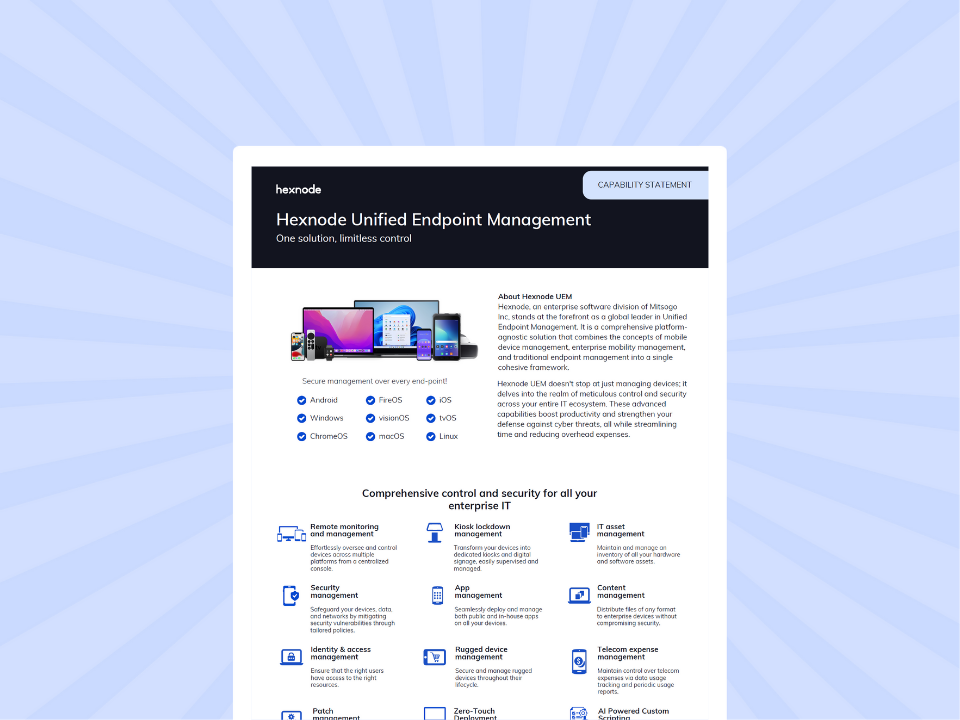
Featured resource
Hexnode UEM Capability Statement
Hexnode capability statement: a quick overview of UEM tools, features, and benefits.
DOWNLOADThen ask:
- Do we have native controls for these requirements on each OS?
- Are we relying on manual steps, scripts, or exceptions for certain platforms?
- Do helpdesk teams have the same visibility and actions across platforms?
If your secondary OS consistently has less control, more exceptions, or more manual work, you’re absorbing platform bias as ongoing operational cost.
3. The Console Count
List the tools your support team uses for common device actions:
- Enroll/assign device ownership
- Push apps and configurations
- Remote lock/wipe / retire
- View compliance posture and device health
- Pull logs or device details for troubleshooting
- Create/respond to tickets (ITSM) and send security signals (SIEM)
Now count how many separate portals are required for the same workflow. If it’s more than one, you have measurable overhead:
- More training and context switching
- Slower ticket resolution due to handoffs
- Inconsistent enforcement and reporting across platforms
A lower console count usually correlates with faster operations and fewer gaps.
What to do with the results – At the end of this audit, document:
- Your “pivot readiness” time estimate (even a range is useful)
- The top 5 policy gaps across non-primary platforms
- The number of consoles required for key helpdesk actions
This gives you a clear, actionable view of where lock-in is coming from: tooling limits, policy gaps, or operational complexity.
Conclusion: Freedom is a Security Feature
In 2026, agility is a security requirement. Threats evolve quickly, supply chains change, and vendor roadmaps can shift without warning. If your endpoint security depends on a single ecosystem, your ability to respond is constrained.
By using an independent, cross-platform management layer like Hexnode, you reduce dependency on any one OS or hardware vendor. You can standardize baseline controls across device types, adapt faster when your fleet changes, and avoid rebuilding your management approach every time your environment shifts.
Keep endpoint control with your IT and security teams—not tied to a single vendor’s ecosystem decisions.
Ready to Declare Independence?
See how Hexnode manages Windows, Mac, Android, iOS, and more side-by-side in a single, unified console.
SIGN UP NOWFAQs
What is the risk of using a single-vendor stack (like Intune for Windows)?
The primary risk is Strategic Rigidity (Vendor Lock-in). If your management tool is tied to your OS, switching hardware platforms becomes operationally difficult and expensive. Additionally, single-vendor tools often suffer from Ecosystem Bias, providing superior features for their own OS while treating other platforms (like macOS or Android) as second-class citizens with limited management capabilities.
Why is an OS-Agnostic MDM better for security?
An OS-Agnostic MDM (like Hexnode) provides a Unified View of your entire fleet’s security posture. Instead of checking fragmented silos (Intune for Windows, Jamf for Mac), admins have a “Single Pane of Glass” to audit compliance, patch status, and threats across all devices. This eliminates the “Visibility Gaps” where vulnerabilities often hide in mixed-fleet environments.
Does Hexnode support new OS features as fast as Apple or Microsoft?
Yes, and often faster. Because Unified Endpoint Management is Hexnode’s core business (rather than a side feature), we prioritize “Day Zero” support for new OS releases across all platforms. Ecosystem giants often delay support for competitor platforms or wait for monolithic update cycles, whereas independent vendors must innovate rapidly to maintain feature parity.