Identity verification alone cannot secure enterprise access when an authenticated device is unmanaged, compromised, or falls out of compliance during an active session.
Device Trust Engines combine current endpoint posture with user identity, evaluating management, security, OS health, integrity, and compliance signals against resource-specific policies.
Hexnode IdP uses Hexnode UEM data to block unenrolled or non-compliant devices and can reevaluate posture throughout the access lifecycle to revoke access when risk changes.
Phased policies, clear remediation paths, and continuous monitoring help enterprises enforce predictable, risk-based access while limiting unintended denials.
A valid identity does not guarantee trusted access. IAM and IT teams still face a critical gap when an authorized user signs in from an unmanaged, compromised, or non-compliant device. The credentials may be legitimate, but the endpoint handling enterprise data may not be trustworthy.
Traditional authentication makes a largely static decision at sign-in. It confirms identity at one moment but cannot account for subsequent endpoint changes, such as disabled encryption, missing security updates, detected compromise, or loss of compliance. Device-aware access decisions incorporate current posture and reassess trust as these conditions change.
The central question is: How can an identity system determine whether both the user and the device remain trustworthy?
What happens when device risk is disconnected from access control?
When access control ignores device posture, valid authentication artifacts can grant access from unsafe endpoints. Stolen credentials, hijacked session tokens, or fraudulently approved MFA prompts may expose enterprise applications even though the identity system completed its checks successfully.
Delayed posture awareness allows unauthorized access to persist, expands the potential breach impact, and increases compliance exposure. Disconnected identity and endpoint data can complicate investigations, although security tools may still support automated correlation and containment.
Consider a compliant laptop that authenticates successfully but later loses encryption or shows signs of compromise. Without continuous evaluation, its active session remains authorized, allowing the user or an attacker to retain application access despite the device’s changed risk state.
What is a Device Trust Engine?
A Device Trust Engine evaluates endpoint context alongside user identity to determine whether an access request satisfies organizational policy. It converts current device posture into an enforceable access decision before or during a user session.
Device trust is not the same as device ownership. A corporate-owned endpoint may still be untrustworthy if it is compromised, misconfigured, or out of compliance. Conversely, an approved BYOD endpoint may qualify as trusted when it satisfies the organization’s defined security, management, and integrity requirements.
A Device Trust Engine performs three logical stages:
Collect posture signals: Retrieve current information about the device’s management, security, integrity, operating system, and compliance state.
Evaluate access policy: Compare those signals with the requirements assigned to the user, application, or resource being requested.
Return a decision: Allow access when requirements are satisfied, deny access when risk exceeds policy, or require additional verification when the available context calls for stronger assurance.
This process makes device condition part of the access decision rather than treating authentication as sufficient evidence of trust.
Which device posture signals influence access decisions?
Device-aware policies commonly evaluate signals across five categories:
Management status: Whether the device is enrolled, actively managed, or recognized by the organization.
Security configuration: Whether controls such as device encryption and required security settings are enabled.
Operating-system health: Whether the endpoint runs a supported platform and meets the minimum OS or patch version.
Device integrity: Whether rooting, jailbreaking, tampering, or detected endpoint threats indicate possible compromise.
Compliance state: Whether the device satisfies assigned policies, including requirements covering prohibited applications and mandatory configurations.
Not every resource requires the same posture evidence. Organizations should select signals according to the sensitivity of the requested resource, the device and ownership model, workforce context, and the reliability and freshness of available telemetry. High-impact access decisions should rely on signals that can be collected consistently and evaluated accurately.
Feature Resource
Hexnode IdP Solution Brief
Check out this solution brief for a quick glance into Hexnode IdP's capabilities.
How do real-time posture checks change the decision flow?
Real-time posture checks make the device’s current condition an active input to access enforcement rather than a one-time prerequisite. The request-to-decision sequence is:
Authenticate the user.
Identify the requesting device.
Retrieve its current posture.
Evaluate identity and device context against policy.
Enforce the resulting access decision.
Periodic or continuous reevaluation extends this process into the active session. If the device becomes non-compliant after authentication, the access system can respond without waiting for the user’s next login.
The policy engine determines the access decision, and the policy administrator directs the enforcement point to carry it out. A failed posture check before access may result in an immediate denial. A post-login change may instead require reauthentication, shorten the session duration, or revoke application access, depending on resource sensitivity and the organization’s defined risk policy.
When to Use an Identity Provider: A Practical Guide for IT Teams
Learn when to use an identity provider to centralize authentication and support device-aware access.
How should enterprises implement device-aware conditional access?
Enterprises should implement device-aware conditional access as a phased program: define posture standards, map access rules, test expected outcomes, enforce policies gradually, and monitor decisions continuously. The program requires coordination across IAM, endpoint, security, application, and help-desk teams because each group owns part of the decision or remediation path.
The following steps provide a reusable, vendor-neutral framework for designing the program rather than a product-specific configuration guide.
Step 1: Define what a trusted device means
Begin by inventorying protected applications, user groups, device ownership models, supported operating systems, and existing posture-data sources. This establishes where reliable device context is available and where coverage gaps could affect access decisions.
Define measurable trust criteria for each resource risk tier. Requirements may include active management or enrollment, enabled encryption, a supported OS version and patch level, and no evidence of rooting, jailbreaking, or other integrity failures. Higher-risk resources should require stronger assurance.
Document how policies will handle unknown, stale, or unavailable posture data. Predetermined fallback behavior, such as denial, restricted access, or additional verification, keeps enforcement consistent and prevents ambiguous device states from producing unpredictable outcomes.
Step 2: Map posture conditions to access outcomes
Build a policy matrix that maps each resource’s sensitivity and possible device states to a defined outcome: allow, deny, step-up authentication, restricted access, or remediation. Include compliant, non-compliant, unknown, and stale posture states so every evaluated condition produces a predictable response.
Apply least privilege when assigning these outcomes. High-risk applications containing sensitive data or privileged functions should require stronger device assurance than low-risk resources because compromise would create greater operational or security impact.
Do not limit posture evaluation to the initial login. Define when active sessions must be reevaluated and which changes, such as an integrity failure or loss of compliance, require reauthentication, access restriction, or immediate revocation.
Step 3: Pilot policies and design remediation paths
Test proposed policies with a representative group covering corporate-owned devices, BYOD endpoints, supported operating systems, working locations, and job roles. The pilot should reflect the device and access patterns that production enforcement will encounter.
Begin with an observation phase that records expected decisions without blocking access. Review the results to identify legitimate users, uncommon workflows, telemetry gaps, and device states that would cause unintended denials before expanding enforcement.
When blocking begins, provide actionable denial messages that identify the failed requirement and the appropriate next step. Offer clear self-service instructions, automated remediation where available, and an escalation route so users can restore compliance without generating avoidable help-desk requests.
Step 4: Monitor decisions and refine the trust model
Track denied access attempts, posture failures, remediation success rates, repeated exceptions, session revocations, and false-positive patterns. These indicators reveal where policies are effective, overly restrictive, or dependent on unreliable telemetry.
When investigating disputed decisions or suspicious access, review sign-in records alongside device-compliance evidence. Correlating identity and endpoint context helps teams determine which signal triggered enforcement and whether the response matched policy.
Establish a recurring review cycle to update the trust model as new applications are introduced, workforce and device patterns change, threats emerge, or security baselines are revised. Retire outdated exceptions and retest material policy changes before enforcement.
How Hexnode IdP’s Device Trust Engine connects posture to access
Hexnode IdP provides centralized identity management, authentication, and application access controls. Separately, Hexnode UEM integrates with Microsoft Entra ID to share device compliance information, allowing Microsoft Entra Conditional Access policies to control access to protected resources.
Hexnode UEM evaluates configured device-compliance requirements, including supported integrity and encryption checks. Its Microsoft Entra ID integration allows Conditional Access policies to require compliant devices.
The resulting decision connects endpoint compliance directly to the identity layer, preventing valid credentials from automatically granting access through a device that fails defined security requirements.
These controls operate alongside Hexnode IdP’s broader access capabilities:
Hexnode IdP supports Conditional Access rules that restrict access based on location and network.
Hexnode IdP supports multi-factor authentication using an authenticator app or email verification.
Hexnode IdP includes session management policies among its security policies.
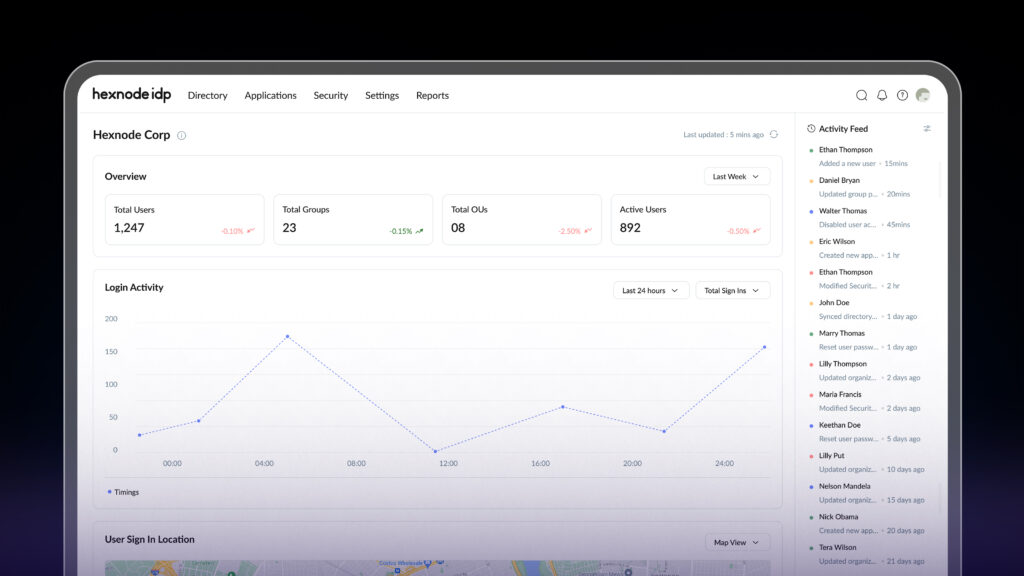
Hexnode IdP provides sign-in and authentication reports, while its Applications dashboard shows provisioning coverage and SCIM synchronization-failure metrics.
Device trust supplies evidence and enforces access outcomes; it does not remediate the underlying endpoint issue. Administrators must still use endpoint management and security controls to restore the device to compliance before access can resume.
FAQs
Can a corporate-owned device still fail a device trust check?
Yes. Device ownership alone does not establish trust; a corporate-owned endpoint may fail if it is compromised, misconfigured, unencrypted, or otherwise non-compliant.
What happens when device posture data is stale or unavailable?
Organizations should define fallback outcomes for unknown, stale, or unavailable posture data before enforcing access policies. Depending on the resource’s sensitivity, the policy may deny access, restrict access, or require additional verification.
Can Hexnode IdP revoke access after a user has already signed in?
Yes. Continuous Zero Trust Enforcement allows Hexnode IdP to reevaluate device posture during the access lifecycle and revoke application access when compliance or risk conditions change.
How does Hexnode IdP use compliance data from Hexnode UEM?
Hexnode IdP uses device information from Hexnode UEM to evaluate whether an endpoint meets organizational access requirements. Through Compliance-Based Access, it can block sign-ins from devices flagged as unenrolled or non-compliant, including rooted, jailbroken, or unencrypted devices.
Does Hexnode IdP fix a device that fails a posture check?
Administrators can use Hexnode UEM to identify failed compliance requirements and apply the relevant remediation, such as deploying required apps or enforcing encryption.
Should every enterprise application require the same device posture checks?
No. Posture requirements should reflect the resource’s sensitivity, device ownership model, workforce context, and the reliability of available telemetry, with stronger assurance applied to higher-risk applications.
Evaluate device-aware access with Hexnode IdP
IAM leaders, IT administrators, and CISOs can request a Hexnode IdP demo to evaluate how the Device Trust Engine applies identity and real-time posture to their applications and access policies. Bring a representative access scenario, target application, and compliance requirement to test how device-aware decisions would operate in your environment.
Secure Access Starts with Device Trust
Connect identity and real-time device posture with Hexnode IdP to enforce smarter access decisions.
I’m a technical content writer at Hexnode who loves simplifying tech. I break down complex ideas, remove the fluff, and help readers clearly understand our product for what it actually is: simple, reliable, and built to solve real problems.