Understanding Workforce Identity vs CIAM is critical for building a secure identity strategy. Workforce identity protects employee access to enterprise resources, while CIAM secures customer authentication for digital services. Organizations need both approaches to reduce risk, improve user experiences, and scale identity management effectively. Solutions like Hexnode IdP help centralize workforce identity management without sacrificing security or productivity.
Identity has become the foundation of enterprise security. As organizations adopt cloud services, remote work models, and digital customer experiences, managing who can access what has become increasingly complex. Yet many organizations still struggle to distinguish between identity solutions designed for employees and those built for customers.
The confusion around Workforce Identity vs CIAM often leads to poor technology decisions, fragmented security controls, and inconsistent user experiences. Employee identities and customer identities operate in fundamentally different environments. They have different security requirements, growth patterns, compliance considerations, and user expectations. Applying the same identity strategy to both groups can create unnecessary risk while increasing administrative overhead.
Organizations need a clear understanding of where workforce identity ends and where Customer Identity and Access Management begins. This distinction helps security leaders select the right tools, implement stronger controls, and build a scalable approach to digital identity management that supports both internal operations and customer-facing services.
Customer Identity and Access Management (CIAM) focuses on managing identities for external users who interact with digital services, applications, and platforms. While workforce identity prioritizes security and governance, CIAM balances security with usability, scalability, and customer engagement.
Organizations implementing CIAM solutions often manage thousands or even millions of user accounts. Unlike employees, customers can register independently, update their profiles, reset passwords, and interact with digital services without direct oversight from IT teams.
A major objective of CIAM is to create frictionless customer authentication experiences. Customers expect fast registration processes, simple login workflows, and consistent access across devices and channels. Every additional authentication barrier can impact customer satisfaction, conversion rates, and retention.
At the same time, organizations must protect customer accounts against fraud, credential theft, and account takeover attacks. This creates a unique challenge where security controls must remain strong without creating unnecessary friction.
Common CIAM Use Cases
CIAM platforms commonly support:
Customer portals
E-commerce websites
Mobile applications
Banking platforms
Subscription services
Digital self-service experiences
Consumer SaaS applications
As digital engagement becomes a competitive differentiator, organizations increasingly view CIAM as both a security capability and a business growth enabler.
What Is Workforce Identity?
Workforce identity refers to the processes, technologies, and policies used to manage employee, contractor, and partner identities across an organization’s systems and applications. Its primary goal is to ensure that authorized personnel can access the resources they need while preventing unauthorized access to sensitive data and business systems.
Unlike customer identities, workforce identities typically exist within a controlled environment. Organizations have visibility into who their employees are, what roles they perform, and what systems they should access. This allows IT and security teams to establish structured identity governance processes that align with business requirements.
Modern workforce identity programs focus heavily on employee access management. Organizations must continuously verify user identities, enforce role-based permissions, and remove access when employees change roles or leave the company. These capabilities help reduce insider threats and limit the damage that compromised accounts can cause.
Workforce identity platforms also play a critical role in supporting compliance initiatives. Regulatory frameworks increasingly require organizations to demonstrate that access controls are enforced consistently and reviewed regularly. Effective identity management provides the visibility and auditability necessary to meet these requirements.
Core Workforce Identity Use Cases
Organizations commonly use workforce identity solutions to:
As enterprises continue to expand their digital ecosystems, workforce identity serves as a critical layer of security that protects both users and corporate resources.
What Is Workforce Identity? A Complete Guide for IT Teams
Learn what workforce identity is and how it secures employee access across modern enterprises.
Workforce Identity vs CIAM: A Side-by-Side Comparison
Although both solutions fall under the broader category of identity management, they address different business requirements.
Factor
Workforce Identity
CIAM
Primary Users
Employees, contractors, partners
Customers and consumers
Objective
Secure internal access
Seamless customer access
Scale
Hundreds to thousands of users
Thousands to millions of users
Authentication Focus
Security and governance
User experience and security
Lifecycle Management
Employee onboarding and offboarding
Customer registration and account management
Compliance Requirements
Internal audits and governance
Privacy and data protection
Access Environment
Enterprise systems
Customer-facing applications
Personalization Needs
Limited
Extensive
The differences extend far beyond user populations. Each identity model requires distinct architecture, operational processes, and security controls.
Five Critical Differences Between Workforce Identity vs CIAM
While workforce identity vs CIAM both manage digital identities, they are designed to solve very different challenges. Understanding their key differences helps organizations choose the right approach for security, scalability, governance, and user experience.
1. User Population and Scale
The most obvious difference lies in the users being managed. Workforce identity solutions serve internal users whose identities are typically verified through HR systems, corporate onboarding processes, or partner agreements.
CIAM environments operate at a completely different scale. Customer populations can grow rapidly and unpredictably, especially during product launches, seasonal spikes, or business expansion initiatives. Identity platforms must support this growth without sacrificing performance or reliability.
This difference significantly influences platform architecture, infrastructure requirements, and identity governance strategies.
2. Security Priorities
Security remains important in both environments, but the priorities differ considerably.
Workforce identity systems focus on protecting enterprise assets. Organizations implement strong authentication controls, access reviews, device trust verification, and least-privilege policies to reduce risk. Security teams often prioritize visibility, control, and governance over convenience.
CIAM solutions must strike a delicate balance. Strong security remains essential, but excessive authentication requirements can frustrate customers and increase abandonment rates. Organizations often rely on adaptive authentication techniques that evaluate risk signals and adjust security requirements dynamically.
This balance between protection and usability is one of the defining characteristics of CIAM.
Workforce identities follow predictable lifecycle events. New employees receive accounts during onboarding, permissions evolve as responsibilities change, and access is revoked when employment ends. Organizations can automate many of these processes using HR-driven workflows.
Customer identities operate differently. Users create accounts independently, update personal information, reset passwords, and manage preferences throughout their relationship with the organization. Businesses have less direct control over these interactions.
These differences require unique approaches to provisioning, access control, and identity governance.
4. User Experience Expectations
Employees and customers have very different expectations regarding authentication.
Employees understand that security measures exist to protect corporate resources. While convenience remains important, users generally accept stronger authentication requirements as part of their daily workflows.
Customers often have less tolerance for friction. Complicated registration processes, excessive authentication steps, and inconsistent login experiences can drive users toward competitors. This makes customer authentication a critical component of the overall customer experience strategy.
Organizations must carefully design authentication workflows that align with user expectations while maintaining appropriate security controls.
5. Compliance and Data Governance
Regulatory requirements affect workforce identity and CIAM differently.
Workforce identity programs often focus on demonstrating access control effectiveness, segregation of duties, and audit readiness. Organizations need detailed visibility into who accessed which systems and when those actions occurred.
CIAM environments place greater emphasis on customer privacy, consent management, and personal data protection. Regulations increasingly require organizations to provide transparency regarding data collection, storage, and usage practices.
These compliance obligations influence everything from identity architecture to operational procedures.
Why Organizations Need Both Workforce Identity and CIAM
Some organizations attempt to manage employees and customers using a single identity framework. While this may appear efficient initially, it often creates long-term challenges.
Employee identities and customer identities have fundamentally different objectives. Combining them into a single framework can result in overly complex policies, inconsistent user experiences, and unnecessary security risks.
A modern digital identity management strategy recognizes these differences and applies specialized controls where appropriate. Workforce identity platforms can focus on governance and secure access, while CIAM solutions optimize customer engagement and authentication experiences.
Separating these functions also improves scalability. Organizations can evolve internal identity programs without disrupting customer-facing services and vice versa.
As businesses continue to digitize operations, maintaining distinct identity strategies becomes increasingly important for both security and operational efficiency.
Key Questions to Ask Before Choosing an Identity Solution
Before selecting an identity platform, organizations should evaluate several critical factors.
Who Are Your Primary Users?
The intended user population should guide identity strategy decisions. Internal users require governance-focused controls, while customer-facing environments prioritize scalability and user experience.
What Are Your Security Requirements?
Organizations should assess risk exposure, compliance obligations, and access control requirements before selecting a solution. Workforce environments often require stronger governance capabilities, while customer-facing platforms must balance protection with convenience.
How Important Is User Experience?
Authentication experiences directly influence productivity and customer satisfaction. Understanding user expectations helps organizations implement controls that support both security and usability goals.
What Scale Must the Platform Support?
Identity platforms must accommodate future growth. Organizations should evaluate current user volumes, anticipated expansion, and evolving business requirements when making technology decisions.
Answering these questions helps organizations identify the identity architecture best suited to their environment.
Featured Resource
Hexnode IdP Use Cases
Explore real-world Hexnode IdP use cases for secure, context-aware identity and access management.
How Hexnode IdP Strengthens Workforce Identity Management
As workforce environments become increasingly distributed, organizations need centralized identity controls that simplify access management while maintaining strong security standards. Traditional authentication approaches often create fragmented user experiences, increase administrative complexity, and leave security gaps that attackers can exploit.
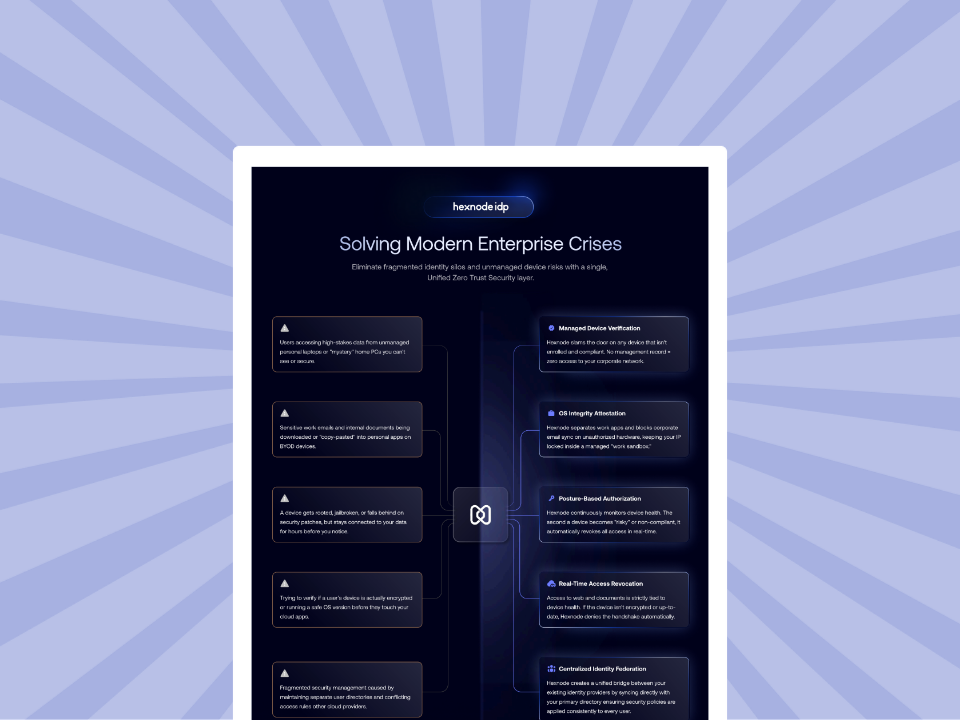
Hexnode IdP helps organizations address these challenges through a unified identity platform designed for modern workforce environments. Hexnode IdP provides secure, policy-controlled access to approved web, mobile, and SaaS applications, with SSO integration for SaaS access. By unifying user identity and device posture, Hexnode IdP helps organizations enforce access rules based on identity, device compliance, and security context.
Hexnode IdP supports stronger access security through conditional access, role-based access control, contextual authentication, session management, activity reports, and SCIM-based lifecycle management. IT teams can access centralized reports covering sign-in logs, provisioning, and authentication history across users and applications, while automating user access changes through SCIM-based lifecycle management.
Hexnode IdP enforces access rules based on user identity, device compliance, and security context, and provides policy-controlled access to approved web, mobile, and SaaS applications.
Hexnode IdP unifies user identity and device posture to secure access across devices and applications with enterprise-grade authentication and identity management.
FAQs
Can CIAM replace workforce identity solutions?
Not effectively. CIAM platforms are designed for customer-facing environments and generally lack the governance capabilities required for workforce identity management.
Why do enterprises need separate identity strategies for employees and customers?
Employees and customers have different security requirements, lifecycle processes, and user expectations. Separate strategies allow organizations to optimize security and user experience for each audience.
Conclusion
The debate around Workforce Identity vs CIAM is not about choosing one over the other. It is about understanding that different user groups require different identity strategies. Workforce identity focuses on securing employees and business resources through governance-driven controls, while CIAM prioritizes scalable and seamless customer authentication experiences.
Organizations that recognize these distinctions can build stronger security programs, improve user experiences, and create a more resilient identity architecture. As identity continues to serve as the foundation of enterprise security, implementing the right solution for the right audience will remain essential for long-term success.
Secure Every Workforce Identity
Strengthen identity security, verify trusted devices, and enforce secure access with Hexnode Identity and UEM.
Content writer at Hexnode. Fueled by good coffee and the occasional cat cuddle, I enjoy crafting content that informs, connects, and resonates. Nothing excites me more than knowing my words have been read, appreciated, and maybe even bookmarked.