How UEM reduces IT costs
Discover 6 other ways UEM cuts operational expenses from automating onboarding to eliminating expensives.

Get fresh insights, pro tips, and thought starters–only the best of posts for you.

In 2026, the Request for Proposal (RFP) has changed.
For the last decade, IT procurement was decided by two people: the CIO (Security) and the CFO (Cost). Today, a third stakeholder has entered the room with veto power: the Chief Sustainability Officer (CSO).
The driver is regulatory, not just ethical. The European Union’s Corporate Sustainability Reporting Directive (CSRD) now mandates that roughly 50,000 large companies (including non-EU firms with significant EU revenue) report on their “Scope 2” emissions – indirect emissions from the electricity purchased and consumed by their operations.
This places your End-User Computing (EUC) fleet under the microscope. Implementing robust Enterprise Power Management for Carbon Reduction is no longer optional – it is a compliance requirement.
Most enterprises have a massive blind spot here. They can tell you exactly how much electricity their data centers consume, but they have zero visibility into the 10,000 laptops sitting in home offices or the 5,000 digital signage kiosks running 24/7 in retail stores.
This guide explains how to move from “Passive Monitoring” to “Active Enforcement” using Hexnode UEM transforms your device fleet from a carbon liability into a measurable ESG asset.
Many IT Admins confuse operational metrics with sustainability metrics.
The gap between those two numbers is Policy.
A Windows laptop left in “High Performance” mode while idling draws roughly 15-25 watts. That same laptop in “Modern Standby” draws <1 watt. Across a fleet of 20,000 devices, that policy difference alone equates to megawatt-hours of wasted electricity annually.
Your “Green Dashboard” shouldn’t just report the battery percentage; it should report the Policy Compliance Rate of your Enterprise Power Management for Carbon Reduction strategies.
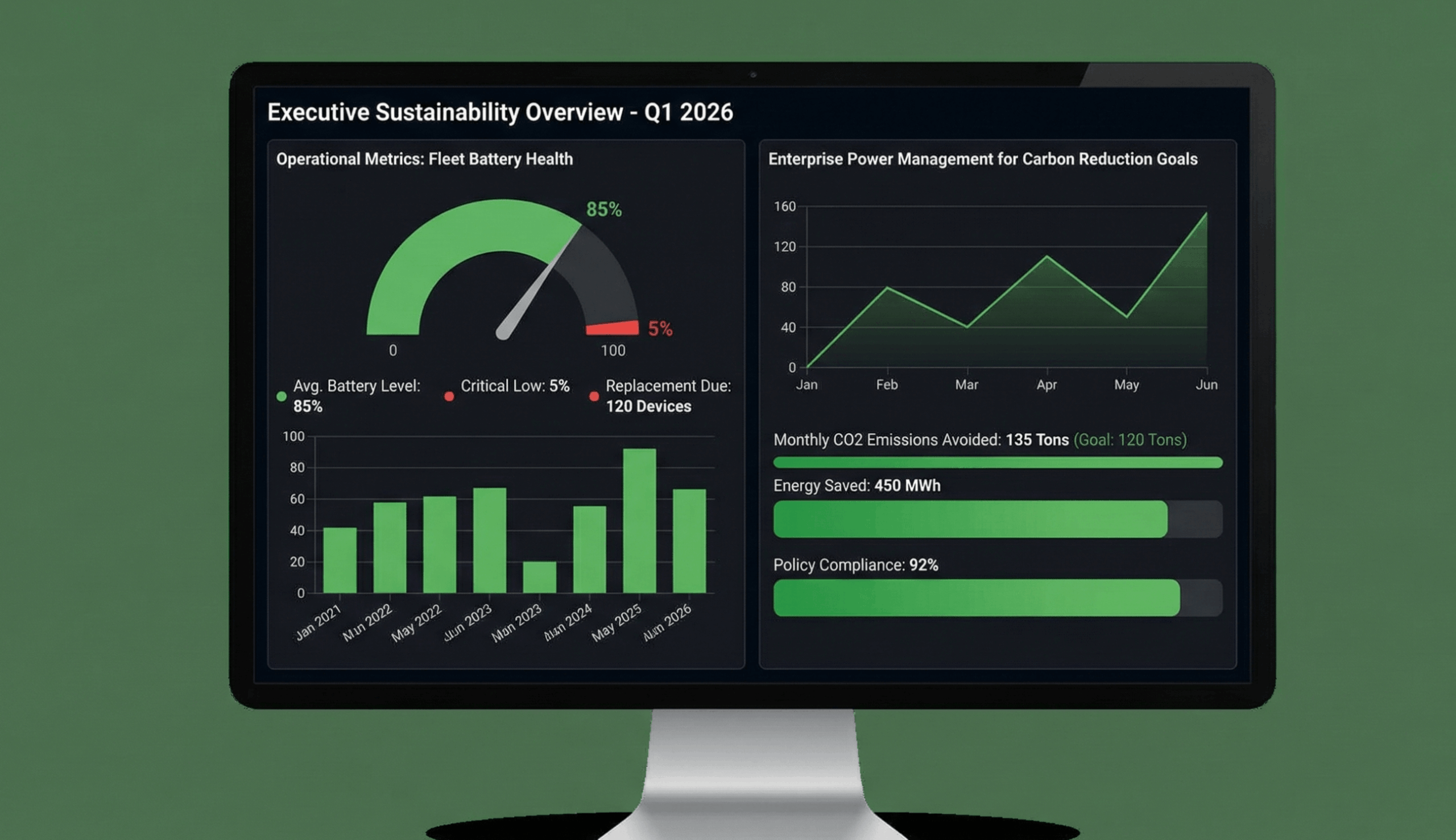
The biggest energy waste in the enterprise is the “Sleep-Disabled” laptop. Users often disable sleep mode to keep Teams “green” or prevent VPN disconnects.
You must forcefully override user behavior with OS-level power policies.
Windows: The Custom Script Configuration
Don’t rely on GPOs that fall off when the device leaves the domain. Use Hexnode’s Remote Scripting engine to push configuration commands that survive off-network.
The Command: Use powercfg to enforce standby.
# Sets monitor timeout to 5 minutes on battery

powercfg /change monitor-timeout-dc 5

# Sets standby timeout to 15 minutes on AC power

powercfg /change standby-timeout-ac 15
The Result: Enforcing S0 Low Power Idle (Modern Standby) allows the device to stay connected to the network (for emails/updates) while dropping power consumption to near-zero.
macOS: The Energy Saver Policy
Hexnode provides a native Energy Saver Configuration payload for Macs.
“A screensaver is not power management. If the CPU is running at 100% while the screen displays flying toasters, you are burning carbon for nostalgia.”
Unattended devices – kiosks, digital signage, POS terminals – are the low-hanging fruit of carbon reduction. A digital menu board running at 3:00 AM in a closed restaurant is pure waste.
Instead of relying on store managers to turn screens off (they won’t), automate it via Hexnode.
Android/Knox: OEMConfig
For Samsung Knox devices, use Hexnode’s OEMConfig profiles to schedule hardware-level power states.
iOS/iPadOS: Single App Mode & Brightness
Since iOS cannot physically “Power Off” via MDM, use Single App Mode brightness control to simulate it.
Turning off a fleet of 1,000 signage displays for 8 hours/night saves approximately 292,000 kWh per year. In terms of ESG reporting, that’s equivalent to removing ~45 cars from the road.
For modern smartphones (iPhone 12+, Galaxy S Series), the screen technology itself dictates energy usage. OLED pixels consume power individually – white pixels use max power, black pixels use zero.
This is a micro-optimization that scales massively.
For a logistics company with 50,000 driver handhelds, this doesn’t just reduce charging cycles (Scope 2 emissions); it extends battery health, delaying the carbon-heavy manufacturing cost of replacing the device (Scope 3 emissions).

You cannot optimize energy usage for devices you don't track. Download this guide to gain 100% visibility over your hardware assets.
Download White paperTo satisfy the Sustainability Officer, you need data that maps to the CSRD or GRI (Global Reporting Initiative) standards.
Hexnode can generate a “Power Policy Compliance” artifact for your annual ESG report using the Reports Tab.
Constructing the Report:
This turns a technical MDM configuration into a board-level sustainability proof point.
Can MDM reduce a company’s carbon footprint?
Yes. By enforcing aggressive power management policies such as Modern Standby, Screen Dimming, and Scheduled Power Off for kiosks – MDM can significantly reduce the electricity consumption (Scope 2 emissions) of the end-user computing fleet. For large enterprises, this can amount to megawatt-hours of saved energy annually.
How do I report IT energy usage for CSRD compliance?
To comply with EU CSRD reporting for IT assets, you must demonstrate “Reasonable Assurance” of your energy efficiency. While MDMs cannot measure wall-socket draw directly, they can provide Compliance Reports proving that 100% of devices are adhering to strict energy-saving configurations (e.g., Sleep after 5 mins), which serves as a proxy for efficiency in ESG audits.
Does Dark Mode actually save energy for enterprise fleets?
On devices with OLED screens (modern iPhones and Androids), yes. Purdue University studies show Dark Mode can save 39-47% of battery power at full brightness. Enforcing Dark Mode via MDM is a valid strategy for extending battery lifecycles and reducing charging frequency for mobile workforces.
The “Green IT” conversation is often dismissed as marketing fluff. But for the Enterprise Architect, it is actually just an efficiency conversation.
A device that wastes energy is a device that is degrading its battery, overheating its CPU, and inviting security risks. By optimizing Enterprise Power Management for Carbon Reduction via Hexnode, you aren’t just saving the polar bears you are saving the budget.
Don’t let the Sustainability Officer veto your RFP. Show them you have the controls to run the leanest fleet in the industry.
Audit your fleet's power settings today. Start your 14-day free trial of Hexnode.
Start Free Trial