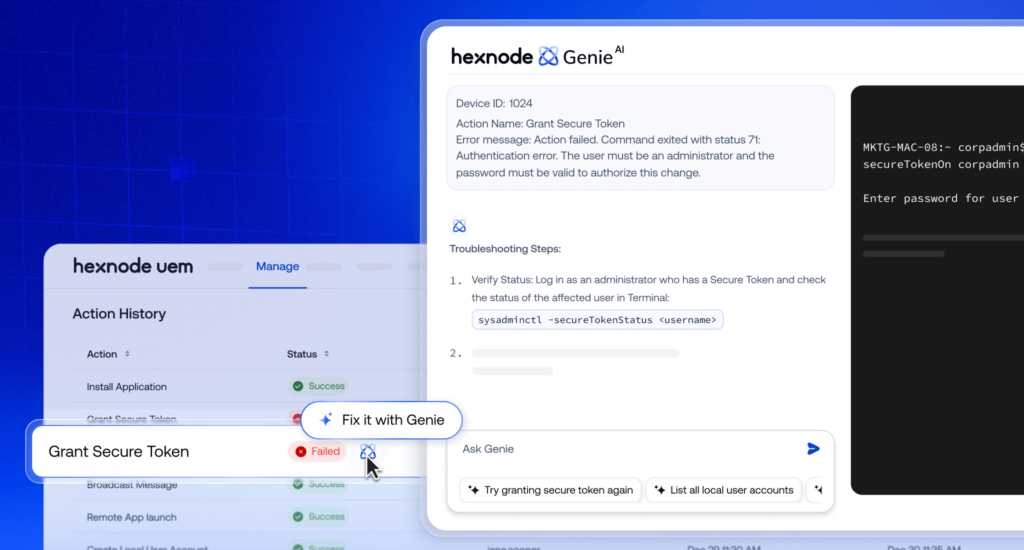
Hexnode launches Genie: AI powered Chat Assistant and Script Generator
Secure your devices & streamline your workflow by simply chatting with your new AI-powered assistant - Hexnode Genie.

Get fresh insights, pro tips, and thought starters–only the best of posts for you.
In the traditional IT Support model, success is measured by how fast you can put out a fire.
A user’s laptop crashes. They call the Helpdesk. A ticket is created. A technician investigates. A script is written. The fix is deployed.
Total time elapsed: 4 Hours.
Productivity lost: Half a day.
This is the “Break/Fix” Loop. It is reactive, expensive, and in an era of distributed workforces, it is unsustainable.
The future of Unified Endpoint Management (UEM) is not about “Managing” devices faster. It is about Autonomous Healing.
Imagine a world where the laptop detects the crash precursor, writes its own remediation script, and fixes itself, before the user even knows something was wrong.
Total time elapsed: 4 Seconds.
Productivity lost: Zero.
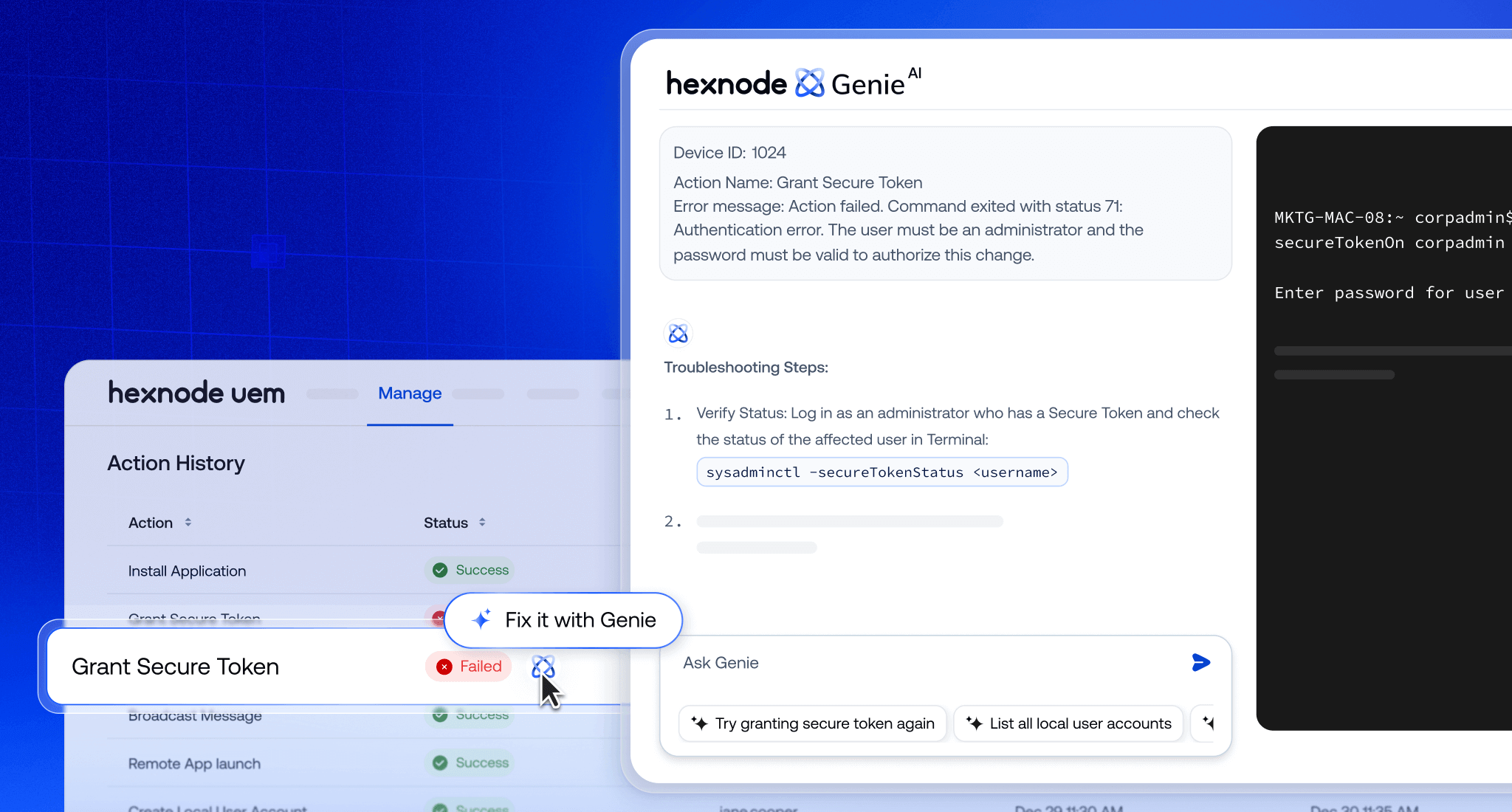
This is the promise of Hexnode Genie. While many know Genie as an intelligent scripting assistant, its true value lies deeper. It is the engine of Agentic AI, artificial intelligence that doesn’t just suggest solutions, but actively accelerates Mean Time to Resolution (MTTR) to near zero.
This guide explores the shift from Reactive to Autonomous IT, and how to leverage Hexnode Genie to build a self-healing enterprise fleet.
To understand where we are going, we must look at the trajectory of our industry.
Hexnode Genie is the bridge to Phase 3.
When we launched Hexnode Genie, the headline was “AI Scripting Assistant.” And yes, if you tell genie to “Write a bash script to block USB drives,” it will generate perfect code in seconds.
In the context of Agentic AI, genie is an accelerator. It removes the single biggest bottleneck in IT operations: The “Research & Develop” Phase.
|
1 |
MTTR = \text{Detection Time} + \text{Analysis Time} + \text{Scripting Time} + \text{Execution Time} |
In a manual world, scripting time is the killer. Writing, syntax-checking, and validating a PowerShell script for a new vulnerability can take hours.
Hexnode Genie reduces Scripting Time to seconds.
This isn’t just convenience; it is operational velocity.
The scenario:
A critical security agent (e.g., CrowdStrike or SentinelOne) hangs on 500 Windows endpoints after a bad OS patch. The devices are technically online, but undefended.
The reactive nightmare:
The Autonomous workflow with genie:
The scenario:
A developer temporarily disables the Firewall to test some code. They forget to turn it back on. The device is now non-compliant.
The reactive nightmare:
The Autonomous workflow with genie:
The scenario:
A zero-day vulnerability is announced in Chrome. There is no official patch yet, but a registry workaround exists.
The reactive nightmare:
The Autonomous workflow with genie:
The fear with “Autonomous AI” is that it will go rogue (like Skynet).
Hexnode advocates for Agentic AI with Guardrails.
Genie generates the intelligence, but the Human provides the authorization.
This model provides the Speed of AI with the Safety of Human Judgment.
Why should the CIO care about a scripting bot? Because it impacts the bottom line.
By deploying self-healing scripts generated by Genie, you prevent Level 1 tickets (printer resets, cache clearing, app restarts).
Stat: A 30% reduction in tickets equals thousands of man-hours saved annually.
Digital Employee Experience (DEX) is a retention metric. Employees hate waiting for IT. When problems are fixed autonomously, employees stay productive and happy.
You cannot scale your IT team linearly with device growth. You need force multipliers. Genie allows a Junior Admin to write Senior-level automation scripts, effectively “up-skilling” your team instantly.
The term “Management” implies supervision. “Orchestration” implies a system that flows.
Hexnode Genie is the conductor of that orchestration. By moving from manual “Break/Fix” cycles to AI-driven “Predict/Prevent” workflows, you transform your IT department from a cost center into a resilience engine.
The question is no longer “How fast can you fix it?”
The question is “Why did it ever break in the first place?”
With Hexnode Genie, the answer is: It didn’t. We fixed it before you knew.
Ready to Automate Your Operations?
Try Hexnode Genie today. Ask it to write your first self-healing script and watch your MTTR drop to zero.
What is the difference between Reactive and Autonomous IT Support?
Reactive IT Support relies on a “Break/Fix” model: something breaks, a user reports it, and IT fixes it. Autonomous IT Support uses AI (like Hexnode Genie) to detect anomalies and execute remediation scripts automatically before the user is even aware of the issue, reducing downtime to near zero.
How does Hexnode Genie reduce Mean Time to Resolution (MTTR)?
Hexnode Genie accelerates MTTR by eliminating the time-consuming “Research and Scripting” phase of troubleshooting. Instead of spending hours writing code, IT admins can prompt Genie to generate precise remediation scripts (PowerShell, Bash, Python) in seconds, allowing for immediate deployment and resolution.
Can AI replace IT administrators?
No. Tools like Hexnode Genie represent “Agentic AI,” designed to act as a force multiplier for IT teams. They handle the repetitive, complex coding tasks, allowing human administrators to focus on strategy, authorization, and “Human-in-the-Loop” decision-making.
Stop chasing tickets and start predicting them. Get 14 days of Hexnode Genie for free!
Signup now!