Hexnode vs Jamf: A Practical Guide for IT Teams
Hexnode and Jamf compared for cross-platform and Apple-first management

Get fresh insights, pro tips, and thought starters–only the best of posts for you.

For the past decade, organizations treated a separate Apple device management platform as mandatory. If you deployed Macs, you invested in a specialist tool and accepted higher licensing costs, fragmented reporting, and additional administrative overhead. That decision once made sense because macOS management required platform-specific expertise and custom workflows. This model reinforced what many now recognize as the Apple Tax in IT.
Today, Apple has standardized macOS management through Declarative Device Management and built identity capabilities, such as Platform SSO macOS, directly into the operating system. The technical barriers that justified a silo no longer exist. Maintaining a separate Apple device management platform now creates avoidable complexity, weakens visibility into hybrid fleet management, and increases operational costs. Organizations need a unified approach that aligns macOS management with the rest of the enterprise environment through a single platform.
Vendors that defend a separate Apple device management platform often rely on one claim: exclusive Day Zero support for new macOS releases. A decade ago, this distinction mattered. Today, it does not. Apple has standardized its management architecture. The perceived advantage of specialist tooling has narrowed significantly.
What Changed
Where Parity Exists
Day Zero support is now a baseline expectation. It does not justify maintaining separate tooling or absorbing the Apple Tax in IT. Organizations managing hybrid fleets need unified control and visibility across platforms, not parallel systems built on identical Apple frameworks.
Consider a 1,000-user enterprise with a 70/30 Windows to Mac split. The cost impact of maintaining a separate Apple device management platform becomes clear when you examine the total cost of ownership.
Windows fleet: Managed in Intune, often bundled with existing licenses.
Mac fleet: Managed in a dedicated Apple platform, typically priced between 7 and 10 dollars per device per month, plus add-ons.
This is where the Apple Tax in IT becomes visible.
Operational impact:
Security teams cannot generate a unified report showing all unencrypted laptops across the organization. IT must extract data from multiple consoles and reconcile it manually. This fragmentation slows audits and increases risk, especially for organizations managing hybrid fleets.
Entire fleet: Managed in a single console with Hexnode.
By integrating one Apple device management platform into a broader UEM strategy, organizations reduce licensing complexity and administrative overhead. The helpdesk does not switch dashboards to reset a password or enforce encryption. Policies apply consistently across macOS and Windows devices, and reporting reflects the full fleet in real time.
A Jamf vs Hexnode cost comparison often focuses on per-device pricing. The larger savings come from eliminating duplicated effort, reducing tool sprawl, and consolidating visibility into one operational layer.
One of the strongest reasons some teams cling to a separate Apple device management platform is identity integration. Many administrators believe that without tools like Jamf Connect, they cannot sync macOS local passwords with identity providers such as Okta or Entra ID. In reality, Apple now provides built-in support for identity integration, and Hexnode UEM can configure it natively without relying on third-party add-ons.
Apple introduced Extensible Single Sign-On (SSO) to improve the login experience for macOS users. Extensible SSO allows devices to use an identity provider for login into apps and services with minimal repeated authentication prompts. Hexnode supports configuring Extensible SSO settings through its policy engine, enabling secure platform authentication without extra tooling.
Before configuring anything in Hexnode, ensure your Identity Provider (Okta) tenant trusts your devices and can issue the necessary tokens. This typically involves registering an application or integration in Okta and generating client credentials for use within your management platform.
In the Hexnode portal:
Some identity brokers require an app or extension to handle token exchange on the device. Add and deploy these as required apps in Hexnode so that every managed macOS device receives them.
Once deployed and devices check in, users authenticate with their identity provider credentials at login. This binds the macOS local account to the enterprise identity system. Users enjoy a seamless sign-on experience across apps and services using their corporate credentials.
This setup removes the need for standalone identity tooling while maintaining secure authentication across macOS devices. It aligns with modern standards and removes another reason organizations feel compelled to maintain separate tooling when managing hybrid fleets with a unified Apple device management platform.
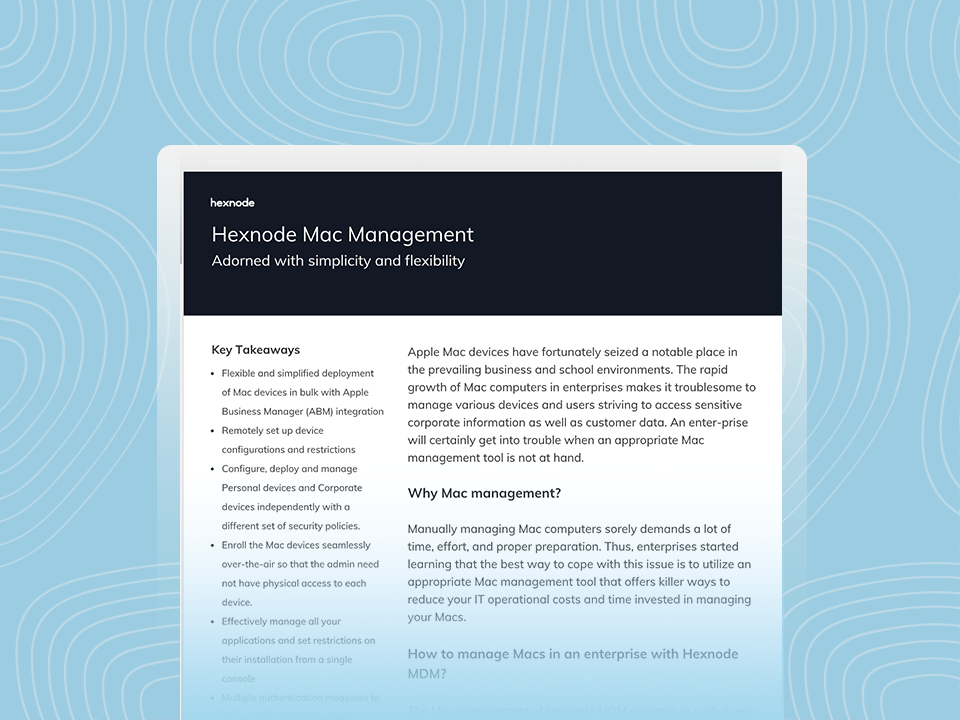
Secure and manage Mac devices end to end with Hexnode’s unified management solution.
Download the datasheetAn isolated Apple device management platform limits enterprise visibility. When macOS reporting lives in a separate console, security and compliance teams cannot evaluate risk across the entire environment in real time.
In siloed environments, answering a simple audit question, such as whether all corporate devices meet encryption or patch compliance standards, requires exporting reports from multiple systems and manually reconciling data. This slows audits and increases operational risk.
Hexnode eliminates that fragmentation by delivering unified reporting across the full endpoint fleet.
Hexnode consolidates compliance, vulnerability, and lifecycle insights into one dashboard.
This visibility becomes powerful when enforcing cross-platform policies. For example, you can configure a geofencing rule that wipes corporate data if any managed device leaves a defined geographic boundary. You define the intent once. Hexnode enforces it using native controls across operating systems without requiring separate configurations.
Unified reporting transforms the Apple device management platform from a standalone system into part of a cohesive enterprise security strategy.
The standalone Apple device management platform model no longer reflects how modern IT operates. Apple has standardized macOS management through Declarative Device Management and built identity controls, such as Platform SSO macOS, directly into the operating system. Organizations can continue absorbing the Apple Tax in IT by maintaining separate tools and fragmented reporting. Or they can modernize their Apple device management platform and consolidate to manage hybrid fleets from a single unified system. Unification reduces cost, simplifies operations, and strengthens compliance. The choice is straightforward.
Start your free Hexnode trial and unify your device management today.
SIGN UP NOWYes. Hexnode supports the full Apple MDM framework, including Automated Device Enrollment, app distribution, and Declarative Device Management. Organizations can manage macOS alongside other endpoints from a single console, eliminating silos and reducing operational complexity.
You can configure Platform SSO macOS using Hexnode’s Extensible SSO policy. By defining the appropriate extension identifiers and deploying the required identity provider configuration, you enable secure authentication through providers such as Okta without relying on separate identity tools.
No. Apple releases management capabilities through a standardized MDM protocol that all vendors access simultaneously. Features such as Declarative Device Management are available across compliant platforms, making Day Zero support a baseline expectation rather than a premium advantage.
Maintaining a separate Apple device management platform increases licensing costs, fragments reporting, and complicates compliance validation. A unified approach strengthens visibility, simplifies governance, and supports organizations that are managing hybrid fleets.