AIOps extends conventional IT automation by analyzing operational data for unfamiliar patterns and conditions, while deterministic workflows remain best for predictable, repeatable endpoint tasks.
Reactive endpoint management drains technician time, prolongs disruption, and can magnify errors when poorly designed automation acts across a device fleet.
Teams should start with one measurable problem, reliable contextual data, controlled recommendations, human approval, and outcome-based validation before expanding AIOps-supported workflows.
Hexnode Automations and Genie support rules-based execution and AI-assisted scripting, with review, testing, staged deployment, and administrator oversight still essential.
Why are endpoint teams still firefighting after automating tasks?
Automation handles predefined tasks well, but it does not eliminate the need to investigate unfamiliar failures. Admins still have to connect scattered signals, determine what changed, and decide which response fits the situation. That distinction is central to AIOps explained for IT: automation can execute known procedures, while some operational problems require additional analysis before the next action is clear.
Consider an application update deployed across employee laptops. The deployment workflow executes as configured, yet the application begins failing on only a subset of devices. The automation itself may have worked correctly. The challenge is identifying what those affected endpoints have in common, such as an application version, device characteristic, or deployment timing, and determining why the failure occurred.
This creates an important operational question: when are better rules, filters, or workflows enough, and when could AI-supported analysis help uncover patterns that predefined logic may not capture?
What does reactive endpoint management cost the business?
Reactive endpoint management consumes technician time while unresolved incidents reduce employee productivity, prolong service interruptions, and delay remediation. The cost grows when teams repeatedly investigate similar symptoms instead of quickly identifying which endpoints need attention.
Excessive notifications can make prioritization harder, especially when relevant evidence is spread across device events, application failures, inventory data, and recent changes. Admins must correlate these signals before deciding whether an incident is isolated or part of a broader pattern.
Automation can also amplify mistakes. An incorrect rule or response applied across a device group can turn one faulty decision into a fleet-wide operational issue.
Teams can measure this impact through technician hours spent investigating, repeat ticket volume, recovery time, remediation success, and endpoint downtime. These metrics establish a practical baseline for determining whether improved rules or more advanced analysis actually reduces operational overhead.
What is AIOps, and how does it work?
AIOps, or artificial intelligence for IT operations, applies AI techniques to operational data to support analysis and IT workflows. It focuses on using AI to understand and respond to operational conditions, not on managing, training, or operating the AI models themselves.
In practice, an AIOps workflow can follow a sequence:
Collect telemetry: Gather relevant logs, events, performance metrics, change records, and other operational signals.
Establish context: Associate those signals with affected devices, applications, configurations, users, or recent changes.
Analyze patterns: Identify anomalies, relationships, or recurring conditions that warrant investigation.
Determine a response: Recommend an action or initiate one where that action is explicitly permitted.
Evaluate the outcome: Check whether the response resolved the condition and use the result to inform further analysis.
However, analytical capability is not the same as execution authority. Detecting an unusual pattern does not automatically justify changing configurations or running remediation across endpoints. The value of AIOps depends on reliable data, sufficient operational context, appropriate permissions, and validation of its findings before consequential actions are taken.
What is the difference between IT automation and AIOps?
Conventional IT automation executes explicitly defined logic, while AIOps adds AI-based analysis that can inform operational decisions and existing workflows. The two are complementary: AIOps can identify a condition that needs attention, while deterministic automation can execute an approved response.
Consider storage monitoring. Traditional automation might trigger an action when free disk space falls below a predefined threshold. An AIOps approach could instead analyze relevant historical behavior and identify unusual storage growth, even before the device crosses that fixed threshold.
Area
IT automation
AIOps
Decision logic
Executes predefined rules, conditions, and actions
Uses AI-based analysis to identify patterns or conditions
Data requirements
Uses inputs required by the defined rule
May analyze broader operational and historical data
Unfamiliar conditions
Requires logic that already accounts for the condition
Can help surface anomalies or relationships not explicitly encoded
Maintenance
Rules and thresholds require review as conditions change
Analytical models and their inputs require validation as environments change
Oversight
Admins define and govern execution logic
Admins must validate findings and control permitted responses
This does not make AIOps a higher stage of automation that every endpoint workflow should reach. Deterministic rules remain appropriate for predictable, repeatable tasks where conditions and responses are already understood.
Likewise, event-driven workflows, complex scripts, and automatic remediation are not inherently AIOps. They can remain conventional automation if execution still depends entirely on predefined logic rather than AI-based operational analysis.
Does an AI-generated script count as AIOps?
No. AI-generated scripts are a form of AI-assisted administration, but script generation alone does not demonstrate AIOps capabilities such as operational anomaly detection, event correlation, or predictive analysis.
Generating a script means using AI to create instructions for a task. AIOps involves analyzing operational data to identify conditions that require attention and inform what should happen next. Similarly, providing a chatbot interface does not prove that a tool analyzes fleet conditions or makes operational decisions.
When evaluating an AI-enabled operations tool, ask: “What operational data does the AI analyze, and how does that analysis change the decision?”
That distinction separates AI that helps administrators create operational tools from AI that analyzes IT operations themselves.
Where can AIOps help endpoint teams?
AIOps can potentially help endpoint teams with anomaly detection, related-event analysis, and investigation support, depending on the telemetry and analytical capabilities available. Its value is strongest where administrators need to identify meaningful patterns across operational data rather than simply execute a known response.
Return to the application-update example. An AI-supported system could analyze failures by application version, device characteristics, and timing. It might surface a relationship between the failures and a particular device cohort. An administrator can then investigate that relationship, verify the cause, and approve an appropriate response.
Other potential applications include:
Performance degradation: Detect behavior that differs significantly from the relevant historical baseline, helping administrators identify endpoints that warrant investigation.
Related incident signals: Group events that share timing, device attributes, application activity, or other relevant characteristics so teams can investigate them together.
These findings should not automatically be treated as proven root causes. A correlation may indicate a probable cause or useful investigative lead, but administrators still need supporting evidence.
The benefits should therefore be measurable: faster investigations, more useful alerts, fewer recurring incidents, or more successful remediation, not simply more AI-generated findings.
How should endpoint teams start implementing AIOps?
Start with one measurable operational problem, prepare reliable data, establish a rules-based baseline, pilot AI-supported analysis, and expand only after validating the results. Treat AIOps adoption as an operational improvement project rather than a technology rollout.
Assign a clear owner, define success criteria upfront, and compare the pilot against existing processes. Expansion should follow demonstrated operational value, not AI adoption itself.
Step 1. Choose one use case and establish a baseline
Start with a narrow, measurable problem, such as recurring application failures after updates. Define the affected device cohort, identify the service owner, and specify the desired outcome before introducing AI-supported analysis.
Next, establish a baseline. Measure investigation time, incident recurrence, and technician effort using the current process. Determine whether simpler improvements could address the problem first. Better event filtering, a revised threshold, or an existing runbook may be sufficient.
AI becomes relevant when the problem requires meaningful pattern recognition or contextual analysis beyond what existing rules can provide. For example, administrators may need to identify relationships across device attributes, application versions, timing, and failure records that are difficult to encode reliably as predefined conditions.
Step 2. Prepare reliable endpoint data and context
Identify the operational data required for the selected use case. This might include device attributes, application versions, event timestamps, failure records, and change history. Map these records to consistent device identifiers so events from the same endpoint can be analyzed together.
Then assess data quality. Missing telemetry, stale inventory records, duplicate events, and intermittent device connectivity can distort the patterns being analyzed. Teams should also define appropriate data retention, access permissions, and data-minimization practices before expanding collection.
Representative baselines require enough historical data to distinguish expected behavior from meaningful deviations. They also require relevant device groupings because normal behavior may differ across hardware, applications, or configurations. There is no universal minimum dataset or training period; requirements depend on the use case, available telemetry, and fleet characteristics.
Step 3. Pilot recommendations with controlled responses
Start in observation or recommendation mode with a limited device cohort. Compare AI-generated findings with administrator investigations and the existing rules-based approach. This helps determine whether the analysis adds useful context before it influences endpoint actions.
Define operational guardrails before connecting recommendations to execution. Specify permitted actions, approval requirements, and least-privilege access. Maintain an audit record linking the supporting evidence, recommendation, administrator approval, and resulting action.
Any response scripts should be tested on representative devices before wider deployment. Use a staged rollout to limit the impact of unexpected behavior. Where the tooling supports it, establish stop conditions and rollback procedures before execution.
Disruptive actions require additional scrutiny. Changes that could interrupt applications, alter configurations, or affect device availability should receive explicit administrator review rather than being triggered solely by an analytical recommendation.
Step 4. Measure outcomes before expanding
Compare the pilot with the original baseline using consistently defined metrics. Track investigation time, useful-alert rate, incident recurrence, and remediation success so changes reflect operational outcomes rather than subjective impressions.
Review where the system performs poorly. Examine false positives, missed incidents, rejected recommendations, and failed actions to identify weaknesses in the data, analysis, or response process. Fewer notifications alone do not prove improvement if important incidents are missed or resolution takes longer.
Performance can also change as applications, operating systems, configurations, and device populations evolve. Reassess the pilot after significant environmental changes. Expand AIOps-supported workflows only when measured improvements justify the continuing costs of integration, validation, maintenance, and human oversight.
How does Hexnode support automation and AI-assisted endpoint operations?
Hexnode supports rules-based endpoint execution through Hexnode UEM Automations and AI-assisted scripting through Hexnode Genie. Automations use Time or Activity Triggers with Target Filters to scope predefined actions. Filters can evaluate device, user, network, and other supported attributes, allowing admins to control which endpoints receive an action.
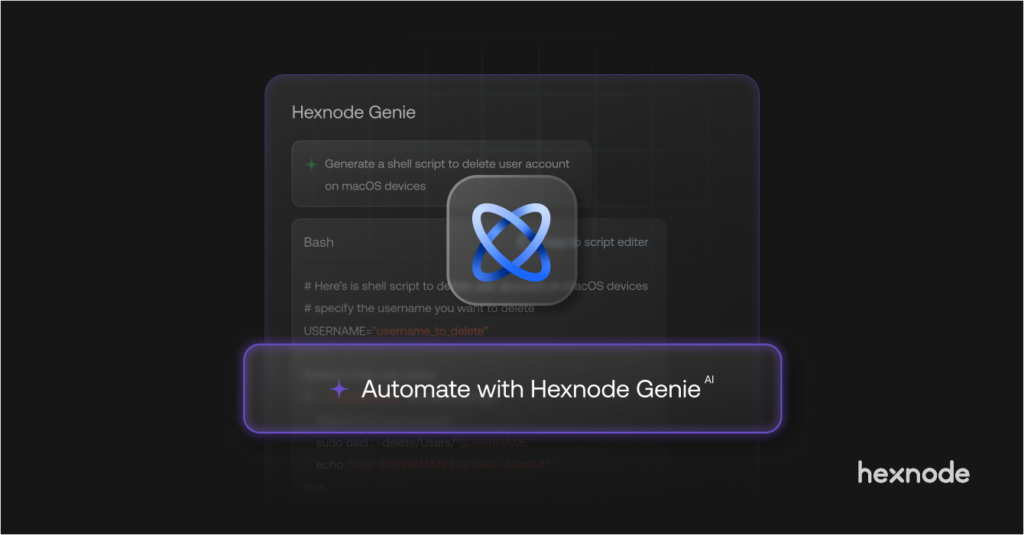
Hexnode Genie provides an AI-powered terminal script generator. Admins describe the required task in natural language, then copy the generated code to the Script Editor for review or modification. The completed script can be saved to the Hexnode Repository.
For example, an admin could ask Genie to prepare a Windows diagnostic script. After reviewing the code, the admin can save it and use Execute Custom Script to run the script on supported Windows endpoints. Hexnode specifically recommends validating scripts on a test device before bulk deployment.
This supports a controlled adoption workflow: define the task, generate or prepare the script, review and test it, then deploy it through an appropriate supported workflow. For recurring script deployments, Hexnode also recommends validating on a small pilot group before wider rollout.
These documented capabilities demonstrate rules-based automation and AI-assisted scripting. They should not, however, be interpreted as evidence of fleet-wide predictive analytics or autonomous root-cause analysis. Human review, testing, and controlled deployment remain important parts of the workflow.
AI Endpoint Security: Moving Beyond Traditional UEM Automation with Context-Aware Endpoint Operations
Explore how AI endpoint security adds context, prioritizes risks, and guides remediation with human oversight.
Ready to improve your endpoint workflows with Hexnode?
Start with one repetitive endpoint task and assess whether Hexnode Automations or Genie-assisted scripting could reduce the manual work involved. Keep the problem and expected outcome clearly defined before changing the workflow.
The broader principle remains simple: use predictable, rules-based automation for known tasks and evaluate AI assistance only where it addresses a specific operational need. This keeps automation purposeful while preserving appropriate administrator oversight.
How can endpoint teams tell whether they need AIOps or better automation rules?
Use conventional automation when the condition and appropriate response are predictable and repeatable. Consider AIOps when resolving the problem requires pattern recognition or contextual analysis across signals that are difficult to encode reliably as predefined rules.
What endpoint data is needed for an AIOps pilot?
The required data depends on the use case but may include device attributes, application versions, timestamps, failure records, and change history. Records should use consistent device identifiers, while missing telemetry, stale inventory, duplicate events, and intermittent connectivity should be addressed before analysis.
Should AIOps recommendations automatically trigger endpoint remediation?
AIOps recommendations should initially operate in observation or recommendation mode rather than directly triggering consequential actions. Teams should define permitted actions, approval requirements, least-privilege access, audit records, stop conditions, and rollback procedures before connecting analysis to execution.
How can IT teams validate whether an AIOps finding is useful?
Compare the finding with administrator investigations and the existing rules-based process. A detected correlation should be treated as an investigative lead until supporting evidence confirms the cause, and value should be measured through outcomes such as investigation time, useful-alert rate, incident recurrence, and remediation success.
Can Hexnode Automations and Hexnode Genie be considered full AIOps capabilities?
Hexnode Automations provides rules-based endpoint execution, while Hexnode Genie assists administrators by generating terminal scripts from natural-language requests. These documented capabilities do not establish fleet-wide predictive analytics, anomaly detection, or autonomous root-cause analysis, so generated scripts still require review, testing, and controlled deployment.
Try Hexnode free for 14 days
Put smarter endpoint workflows into practice with Hexnode automation and AI-assisted scripting.
I’m a technical content writer at Hexnode who loves simplifying tech. I break down complex ideas, remove the fluff, and help readers clearly understand our product for what it actually is: simple, reliable, and built to solve real problems.