AI endpoint management adds an intelligence layer to traditional endpoint operations, helping IT teams interpret telemetry, prioritize risks, and respond faster without removing admin control. Copilots and AI agents support decision-making and orchestration, while endpoint agents, automation, and scripts provide the telemetry, workflow, and execution layers. The strongest model is AI-assisted decision-making with governed execution, where speed improves without weakening security, compliance, or accountability.
AI is becoming a practical layer in endpoint management, not just a vendor talking point. IT teams are already dealing with expanding device fleets, hybrid work, rising security expectations, and pressure to resolve issues faster with leaner teams. AI can help by interpreting endpoint telemetry, identifying risk patterns, recommending remediation, and reducing repetitive operational work. But the terminology around it is often unclear. Copilots, agents, automation, and scripts are frequently grouped, even though they serve different roles in endpoint operations. Some are AI-native, while others are established endpoint management capabilities enhanced by AI. This AI endpoint management glossary breaks down the terms IT leaders need to understand as AI becomes embedded in endpoint operations, including copilots, endpoint agents, AI agents, automation, and scripts.
AI endpoint management is the use of artificial intelligence to improve how organizations monitor, secure, and manage enterprise endpoints. It does not replace traditional endpoint management. Instead, it adds an intelligence layer that helps IT and security teams interpret endpoint data faster, prioritize risks more accurately, and act with greater consistency.
At its core, AI endpoint management brings together endpoint telemetry, policy enforcement, automation, and AI-assisted insights. The endpoints involved may include laptops, desktops, mobile devices, servers, rugged devices, and other managed devices connected to the enterprise environment.
The value of AI lies in its ability to process large volumes of endpoint data and surface what matters. For example, AI can help teams identify unusual device behavior, detect compliance gaps, recommend remediation steps, summarize incident context, or reduce repetitive administrative work.
However, AI should not be treated as unrestricted autonomy. Endpoint decisions often affect business continuity, user productivity, regulatory compliance, and security posture. For that reason, enterprise-grade AI endpoint management should operate within clear admin controls, approval workflows, role-based access, and audit trails.
The goal is not to remove IT oversight. The goal is to give IT teams better context, faster decision support, and safer ways to manage endpoints at scale.
Why does an AI endpoint management glossary matter?
AI terminology in endpoint management is not always used consistently. One vendor may use “agent” to describe software installed on a device, while another may use the same word for an AI system that can reason, plan, and trigger actions. The same issue applies to terms like copilot, automation, and scripts.
That lack of precision creates real evaluation risk. Not every term in an AI endpoint management discussion is AI-native. Copilots and AI agents are directly tied to AI-assisted decision-making, analysis, or orchestration. Endpoint agents, automation, and scripts existed long before AI, but they become part of AI-enabled workflows when they provide telemetry, enforce actions, or execute recommended remediation.
For IT and security leaders, the distinction matters. A recommendation engine is not the same as an execution layer. A script suggested by AI is not the same as a script safely tested, approved, and deployed through governed controls.
Clear terminology helps teams assess:
Security impact: What can the system detect, recommend, or change?
Compliance exposure: Are actions logged and auditable?
Change control: Who approves endpoint-level changes?
Operational accountability: Can teams trace why an action occurred?
The following sections break down each term and explain its role in AI-enabled endpoint management.
Copilots in AI endpoint management
A copilot in AI endpoint management is an AI-assisted interface that helps IT admins and security teams understand endpoint data, ask operational questions, and make better decisions. Its primary role is to support human decision-making, not to act independently by default.
In enterprise environments, this distinction matters. Endpoint actions can affect productivity, compliance, access, and security posture. A copilot should help teams move faster, but it should still operate within defined admin controls, approval workflows, and audit requirements.
What does an endpoint management copilot do?
An endpoint management copilot helps convert complex endpoint data into a usable operational context. Instead of requiring admins to manually move through multiple dashboards, reports, and device records, a copilot can help surface relevant information faster.
A copilot may help teams:
Summarize device health and endpoint security posture.
Answer natural-language questions about managed devices.
Explain why specific endpoints are non-compliant.
Recommend remediation steps based on available telemetry.
Generate reports, ticket notes, or investigation summaries.
Surface high-priority risks from large volumes of endpoint data.
For example, an admin might ask which devices are missing required security controls or why a group of laptops failed compliance checks. The copilot can provide a focused answer with supporting context.
Where copilots add value
Copilots add value by reducing the time required to interpret endpoint data. This can improve incident investigation, reduce dashboard switching, and help teams prioritize the issues that carry the highest operational or security risk.
They can also support less experienced admins by translating raw telemetry into clearer explanations and recommended next steps. That reduces dependency on tribal knowledge and helps standardize response quality.
What copilots should not be confused with
A copilot is not the same as an endpoint agent. The endpoint agent collects telemetry and enables enforcement on the device. The copilot interprets that information and presents it in a usable way.
A copilot is also not always autonomous. High-impact actions, such as wiping a device, changing security policies, or running scripts at scale, should require defined approval controls and clear auditability.
Agents: Endpoint agents vs AI agents
“Agent” is one of the most overloaded terms in endpoint management. In one context, it refers to software installed on a device. In another, it refers to an AI system that can reason through a task and use tools to complete it. For enterprise IT teams, this difference is not semantic. It affects architecture, control, risk, and vendor evaluation.
What is an endpoint agent?
An endpoint agent is software installed on a managed device to collect telemetry, enforce policies, and execute approved actions. It is the operational link between the endpoint management platform and the device.
This data gives IT teams visibility into device state, configuration drift, security posture, and policy adherence. The endpoint agent may also support enforcement actions, such as applying configurations, installing applications, collecting logs, restarting services, or initiating remediation tasks.
In this model, the endpoint agent acts as the data and control layer for endpoint management. Without reliable agent telemetry, AI-assisted insights have limited value because the system lacks accurate endpoint context.
What is an AI agent?
An AI agent is a software system that can reason, plan, use tools, and act toward a defined goal. In endpoint operations, an AI agent may assist with investigation, workflow selection, or supervised execution.
An AI agent could help teams:
Investigate incidents
Identify affected devices
Suggest remediation steps
Trigger approved workflows
Validate whether remediation succeeded
The level of autonomy can vary. Some AI agents only recommend actions. Others may execute tasks after admin approval. More advanced implementations may act within predefined policy boundaries, but that requires strong governance, role-based access, and auditability.
Why the distinction matters
Endpoint agents run on devices. AI agents operate as an intelligence or orchestration layer. Endpoint agents provide telemetry and enforcement. AI agents may interpret that telemetry, recommend next steps, or coordinate approved actions.
Confusing the two can create unrealistic expectations. An endpoint agent does not “think” because AI is mentioned in the platform. An AI agent should not automatically gain unrestricted access to endpoint actions. Clear separation helps teams evaluate capability, define controls, and avoid governance gaps.
Agent-Based Endpoint Management: Pros and Cons
Agent-based endpoint management improves visibility, control, automation, and offline enforcement.
Automation in AI endpoint management
Automation in endpoint management refers to the rule-based or workflow-based execution of tasks that would otherwise require repeated manual effort. It is not automatically AI. Traditional automation follows defined triggers, conditions, and actions. AI becomes relevant when it helps decide which workflows matter, when they should run, or how they should be prioritized.
For enterprise teams, automation is valuable because endpoint environments operate at a scale where manual response is slow, inconsistent, and difficult to audit. The goal is not just speed. The goal is repeatable execution with clear controls.
What endpoint automation does
Endpoint automation helps IT teams standardize routine management and response tasks across distributed device fleets. It can reduce operational load while improving consistency.
Common automation use cases include:
Applying policies to devices based on ownership, role, location, or risk.
Installing required applications during onboarding.
Sending alerts when devices become non-compliant.
Triggering remediation workflows for known issues.
Moving devices into groups based on attributes or risk level.
Initiating actions such as lock, wipe, restart, or quarantine, where supported.
Automation works best when the process is known, repeatable, and tied to clear business or security requirements.
How AI changes automation
AI can make automation more contextual. Instead of treating every event the same way, AI can analyze endpoint signals and help prioritize the workflows that matter most.
For example, AI may identify that a non-compliant device is also showing unusual activity, missing critical controls, and accessing sensitive systems. That context can help teams distinguish routine hygiene issues from higher-risk incidents.
AI can also recommend the most relevant automation based on device state, incident history, policy status, or similar past cases. This helps reduce alert fatigue and prevents teams from applying the same response to every endpoint issue.
Governance considerations
Automation must operate within defined triggers, conditions, and limits. High-impact actions should require approval, especially when they affect access, data, user productivity, or business continuity.
Every workflow should be logged, auditable, and tied to a clear policy rationale. Teams should also validate outcomes after automated actions to confirm that remediation worked and did not introduce new risk.
Scripts in endpoint management
Scripts are specific technical instructions used to perform tasks on managed endpoints. They give IT teams a flexible way to configure devices, collect information, remediate known issues, and enforce operational standards beyond what prebuilt controls may cover.
In enterprise endpoint management, scripts are powerful because they can be precise and highly customizable. That same flexibility also creates risk. A script can resolve a recurring issue across hundreds of devices, but it can also introduce configuration drift or service disruption if deployed without proper validation.
Common use cases for scripts
Scripts are commonly used when IT teams need targeted execution at the device level. Typical use cases include:
Configuring device settings
Restarting services
Collecting logs for troubleshooting or investigation
Removing unwanted files
Installing or uninstalling software
Applying security hardening configurations
Checking for unauthorized applications
Fixing known endpoint issues
Scripts are especially useful when teams need to bridge gaps between policy-based management and environment-specific operational requirements.
How AI relates to scripts
AI can support script-related work, but it does not remove the need for engineering discipline. AI may help generate script drafts, recommend when a script should be used, review scripts for errors or risky commands, or create documentation that explains what a script does.
This can reduce manual effort, especially for repetitive administrative tasks. However, AI-generated or AI-recommended scripts should still go through testing, approval, staged rollout, and execution monitoring before broad deployment.
Script risks to mention
Script risk usually comes from poor control, not from scripting itself. Common risks include:
Incorrect targeting across device groups
Unintended configuration changes
Compatibility issues across operating systems or versions
Lack of rollback options
Poor visibility into execution results
For enterprise teams, scripts should be treated as controlled change mechanisms. They need ownership, versioning, permissions, logs, and a clear recovery path.
How copilots, agents, automation, and scripts work together
Copilots, agents, automation, and scripts should not be viewed as separate capabilities. In an AI-enabled endpoint management workflow, each one plays a distinct role in moving from endpoint visibility to controlled remediation.
A practical workflow may look like this:
The endpoint agent collects telemetry from managed devices, including device health, compliance state, policy status, and security events.
The AI layer analyzes that data to identify risk patterns, configuration gaps, or incident signals.
The copilot explains the issue to the admin in operational terms, including affected devices, possible impact, and recommended next steps.
The admin reviews the recommendation and decides whether to approve, modify, or reject the action.
Automation triggers the approved workflow based on predefined conditions and scope.
A script performs a targeted remediation task, such as collecting logs, restarting a service, removing an unauthorized application, or applying a configuration change.
The endpoint agent reports the execution result back to the platform.
The platform updates the device status, incident record, and audit trail.
This sequence shows why terminology matters. The copilot helps interpret the issue. The endpoint agent provides telemetry and enforces approved actions. An AI agent, when used, may assist with investigation or orchestration. Automation coordinates the workflow. Scripts execute specific technical tasks on the device.
For enterprise teams, the strongest model is not full autonomy by default. It is AI-assisted decision-making with governed execution. That structure gives IT and security teams faster insight while preserving control over endpoint changes, user impact, and compliance accountability.
What should IT teams look for in AI endpoint management tools?
AI endpoint management tools should be evaluated on how well they improve clarity, response speed, and operational control. The presence of AI features is not enough. IT teams need to understand what data the system uses, what actions it can recommend, and how safely those actions can be executed.
The first requirement is the quality of endpoint telemetry. AI-assisted insights depend on accurate signals from managed devices, including device health, compliance status, policy state, app inventory, and security events. Weak telemetry leads to weak recommendations.
IT teams should also assess whether the platform provides clear visibility into endpoint security posture. AI should help teams understand which devices are at risk, why they are exposed, and what action is needed.
Key evaluation criteria include:
Admin approval controls for sensitive or high-impact actions.
Role-based access to limit who can approve, trigger, or modify workflows.
Clear audit logs that show recommendations, approvals, executions, and outcomes.
Policy-aware recommendations that align with existing security and compliance requirements.
Safe automation boundaries for actions such as lock, wipe, restart, or quarantine.
Script testing and execution visibility before broad deployment.
Remediation validation to confirm whether an action resolved the issue.
Integration with existing endpoint workflows, ticketing processes, and security operations.
Scalable device grouping to apply controls by ownership, risk, department, OS, or location.
The right platform should make endpoint operations faster without making them harder to govern. AI should reduce investigation time, highlight priority risks, and recommend next steps, but it should not bypass change control or weaken accountability. For enterprise IT, the goal is AI-assisted action with administrator-controlled execution.
Featured resource
Why Hexnode UEM
Hexnode UEM simplifies device onboarding, management, and security for modern enterprise endpoint environments.
How Hexnode supports the foundation for AI endpoint management
AI-driven endpoint workflows are only as reliable as the management layer beneath them. Before AI can recommend actions, prioritize risks, or support remediation, IT teams need accurate endpoint data, consistent policy enforcement, and controlled execution.
Hexnode provides that foundation through centralized endpoint visibility and management control across diverse device fleets. The Hexnode UEM app acts as the agent app for device-server communication, enabling Hexnode to remotely configure devices, enforce security measures, manage apps, execute remote actions, and display device compliance information.
Hexnode’s capabilities align with the core building blocks of AI-enabled endpoint operations:
Hexnode helps teams assess and improve endpoint security posture through compliance, configuration, update, encryption, and remote action controls.
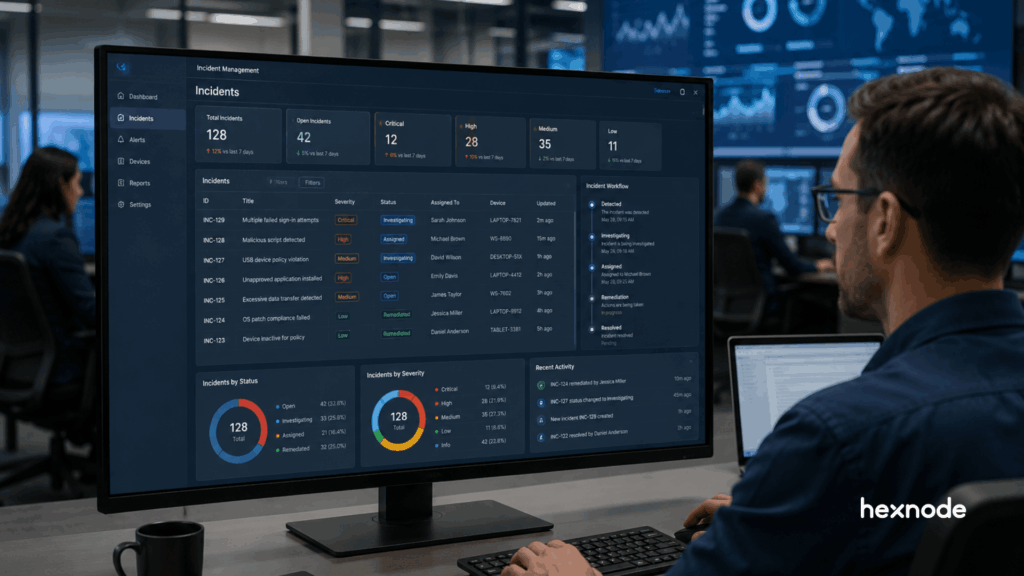
Incidents support threat investigation and issue tracking.
Policies enable consistent security enforcement.
Groups support scalable management through user groups, device groups, custom groups, and dynamic device groups that update membership based on predefined criteria.
Actions provide response control for approved endpoint tasks.
Hexnode Genie AI supports AI-assisted scripting, troubleshooting, device queries, and operational guidance through natural language interactions.
This matters because AI cannot compensate for weak endpoint visibility or uncontrolled execution. AI-supported recommendations need reliable telemetry, governed workflows, and clear administrative oversight.
Hexnode helps IT teams maintain that balance by combining endpoint visibility, policy enforcement, scalable management, remote actions, and Hexnode Genie AI capabilities such as natural language fleet queries, AI-assisted script generation, and troubleshooting support.
Final thoughts
AI endpoint management is not defined by a single feature. It is built on how well intelligence, telemetry, workflow control, and endpoint execution work together. Copilots and AI agents can help IT teams interpret data, prioritize risks, and move faster. Endpoint agents, automation, and scripts provide the operational layer needed to collect signals, enforce policies, and complete approved actions.
The distinction matters because endpoint decisions carry security, compliance, and business impact. AI should improve clarity and response speed, not bypass governance or reduce accountability.
Enterprise IT teams should use AI-assisted decision-making with controlled execution. With centralized visibility, policy enforcement, scalable grouping, response actions, and AI-assisted support through Hexnode Genie AI, Hexnode helps teams build that foundation across managed endpoints.
Build a stronger foundation for AI endpoint management
Manage visibility, policies, automation, scripts, and response actions from a centralized UEM platform.
No. A copilot assists users through explanations, summaries, and recommendations. An AI agent may reason, plan, and act toward a goal, depending on its level of autonomy.
Is an endpoint agent an AI agent?
No. An endpoint agent is installed on a managed device to collect telemetry and enforce actions. An AI agent is an intelligence layer that can interpret information and perform or recommend tasks.
Is automation the same as AI?
No. Automation follows predefined workflows. AI can make automation more context-aware by helping identify patterns, prioritize risks, or recommend actions.
Are scripts still relevant in AI endpoint management?
Yes. Scripts remain useful for targeted endpoint tasks. AI may help generate or recommend scripts, but admins still need testing, approvals, and execution controls.
Can AI endpoint management replace IT admins?
No. AI can reduce repetitive work and improve decision-making, but IT admins still need oversight, policy control, and accountability for endpoint changes.
A storyteller for practical people. Breaks down complicated topics into steps, trade-offs, and clear next actions—without the buzzword fog. Known to replace fluff with facts, sharpen the message, and keep things readable—politely.