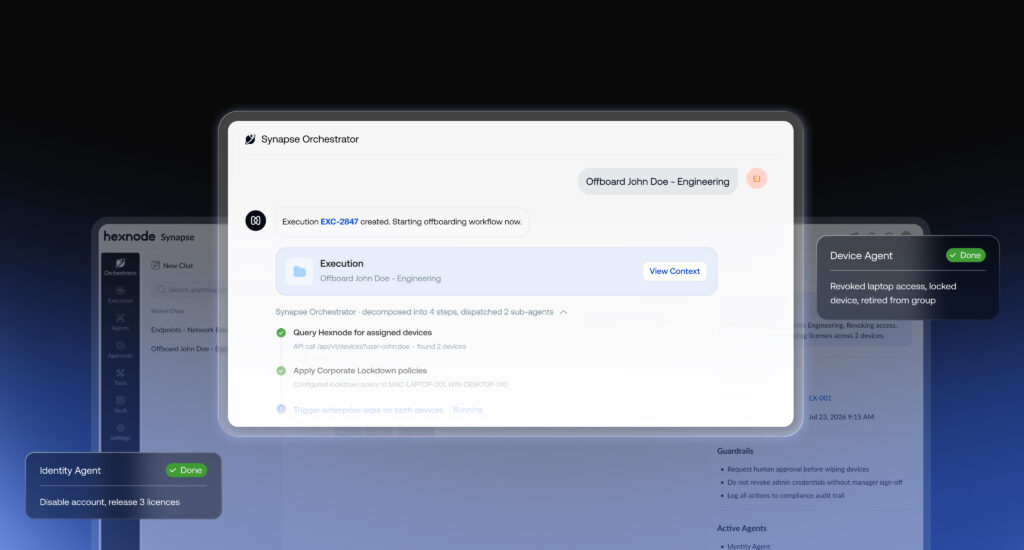
Multi-agent systems coordinate specialized software agents across fragmented IT workflows, reducing manual handoffs while preserving governed execution.
Shared context, orchestration, bounded roles, and authorized tools let agents sequence endpoint, identity, security, service-management, and MSP tasks toward a defined outcome.
Safe adoption starts with narrow, repeatable, reversible workflows using least-privilege access, approval gates, stop controls, rollback procedures, complete execution histories, and named human owners.
Hexnode Synapse’s announced pre-release model coordinates Device, Identity, and Threat Agents with action-level approvals and traceable execution, but availability and pricing remain unconfirmed.
Why do disconnected IT workflows overwhelm operations teams?
Disconnected IT workflows overwhelm operations teams because IT, endpoint, identity, security, and MSP staff must repeatedly transfer information among monitoring, ticketing, access, device management, and security tools. Each handoff interrupts investigation and adds a point where context is delayed or lost.
Isolated automations and single-purpose assistants may complete tasks, but administrators interpret events, decide what happens next, and coordinate work across systems. Consider employee offboarding: an admin may need to disable accounts, revoke application access, lock or wipe the endpoint, and document completion in a ticket. Without shared context and coordinated execution, one request becomes dependent workflows that people must track.
What does fragmented coordination cost the business?
Fragmented coordination costs the business through security exposure, operational delays, and weak accountability. When handoffs stall, alerts remain unresolved, former employees retain excessive access, endpoints drift out of compliance, and containment begins too late. A missed device action can interrupt service, while inconsistent ticket updates leave auditors without complete evidence.
The coordination itself consumes specialist time: staff must chase approvals, reconcile records, and confirm whether teams completed their tasks. Every manual transfer creates an opportunity to overlook a dependency. These risks become harder to govern across distributed environments, where teams work asynchronously, and across MSP operations managing multiple customer tenants.
What are multi-agent systems in IT operations?
A multi-agent system in IT operations uses multiple specialized software agents that share information and coordinate actions toward a defined operational outcome. Instead of relying on one general-purpose assistant, it assigns distinct responsibilities within a managed workflow.
Its key elements include:
Specialized agents that perform bounded roles, such as identity validation or endpoint remediation.
Shared context that gives each agent the relevant operational data.
Authorized tools that let agents inspect systems or execute permitted changes.
Communication and handoff rules that define how tasks, results, and exceptions move between agents.
Human oversight that applies approvals, reviews outcomes, and intervenes when needed.
Here, “multi-agent” describes coordinated roles working toward the same objective. It does not mean several independent chatbots responding to unrelated prompts without shared state or responsibility. The value comes from cooperation within explicit boundaries and a coherent, governed workflow.
Feature Resource
Why Hexnode UEM
Download the brochure to know more about Hexnode's UEM features and why UEM implementation may be the best thing to do right now!
How do multiple AI agents coordinate an IT workflow?
Multiple AI agents coordinate an IT workflow by dividing an operational goal into bounded tasks, exchanging relevant context, and sequencing authorized actions until the outcome is validated and recorded.
A typical workflow starts with a trigger, retrieves context, decomposes the request, and selects the appropriate agents. Those agents hand work across roles, execute actions through approved tools, validate results, and log completion.
An orchestrator commonly maintains workflow state, supplies only relevant context to each agent, resolves dependencies, and routes exceptions to another agent or a human owner. Implementations may distribute these functions differently. In employee onboarding, an HR record can trigger an identity agent to create an account, an access agent to assign approved applications, a device agent to provision an endpoint, and an ITSM agent to update the service request after validation with the final outcome and supporting evidence.
What roles can specialized agents perform in IT operations?
Specialized agents can perform clearly bounded roles across endpoint, identity, security, service management, and MSP operations. Each agent handles a defined part of a workflow and returns its results for coordinated action.
Endpoint agents can collect diagnostic data, identify configuration drift, and apply approved settings or remediation steps.
Identity agents can create, modify, review, or revoke access as users move through the account lifecycle.
Security agents can enrich and triage alerts, correlate evidence, and coordinate approved response actions across tools.
Service-management agents can create, route, update, and close tickets while preserving status, ownership, and completion evidence.
MSP-oriented agents can coordinate repeatable work across properly isolated customer environments without mixing tenant context or permissions.
Specialization helps clarify task ownership and intended responsibilities; enforced permissions limit each agent’s access, while action-level logging provides execution records for accountability. However, every agent still requires explicit permissions, reliable integrations with source systems, defined handoff rules, and escalation paths for missing data, failed actions, conflicting results, or decisions requiring human approval.
Why do shared context and human oversight matter?
Shared context helps agents coordinate from consistent operational information, while human oversight keeps consequential actions accountable and reviewable. Together, they reduce the chance that one agent acts on assumptions another agent has already invalidated.
Without these controls, stale data can trigger inappropriate actions, excessive permissions can expand impact, and conflicting decisions can send a workflow down incompatible paths. Context leakage may expose information across teams or tenants; ambiguous ownership can delay intervention; and one failed handoff can cascade into further execution errors.
Safe coordination therefore requires least-privilege access, explicit approval gates for high-impact changes, and enforced tenant and data boundaries. Teams should also maintain complete execution histories, stop controls, structured exception handling, and named human owners. These controls enable workflow pauses, action tracing, failure correction, and clear responsibility for outcomes.
Where should IT teams apply multi-agent systems first?
IT teams should first apply multi-agent systems to narrow, repeatable workflows with frequent cross-system handoffs and limited consequences if execution fails. A candidate should have clear inputs and outcomes, reliable source data, stable APIs, and an impact that teams can contain or reverse.
Evaluate starting points by coordination complexity and operational risk:
Ticket routing and alert enrichment offer structured inputs and easily reviewed outputs.
Access requests and employee onboarding cross more systems but usually follow defined policies and approval paths.
Endpoint compliance remediation suits repeatable corrections when detection data is trustworthy and rollback is available.
Routine MSP service workflows can provide repeatable scope but require strict tenant separation and customer-specific controls.
Choose one narrow pilot rather than automating an entire operational process. Before deployment, define a named owner, the workflow scope, each agent’s permissions, approval points, the expected output, and the exception path. Document a rollback procedure and criteria for pausing execution. This creates a controlled test of coordination quality while keeping failures observable and recoverable during early deployment.
Hexnode Synapse different from Hexnode Genie?
Compare Hexnode Genie’s endpoint assistance with Synapse’s approach to IT and security orchestration.
How can IT teams implement a multi-agent workflow safely?
IT teams can implement a multi-agent workflow safely by limiting its initial scope, controlling every action, and expanding authority only after evidence shows reliable performance.
Map the current workflow, including triggers, handoffs, dependencies, outputs, and failure points.
Define each agent’s responsibility, boundaries, expected inputs, and escalation conditions.
Validate context sources, data freshness, system integrations, and API behavior.
Assign least-privilege permissions and separate access by role, system, data, and tenant.
Establish approval gates, stop controls, recovery procedures, rollback steps, and named human owners.
Test normal paths, edge cases, partial failures, conflicting results, and unavailable systems before production use.
Begin in recommendation-only mode so humans assess proposed actions. Move next to approval-based execution, then allow limited autonomy only for proven, low-risk actions. Before expanding scope, monitor completion rate, failed actions, human overrides, approval delays, correction effort, security events, and business outcomes. Review trends together: technical success is insufficient if the workflow increases risk, workload, or service disruption for affected users and customers.
FAQs
What is the difference between a multi-agent system and a single AI assistant in IT operations?
A single AI assistant can use tools to complete multistep workflows, while a multi-agent system distributes responsibilities among multiple agents that coordinate toward an operational outcome. The agents share relevant context, coordinate dependencies, and transfer results through an orchestrated workflow.
Which IT workflows are best suited for an initial multi-agent pilot?
The strongest candidates are narrow, repeatable workflows with clear inputs, stable integrations, frequent cross-system handoffs, and recoverable failures. Ticket routing, alert enrichment, access requests, and controlled endpoint compliance remediation are practical starting points.
How should a multi-agent workflow handle partial failures?
The workflow should detect the failed action, pause dependent steps, preserve execution history, and route the exception to a designated agent or human owner. Defined stop controls, recovery procedures, and rollback steps help prevent one failed handoff from triggering further errors.
When should IT teams allow multi-agent systems to act autonomously?
Teams should begin in recommendation-only mode, progress to approval-based execution, and grant limited autonomy only to proven, low-risk actions. Expansion should depend on evidence such as reliable completion rates, manageable correction effort, few human overrides, and acceptable security and business outcomes.
How can organizations evaluate the accountability of a multi-agent system?
Organizations should verify that every workflow has named owners, explicit permissions, approval gates, and a complete record of triggers, decisions, approvals, and executed actions. They should also monitor failed actions, overrides, approval delays, security events, and the impact on users and services.
Is Hexnode Synapse currently available for production deployment?
As of October 2026, Hexnode Synapse remains a pre-release product, with an invite-only trial announced for later in the year. General availability and pricing have not been confirmed, so its endpoint, identity, and threat-agent capabilities should be evaluated as announced product direction.
Explore governed multi-agent orchestration with Hexnode Synapse
Coordinating endpoint, identity, and security tasks through governed multi-agent orchestration can reduce manual handoffs while preserving human approval, execution visibility, and operational accountability. IT Directors, endpoint administrators, security leaders, IAM teams, and MSP decision-makers can assess where cross-system workflows need clearer coordination and control. Join the Hexnode Synapse waitlist to receive product updates and information about the announced invite-only trial.
Explore governed IT orchestration with Hexnode Synapse
Join the waitlist for Hexnode Synapse product updates and information about the announced invite-only trial.
I’m a technical content writer at Hexnode who loves simplifying tech. I break down complex ideas, remove the fluff, and help readers clearly understand our product for what it actually is: simple, reliable, and built to solve real problems.