Why Are IT Teams Weighing Autonomous IT vs AI-Assisted IT?
IT teams are weighing autonomous IT vs AI-assisted IT because routine work spans multiple tools and still requires people to connect each step.
Consider employee onboarding. IT must coordinate HR records, identity provisioning, device configuration, application access, and security policies. Each system handles part of the process, while administrators manage dependencies and resolve exceptions. Consequently, manual handoffs can delay delivery and make actions harder to trace across systems.
Both approaches can reduce manual coordination, but they delegate different levels of decision-making and execution authority. The challenge is deciding which tasks need human judgment and which can operate within defined limits.
What Is the Difference Between Autonomous IT and AI-Assisted IT?
AI-assisted IT uses AI to analyze information and recommend actions, while humans typically retain responsibility for key decisions. Depending on workflow design, selected actions may execute automatically under predefined permissions and approval requirements. Autonomous IT allows AI agents to decide and execute routine tasks within defined limits. Sensitive or uncertain actions can be escalated to humans.
Gartner recommends that infrastructure and operations leaders pursue governed autonomy. Runtime guardrails and operational governance support this transition.
The distinction spans three dimensions:
Decision-making: AI-assisted systems recommend options; autonomous systems select actions within their authorized scope.
Execution: AI-assisted systems help people perform tasks; autonomous systems execute permitted actions directly.
Human oversight: AI-assisted workflows typically involve people at each decision point; autonomous workflows reserve intervention for approvals, exceptions, or higher-risk actions.
However, these approaches form a spectrum rather than a binary choice. Teams can automate low-risk tasks while requiring human approval for privileged access changes or disruptive remediation.
Rule-based automation executes predefined rules and workflows. AI agents can combine these mechanisms with contextual reasoning to select and adjust actions toward a goal.
This distinction also shapes AI orchestration for IT operations, which coordinates agents, tools, and workflows under defined governance controls.
What Is AI-Assisted IT?
AI-assisted IT helps administrators interpret operational data and prepare responses without automatically delegating every decision.
Ticket summarization: AI condenses incident details, previous actions, and relevant context to support faster triage.
Root-cause suggestions: AI analyzes available logs and telemetry to suggest likely causes of an outage or endpoint issue.
Script or policy drafting: AI generates a proposed remediation script or configuration policy for an administrator to review and run.
Human oversight has a trade-off. Administrators may still need to validate recommendations, approve changes, or initiate execution. At scale, manual review can become a bottleneck, especially when workflows span multiple systems or approval routing lacks efficiency.
Featured resource
Explore AI-Powered IT Assistance
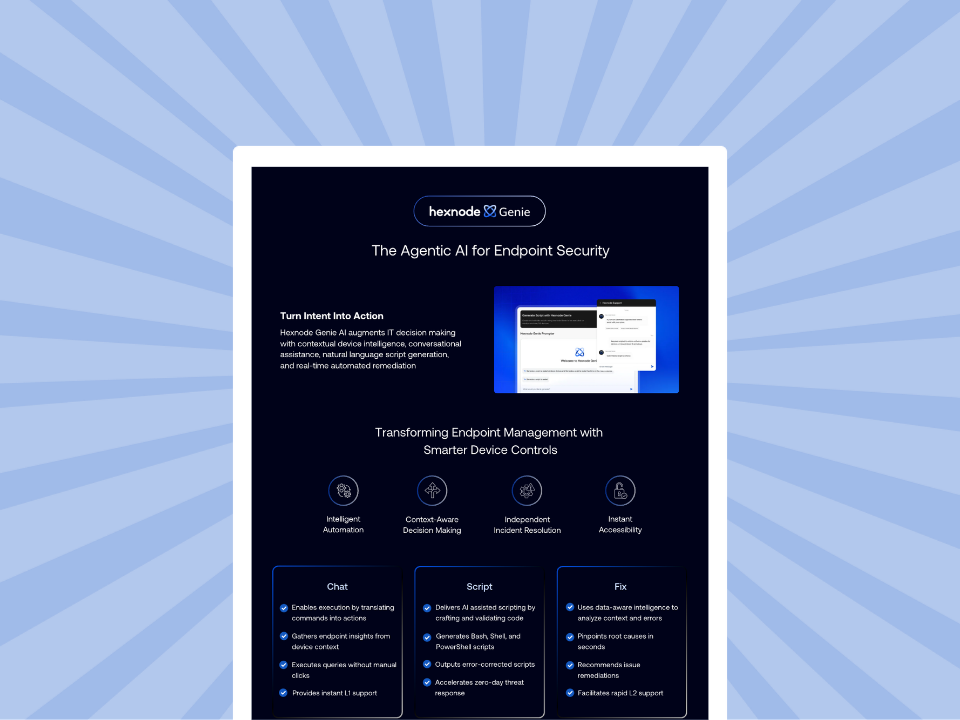
See how Hexnode Genie uses AI-powered assistance, contextual device intelligence, natural-language script generation, and automated remediation to support endpoint operations.
Autonomous IT uses AI agents to interpret requests, select appropriate actions, and execute tasks without waiting for human intervention at every step. Unlike AI-assisted IT, this approach delegates limited decision-making and execution authority to AI systems.
Examples of bounded autonomous IT tasks include:
Compliance drift remediation: Detect a configuration that violates policy and restore an approved setting within predefined limits.
Standard access requests: Process routine requests against established eligibility rules, escalating exceptions for human approval.
Alert triage: Classify incoming alerts, gather relevant context, and route incidents according to defined response criteria.
However, autonomy applies only within a defined operational scope. It does not authorize agents to perform every task or bypass established access controls.
Guardrails are the permissions, policies, action limits, and approval requirements that constrain agent behavior. They define what an agent can do independently and when it must escalate to a human.
When choosing a first AI workflow, teams should consider task boundaries, potential consequences, and how administrators will verify outcomes. The next step is determining which guardrails and approval gates each workflow requires.
How Do Guardrails and Approvals Keep Autonomous IT Safe?
Guardrails and approval gates constrain agent authority, while monitoring and escalation help manage failures and exceptions.
Guardrails: Admin-defined permissions, policies, and action limits control which tasks an agent can execute independently.
Approval gates: Human reviewers authorize sensitive actions, such as wiping a device or changing privileged access, before execution.
Audit log: Execution records capture what triggered a workflow, which decisions the agent made, what actions ran, and their outcomes.
The NIST AI Risk Management Framework (AI RMF 1.0) provides voluntary guidance for managing AI risks through four functions: Govern, Map, Measure, and Manage. NIST has announced plans to revise the framework, so check its official page for the latest revision status.
Additionally, “if the system is unsure, escalate” should be a design requirement. When an agent encounters ambiguous instructions, insufficient evidence, or an action outside its permissions, it should pause and request human review rather than improvise.
Autonomous IT vs AI-Assisted IT: Side-by-Side Comparison
Autonomous IT and AI-assisted IT differ in decision-making authority, execution, and human oversight, although both approaches can combine automation with human approval.
Comparison dimension
AI-assisted IT
Autonomous IT
Who decides
Humans typically evaluate recommendations and retain responsibility for key decisions
AI agents select actions within defined limits, subject to approval requirements
Who executes
Humans execute most actions; selected steps may run automatically
Agents execute authorized actions within defined limits
Human oversight model
Human review at defined decision points; selected steps may run automatically
Autonomous execution within defined limits, with approval gates or escalation where required
Speed at scale
Depends on human availability and review effort
Can reduce handoffs for repeatable tasks, depending on integrations, safeguards, and exception handling
Alert triage, routine remediation, standard requests
Main risk
Human bottlenecks and delayed execution
Incorrect or unauthorized autonomous actions
Audit needs
Record recommendations, approvals, and actions
Record triggers, decisions, execution, and outcomes
Best starting point
Judgment-heavy or sensitive workflows
Predictable tasks with clear rules and rollback paths
Both approaches can complement each other. Teams can use AI assistance for complex investigations while delegating suitable, repeatable tasks to governed autonomous workflows. The appropriate balance depends on operational risk, readiness, available evidence, and approval controls.
How Do You Choose Between Them for Each Task?
Choose between autonomous IT and AI-assisted IT for each task, not for the entire organization. Evaluate five criteria before assigning an execution tier:
Reversibility: Can the system undo the action if something goes wrong?
Blast radius: How many users, devices, or services could the action affect?
Data sensitivity: Does the task expose confidential information or privileged credentials?
Repeatability: Does the task follow stable rules with predictable outcomes?
Compliance requirements: Does policy require documented approval or controlled change management?
Use three tiers to classify tasks. The NIST SP 800-53 Rev. 5, CM-3 control provides guidance on reviewing, approving, and documenting configuration changes.
IT task
Illustrative tier
Restart a failed, noncritical service
Autonomous
Remediate known configuration drift
Autonomous
Apply a routine access request
Autonomous with approval
Revoke privileged access
Autonomous with approval
Wipe a device or change production security controls
Assisted only
These classifications are starting points, not universal rules. Adjust them to your risk appetite, regulatory obligations, and available safeguards. As confidence, logging, and verified results improve, reassess whether specific tasks can move between tiers. This approach also supports a gradual transition toward autonomous endpoint management.
How Does Hexnode Synapse Combine Autonomous Action with Human Approval?
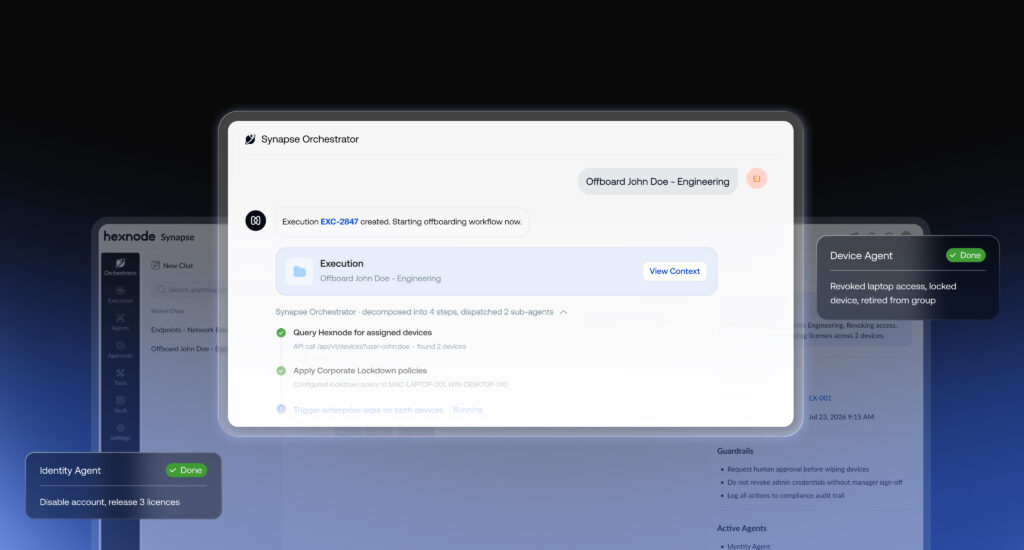
Hexnode Synapse is an agentic AI orchestration layer for IT and security operations. It coordinates routine work autonomously within admin-defined guardrails and routes sensitive actions to named approvers.
Hexnode Synapse brings together three specialist agents:
Device Agent: Handles root-cause diagnostics, compliance-drift remediation, patch and vulnerability remediation, and device provisioning through Hexnode UEM.
Identity Agent: Coordinates access requests, identity lifecycle operations, role changes, and account tasks through Hexnode IdP.
Threat Agent: Supports alert triage, threat investigation, and containment through Hexnode XDR.
Governance determines which actions proceed independently. Work within approved guardrails proceeds autonomously. However, actions such as device wipes, endpoint isolation, and privileged access changes require approval from a named person.
The Execution Centre records what triggered a request, what the agent decided, who approved it, and what ran. Administrators can browse and export execution histories for traceability.
How to Introduce AI Agents into IT Operations With Human Oversight
Learn how IT teams can define agent permissions, approval checkpoints, and expand autonomy through controlled pilots.
FAQs
Can autonomous IT work without replacing existing automation tools?
Autonomous IT can complement existing rule-based automation rather than replace it. AI agents can interpret context and select actions, while established scripts continue handling predictable, predefined tasks.
How should organizations measure whether autonomous IT is working effectively?
Organizations should track execution outcomes, policy compliance, failed actions, escalation frequency, and audit-record completeness. Reviewing these measures helps teams identify weaknesses before expanding autonomous permissions to additional workflows.
Can autonomous IT coordinate actions across identity, endpoint, and security systems?
Yes, an AI orchestration layer can coordinate workflows across identity, endpoint management, and security tools. Each workflow should define system permissions, approval requirements, and execution logging before agents act across systems.
How should teams expand autonomous permissions after an initial rollout?
Teams should review execution results, failures, policy compliance, and escalation records before expanding an agent’s permissions. Increase autonomy incrementally for suitable tasks, while retaining approval gates and safeguards for consequential actions.
Find the Right Balance Between Autonomous IT and AI-Assisted IT
Choosing between autonomous IT vs AI-assisted IT starts with task risk, repeatability, and the level of human oversight required. AI assistance supports complex investigations, while governed autonomy can handle suitable routine tasks.
Start with predictable workflows, define approval boundaries, and review execution results before expanding autonomous permissions. This approach helps IT teams reduce manual handoffs without transferring more authority than each workflow warrants.
Explore Governed AI Orchestration With Hexnode Synapse
Explore how Hexnode Synapse coordinates workflows across endpoint management, identity, and security operations, with controls for human oversight.
I write at the intersection of technology, process, and people, focusing on explaining complex products with clarity. I break down tools, systems, and workflows without any noise, jargon, or the hype.