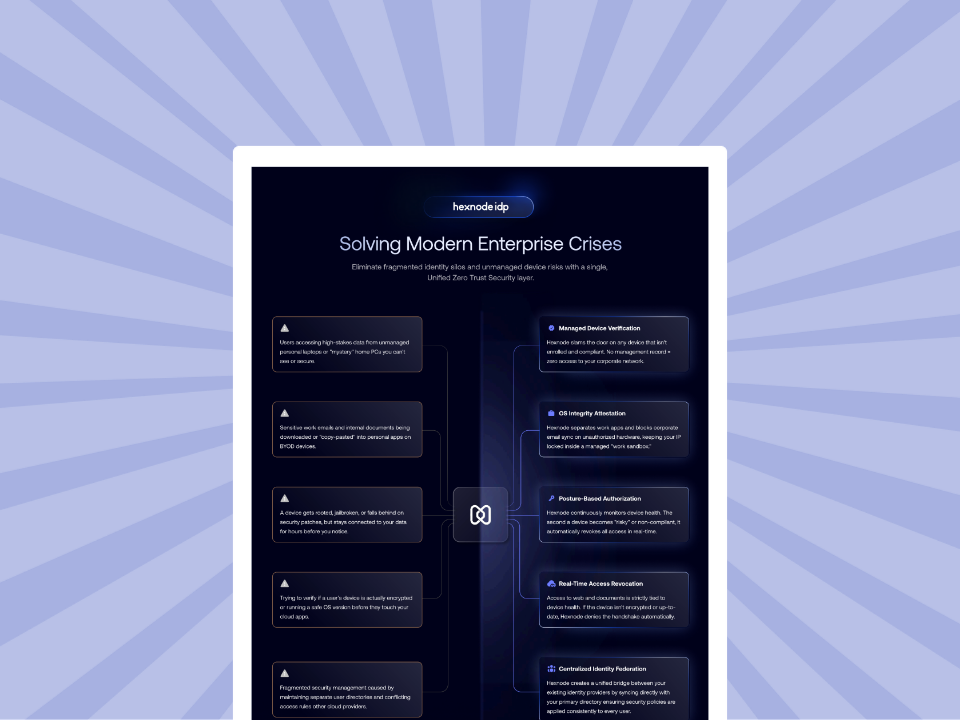
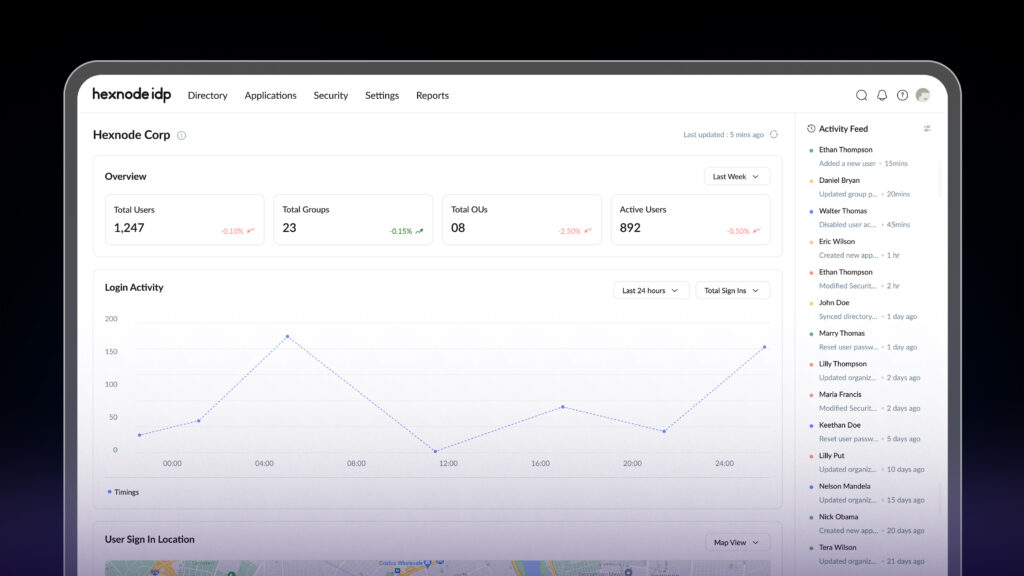
Hexnode IdP brings identity, device context, authentication, authorization, lifecycle management, and reporting together to support coordinated enterprise access management.
Conditional Access, Verified BYOD Access, RBAC, Contextual Authentication, and Session Management help govern access across users, devices, applications, and sessions.
Federated Identity and SCIM-based provisioning support integration with existing identity environments and user lifecycle automation.
Enterprises should validate these controls through requirements mapping, high-risk scenario pilots, Activity Reports, and recurring access reviews before broader deployment.
Why Do Enterprises Struggle to Manage Application Access?
Enterprise application access becomes difficult to manage when identities, applications, devices and permissions operate across disconnected systems. IT teams then have to reconcile inconsistent access policies, manual account changes and fragmented visibility across SaaS applications.
This fragmentation can leave users with excessive privileges, make it harder to verify whether devices meet security requirements and create gaps between identity decisions and application access. As application portfolios expand, maintaining consistent controls across every user, device and resource becomes increasingly difficult.
Hexnode IdP access management provides an option for bringing these controls closer together. Hexnode IdP supports application assignments for users and groups, alongside conditional access based on factors such as user identity, device compliance and security context.
What Are the Costs of Fragmented Access Management?
Fragmented access management increases the likelihood of unauthorized access, orphaned accounts, permission creep and slower incident investigation. When access information is distributed across separate applications and administrative systems, IT and security teams have less consistent control over who can access what.
Manual onboarding, role changes and offboarding compound the problem. Administrators must update access across multiple systems, increasing operational workload and creating opportunities for obsolete permissions to remain active longer than necessary.
Inconsistent enforcement also affects governance. Excessive or outdated access can increase the risk of data exposure, while fragmented records make compliance verification and audits more complex. Employees may also face inconsistent login and access experiences when controls differ between applications. A coordinated access-management approach helps IT apply permissions more consistently while reducing the administrative overhead associated with managing application access individually.
Featured Resource
Hexnode IdP use cases
Explore Hexnode IdP use cases for secure identity management, access control, and device-aware authentication.
What Does Hexnode IdP Offer for Enterprise Access Management?
Hexnode IdP combines identity-based authorization, device-aware conditional access, authentication controls, lifecycle automation and access reporting within a centralized identity framework. It supports user and group application assignments, conditional policies based on identity and device context, SCIM-based provisioning, MFA, session controls and detailed authentication reporting.
Effective enterprise access management must determine who receives access, which devices can connect, what conditions must be satisfied and how long access remains valid. Decision-makers should therefore evaluate Hexnode IdP’s application assignments, conditional access, contextual authentication, session management, lifecycle provisioning and activity reporting as interconnected access controls.
How Should Enterprises Evaluate and Deploy Hexnode IdP?
Enterprises should document requirements, assess access controls, plan integrations, run a controlled pilot and review the results before broader deployment. Start with sensitive applications, privileged users and access scenarios that carry the greatest risk.
Evaluate each documented Hexnode IdP capability against the organization’s existing identity architecture, device estate and operational workflows. This helps confirm that policies, integrations and lifecycle processes behave as required before enforcement expands.
Step 1: Define Access Management Requirements
Begin by inventorying the organization’s existing identity providers, user groups, device types and approved enterprise applications. This establishes where Hexnode IdP must integrate and which access decisions need centralized control.
Separate mandatory security and operational requirements from optional capabilities. Also record dependencies involving specific identity providers, applications, authentication protocols or device-management workflows. This requirements baseline gives administrators measurable criteria for evaluating the deployment rather than assessing features in isolation.
When to Use an Identity Provider: A Practical Guide for IT Teams
Learn when to use an identity provider to simplify authentication and secure enterprise access.
Step 2: Map Hexnode IdP Controls to Priority Risks
Map individual Hexnode IdP controls to the access risks identified during the requirements assessment.
Use Conditional Access to enforce access rules using identity, device compliance and security context. Verified BYOD Access can address scenarios where corporate resources should only be accessible from verified personal devices.
Apply Role-Based Access Control to align permissions with defined roles or functions. Use Contextual Authentication for two-factor step-up authentication during higher-risk actions, while Session Management can limit exposure from unattended sessions through inactivity policies.
Finally, map Application Access requirements across the organization’s approved web, mobile and SaaS application estate.
Step 3: Plan Federation and Lifecycle Automation
Determine how Federated Identity will fit into the existing identity architecture. Hexnode IdP documents integration with existing identity providers such as Microsoft Entra ID and Google Workspace, allowing organizations to account for established identity environments when planning deployment.
Next, identify lifecycle events that should use SCIM-based user lifecycle automation. Hexnode IdP supports SCIM provisioning operations such as creating, updating and deactivating users, with available actions configured for the target application.
During evaluation, verify the exact behavior supported by each integration. Do not assume undocumented attribute mappings, provisioning directions, synchronization behavior or connector options based on how another identity platform operates.
Step 4: Pilot High-Risk Access Scenarios
Run the pilot against access conditions that are most likely to expose policy gaps. Test authentication using compliant, non-compliant, managed, personal and unverified devices where those states apply to the organization’s environment.
Validate whether role-based permissions grant the expected level of access. Test two-factor step-up authentication for higher-risk actions and confirm that inactivity-based session policies terminate or restrict sessions as configured. Hexnode documents both contextual two-factor authentication and session inactivity controls.
Before expanding deployment, confirm that legitimate access, denied access and approved exception scenarios all produce the expected policy outcome.
Step 5: Monitor Activity and Refine Policies
Use Activity Reports during and after the pilot to review sign-in logs, provisioning activity and authentication history across users and applications. Hexnode IdP also provides visibility into failed sign-ins, failed MFA verification and recent authentication activity.
Investigate unexpected access denials, authentication failures and user-access changes before extending enforcement to additional users or applications. These findings can reveal overly restrictive policies, missing assignments or integration issues.
Schedule recurring reviews of roles, application assignments, session policies and lifecycle workflows so access controls continue to reflect organizational responsibilities and application requirements.
Why Is Hexnode IdP a Strong Fit for Enterprise Access Management?
Hexnode IdP brings identity, device context, authorization and access visibility into a coordinated access-management model. Its Conditional Access capability evaluates user identity, device compliance and security context before enforcing access rules. Verified BYOD Access extends this approach to personal devices by allowing corporate resources to be accessed only from verified devices.
At the authorization and authentication layer, Role-Based Access Control (RBAC) assigns access rights according to a user’s defined role or function. Application Access provides policy-controlled access to approved web, mobile and SaaS applications. For higher-risk actions, Contextual Authentication applies step-up authentication with two-factor MFA, while Session Management uses inactivity policies to control session duration and reduce exposure from unattended sessions.
The operational layer supports ongoing administration. Federated Identity integrates with existing identity providers such as Microsoft Entra ID and Google Workspace. SCIM-based user lifecycle automation supports automated access changes as users move through their lifecycle. Activity Reports centralize sign-in logs, provisioning records and authentication history across users and applications. Together, these capabilities give enterprises multiple documented controls for governing access across identities, devices, applications and sessions.
FAQs
What should enterprises evaluate before choosing an IdP for access management?
Enterprises should evaluate how an IdP handles identity authorization, device-aware access, authentication, application assignments, user lifecycle management and reporting. They should also confirm that required integrations and controls fit their existing identity architecture, device estate and operational workflows.
How can an IdP reduce permission creep and orphaned accounts?
An IdP can reduce these risks by combining role-based permissions with lifecycle provisioning and regular access reviews. SCIM-based provisioning can automate supported user creation, updates and deactivation, helping access changes follow user lifecycle events.
Evaluate Hexnode IdP for Your Access Environment
The right IdP should align identity, device trust, application access, user lifecycle and reporting with the way your enterprise actually operates. Evaluation should focus on whether those controls support your existing architecture, priority applications and highest-risk access scenarios.
Start a Hexnode IdP trial or request a tailored demonstration using your organization’s access requirements and application workflows.
Simplify Enterprise Access With Hexnode
Centralize identities, strengthen authentication, and enforce context-aware access across enterprise applications with Hexnode IdP.
Content writer at Hexnode. Fueled by good coffee and the occasional cat cuddle, I enjoy crafting content that informs, connects, and resonates. Nothing excites me more than knowing my words have been read, appreciated, and maybe even bookmarked.