Why is enterprise access becoming harder to secure?
Enterprise identity and access risks are becoming harder to manage because SaaS adoption, hybrid work, BYOD, and distributed identities have expanded the number of access paths IAM teams must govern. Users now access corporate applications and data across different devices, networks, and environments.
Fragmented directories make this complexity harder to control. Application-specific permissions and manual identity processes can create inconsistent access policies, outdated accounts, and privileges that no longer match a user’s responsibilities. These gaps contribute directly to enterprise identity and access risks.
Authentication at login alone also cannot establish trust for an entire session. A user’s privileges can change, a device can fall out of compliance, or session risk can increase after authentication. Effective enterprise identity security therefore requires access controls that account for changing identity, privilege, device, and session context.
What happens when identity and access risks go unaddressed?
Unmanaged identity and access management risks can lead to unauthorized access, compromised accounts, data exposure, and operational disruption. The impact becomes greater when organizations cannot quickly determine who has access, why they have it, or whether that access remains appropriate.
Several weaknesses can increase the damage caused by credential theft or insider misuse:
Delayed access removal allows former employees or users with changed responsibilities to retain unnecessary access.
Excessive permissions give compromised accounts more resources and data than their roles require.
Weak authentication makes stolen or compromised credentials easier for attackers to exploit.
Poor identity governance also creates operational problems. Incomplete access records and inconsistent controls can create audit and compliance gaps, while fragmented identity data forces security and IAM teams to spend more time reconstructing access histories during investigations and manually reviewing or correcting permissions.
When to Use an Identity Provider: A Practical Guide for IT Teams
A practical guide on knowing when your organization needs an Identity Provider.
What are the most common enterprise identity and access risks?
The most significant enterprise identity and access risks involve weak identity verification, excessive privileges, lifecycle gaps, inconsistent application controls, untrusted devices, insecure sessions, and insufficient visibility. These risks often overlap, creating attack paths that can turn an initial account compromise into unauthorized access to sensitive resources.
IAM and security teams can use the following seven risks as a practical framework for assessing weaknesses across the identity and access lifecycle.
Risk 1: Compromised credentials and weak authentication
Workforce accounts can become compromised through phishing, password reuse, credential stuffing, and stolen authentication information. Once an attacker obtains valid credentials, password-only authentication offers limited protection because the attacker can attempt to authenticate as the legitimate user.
Applying stronger authentication requirements to sensitive applications.
Requiring step-up authentication when users perform high-risk or privileged actions.
Authentication controls should reflect the sensitivity and risk of each access request rather than applying the same level of assurance to every resource.
Risk 2: Excessive privileges and permission creep
Permission creep occurs when employees accumulate access rights as they move between roles, projects, or responsibilities without relinquishing permissions they no longer need. Over time, users can gain considerably broader access than their current roles require.
Excessive privileges increase the potential impact of:
Account compromise, by giving attackers access to more resources.
Administrative mistakes, by expanding what users can modify.
Insider misuse, by exposing systems and data beyond legitimate business needs.
Organizations can limit this exposure through least-privilege access, role-based access control (RBAC), and recurring access reviews that identify and remove unnecessary permissions.
Risk 3: Orphaned and inactive user accounts
Orphaned accounts remain accessible after the associated employee, contractor, or external user no longer requires access. They often emerge when identity management and offboarding processes rely on disconnected systems or manual administrative actions.
These accounts create dormant access paths because:
Departing users may retain application access.
Inactive accounts can receive less routine attention.
Access removal may occur inconsistently across connected applications.
Lifecycle automation helps IAM teams connect account provisioning and deprovisioning to joiner, mover, and leaver (JML) events. Promptly disabling unnecessary accounts and removing associated access reduces the window in which outdated identities remain usable.
Risk 4: Inconsistent access controls across applications
Separately managed web, mobile, and SaaS applications can enforce different authentication, authorization, and session requirements. As the application portfolio expands, IAM teams may need to configure and maintain access controls independently across numerous administrative consoles.
Application-by-application management can result in:
Inconsistent authentication requirements.
Different authorization policies for similar users.
Slower or incomplete access removal.
Greater administrative overhead when roles change.
Centralized identity services, federated access, and consistent application-access policies help reduce this fragmentation. They give organizations a more uniform approach to authentication and access enforcement across supported enterprise applications.
Risk 5: Access from unverified or non-compliant devices
A legitimate identity does not automatically make the device requesting access trustworthy. A user can authenticate successfully from an unmanaged, compromised, outdated, or non-compliant device, introducing endpoint risk into an otherwise valid access request.
IAM teams should consider factors such as:
User identity and assigned privileges.
Device compliance and management state.
Application or resource sensitivity.
Relevant security and access context.
Conditional access can use these signals to determine whether to grant, restrict, or deny access. This approach strengthens enterprise identity security by evaluating both the identity and the context from which access occurs.
Risk 6: Session hijacking and unattended access
Session hijacking occurs when an unauthorized party gains control of an authenticated user session, potentially allowing access without re-entering the user’s credentials. Authentication therefore cannot remain the only security checkpoint after a session begins.
Exposure can increase through:
Long-lived authenticated sessions.
Stolen or exposed session tokens.
Unattended unlocked devices.
Weak logout and session termination practices.
Organizations can reduce these identity and access management risks through inactivity timeouts, defined session expiration, session revocation, and reauthentication requirements. Sensitive or privileged actions can also require fresh authentication rather than relying indefinitely on an existing session.
Risk 7: Insufficient identity and access visibility
Fragmented sign-in, authentication, authorization, and provisioning records make suspicious access harder to identify and investigate. IAM and security teams need sufficient visibility to understand how identities receive access and how that access changes over time.
Useful signals can include:
Repeated or abnormal authentication failures.
Unexpected account provisioning or permission changes.
Access attempts from unusual or higher-risk contexts.
Changes to privileged accounts or application assignments.
Centralized reporting and audit records can support investigations, access reviews, and governance activities. Visibility alone, however, does not prevent unauthorized access. Organizations must pair reporting and monitoring with preventive authentication, authorization, lifecycle, and access-control policies.
Featured resource
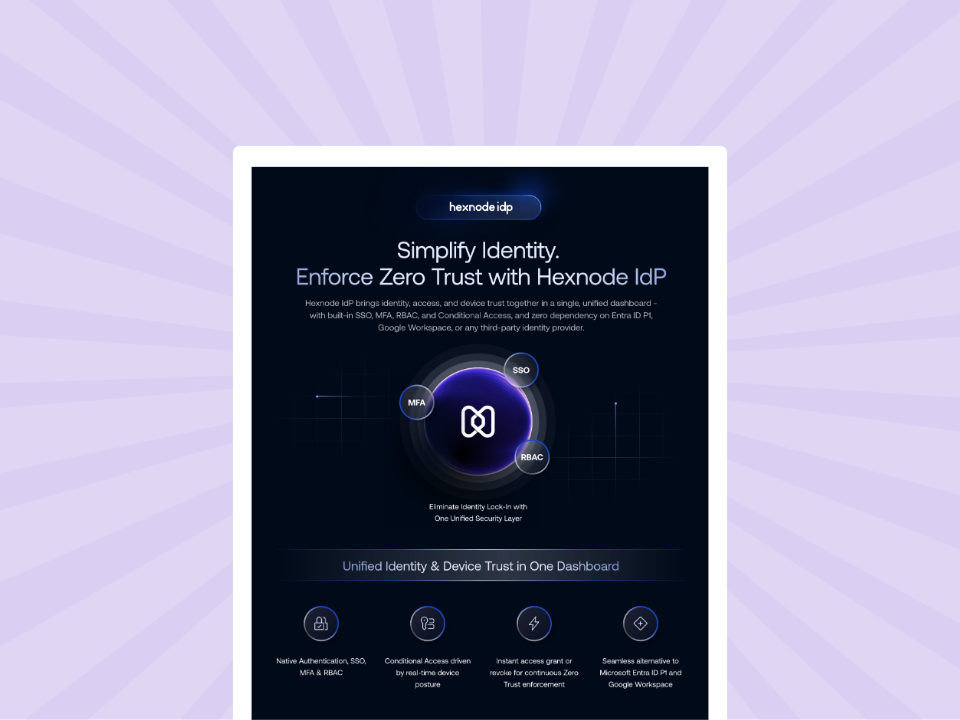
Hexnode IdP Info sheet
Discover how Hexnode IdP unifies identity, access, and device trust into one Zero Trust platform.
How Does Hexnode IdP help address identity and access risks?
Hexnode IdP addresses enterprise identity and access risks by combining identity verification, device-aware access policies, lifecycle controls, and centralized access visibility. Conditional Access enforces rules based on user identity, device compliance, and security context, while Contextual Authentication uses two-factor step-up MFA to add verification for high-risk actions.
Hexnode IdP also provides controls for specific access risks:
Role-Based Access Control (RBAC): Manages access rights and permissions according to defined user roles or functions.
SCIM-Based User Lifecycle Automation: Automates user access changes through SCIM-based lifecycle management, reducing reliance on manual identity processes.
Session Management: Defines policies for session inactivity to reduce exposure from unattended sessions.
For broader enterprise identity security, Application Access provides policy-controlled access to approved web, mobile, and SaaS applications. Federated Identity integrates with existing identity providers such as Microsoft Entra ID and Google Workspace, helping organizations work with their existing identity infrastructure.
Activity Reports centralize sign-in logs and provisioning and authentication histories across users and applications. This gives IAM teams a consolidated record for investigating access activity and supporting identity governance.
FAQs
How often should enterprises review user access permissions?
Enterprises should review access permissions regularly and whenever users change roles, responsibilities, or employment status. Higher-risk and privileged accounts generally require closer review to identify unnecessary permissions and limit permission creep.
What is the difference between authentication and conditional access?
Authentication verifies a user’s identity, while conditional access evaluates additional context before allowing access to a resource. This context can include device compliance, user privileges, application sensitivity, and other security signals.
Can MFA prevent all identity-based attacks?
No, MFA reduces risks associated with compromised credentials but does not eliminate every identity-based attack. Organizations still need least-privilege controls, secure session management, lifecycle management, device-aware access policies, and access monitoring.
Strengthen enterprise access with Hexnode IdP
Reducing enterprise identity and access risks requires coordinated controls across authentication, authorization, user lifecycle management, device trust, session security, and access monitoring. Addressing these areas together helps IAM teams maintain stronger control as identities, applications, and access requirements change.
Explore Hexnode IdP or request a personalized demo to see how it can address your organization’s highest-priority identity and access risks.
Take control of enterprise access risks
Strengthen identity security with Hexnode IdP. Start your free trial.
A storyteller for practical people. Breaks down complicated topics into steps, trade-offs, and clear next actions—without the buzzword fog. Known to replace fluff with facts, sharpen the message, and keep things readable—politely.