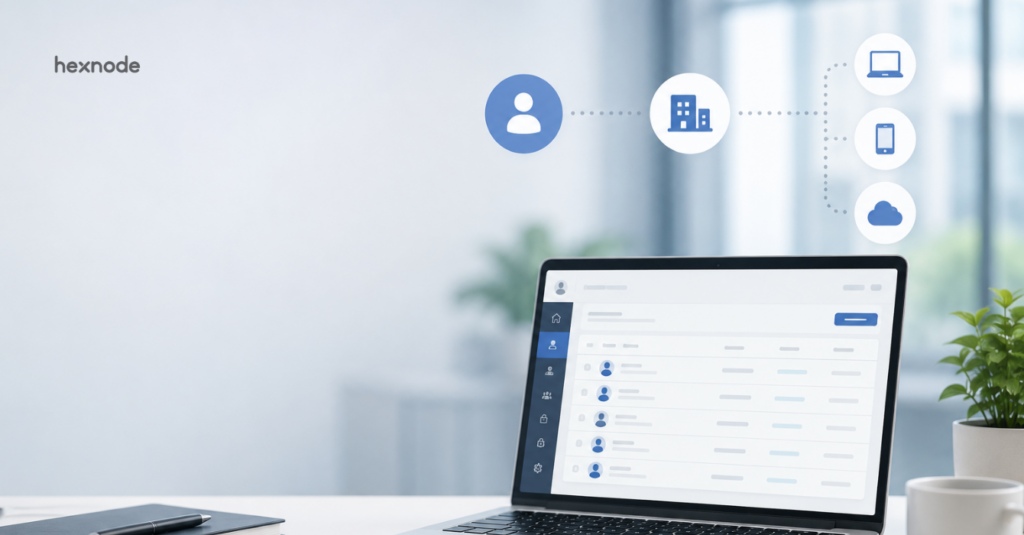
SCIM provisioning helps enterprises automate user lifecycle management across applications, reducing security gaps and IT overhead. Combined with Hexnode’s unified endpoint management capabilities, organizations can strengthen identity-driven access control while simplifying onboarding, offboarding, and compliance management.
Modern enterprises rely on dozens of SaaS applications, cloud platforms, and remote collaboration tools to keep operations running. While these applications improve productivity, they also create a major identity management challenge for IT teams. Managing user access manually across disconnected systems increases administrative overhead, delays onboarding, and leaves organizations exposed to security risks caused by stale accounts and inconsistent permissions. SCIM provisioning addresses this problem by automating how enterprises create, manage, and remove user accounts across applications.
Identity providers, or IdPs, play a central role in enterprise authentication today. However, authentication alone does not solve the broader issue of identity lifecycle management. Organizations also need a reliable way to provision users, synchronize identity attributes, assign permissions, and revoke access immediately when employees leave the company. This is where SCIM provisioning becomes critical.
As enterprises move toward identity-first security strategies, they increasingly combine identity management with endpoint management to strengthen access governance. Platforms like Hexnode help organizations extend identity-driven security beyond authentication by ensuring only compliant and trusted devices can access corporate resources.
SCIM stands for System for Cross-domain Identity Management. It is an open standard designed to automate user identity provisioning between identity providers and cloud applications. Instead of relying on manual account creation and spreadsheets, organizations can use SCIM to synchronize user information automatically across their technology ecosystem.
SCIM provisioning uses REST APIs and standardized JSON-based schemas to exchange identity data between systems. When an employee joins an organization, changes departments, or leaves the company, SCIM updates the connected applications automatically. This process eliminates repetitive administrative tasks while improving consistency and security across environments.
At its core, SCIM provisioning helps organizations automate several critical identity operations, including:
User account creation across connected applications
User attribute updates and synchronization
Group and role assignments
Account suspension for inactive users
Automated user deprovisioning during offboarding
Permission consistency across enterprise platforms
Without automation, IT teams often struggle to maintain accurate user permissions across multiple platforms, especially in environments with rapidly changing access requirements.
SCIM identity management has become increasingly important because enterprises now operate in highly distributed environments. Employees use multiple applications daily, and organizations cannot afford delays or errors in access management. Key business advantages of SCIM provisioning include:
Faster employee onboarding and offboarding
Reduced manual IT workload
Lower risk of orphaned accounts
Improved access governance and compliance
Better scalability for growing SaaS ecosystems
More consistent identity management across cloud services
SCIM allows enterprises to maintain consistent user identities across cloud services while reducing operational complexity.
How SCIM Provisioning Works
SCIM provisioning works by establishing communication between an identity provider and connected applications. The identity provider acts as the authoritative source of user identity data, while SaaS platforms and enterprise tools function as service providers that receive and apply those updates.
A typical SCIM workflow begins when a new employee joins the organization. The process usually follows these steps:
The HR system creates the employee record
The identity provider receives and syncs the identity data
SCIM APIs provision user accounts across approved applications
The system assigns roles, groups, and permissions automatically
Connected applications receive updated identity information in real time
This automated workflow reduces onboarding delays and ensures employees receive the correct access based on their department or job function.
The automation does not stop after onboarding. If an employee changes teams or responsibilities, SCIM updates the user attributes and permissions across integrated platforms automatically. When the employee leaves the organization, SCIM deprovisions access immediately, reducing the risk of orphaned accounts remaining active after offboarding.
The technical architecture behind SCIM provisioning is relatively straightforward but highly effective. A SCIM client initiates provisioning requests, while the SCIM server processes those requests using standardized endpoints. This consistency enables organizations to integrate multiple applications without building custom provisioning workflows for every service.
How IdPs Use SCIM to Streamline Identity Operations
Modern identity providers depend heavily on SCIM to support scalable identity operations. Without automated provisioning, IdPs would only handle authentication while leaving IT administrators responsible for manually managing user accounts across hundreds of applications.
One of the biggest advantages of SCIM is centralized user lifecycle management. Identity providers can automate identity orchestration across collaboration tools, productivity suites, security platforms, and endpoint management systems. This centralized approach ensures users receive the right level of access without requiring manual intervention from IT teams.
Key operational benefits of SCIM provisioning for IdPs include:
Centralized user lifecycle management
Automated account provisioning across applications
Faster onboarding and offboarding workflows
Reduced administrative overhead for IT teams
Consistent permission management across platforms
Improved scalability for growing SaaS ecosystems
Role-based access management also becomes easier with SCIM provisioning. Organizations can map employee roles and departments to predefined permission sets, allowing applications to assign access automatically. For example, finance employees can receive access to accounting tools while engineering teams gain permissions for development platforms. This approach supports least-privilege access policies while improving operational efficiency.
Another reason how IdPs use SCIM has become a major enterprise focus is onboarding speed. New employees expect immediate access to the tools they need to perform their jobs. Delayed provisioning affects productivity and increases IT support requests. SCIM helps organizations accelerate onboarding while ensuring permissions remain aligned with organizational policies.
Organizations that automate onboarding with SCIM can:
Provision accounts instantly across approved applications
Assign role-based permissions automatically
Reduce help desk tickets related to access requests
Improve employee productivity from day one
Minimize manual configuration errors
Offboarding is equally important. Many enterprises still struggle with incomplete deprovisioning processes, leaving inactive accounts accessible long after employees exit the company. SCIM enables immediate access revocation across integrated applications, significantly reducing insider risk exposure.
When to Use an Identity Provider: A Practical Guide for IT Teams
Learn when to use an identity provider to simplify access and strengthen enterprise security.
SCIM vs SAML: Understanding the Difference
Organizations often confuse SCIM and SAML because both technologies play important roles in identity management. However, they solve different problems within enterprise environments.
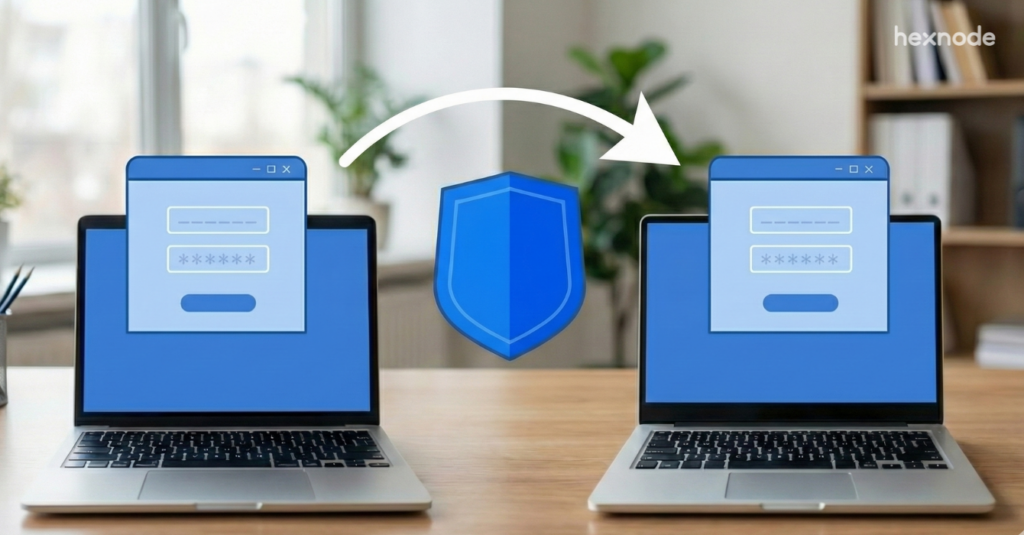
SAML focuses on authentication and single sign-on. It allows users to authenticate once through an identity provider and access multiple applications without re-entering credentials. SCIM, on the other hand, manages the user lifecycle itself by automating provisioning and deprovisioning processes.
The differences between SCIM and SAML become easier to understand when compared side by side:
Feature
SCIM
SAML
Primary purpose
User provisioning and lifecycle management
Authentication and single sign-on
Main function
Creates, updates, and removes user accounts
Verifies user identity during login
Focus area
Identity synchronization
Secure authentication
Data exchange method
REST APIs with JSON schemas
XML-based assertions
User onboarding
Automates account provisioning
Does not provision accounts
User offboarding
Automates deprovisioning
Does not remove accounts
Role management
Supports role and group assignments
Limited role management
Common use case
Managing user access across apps
Enabling SSO across applications
The difference becomes clearer in practical scenarios. SAML verifies whether users should access an application, while SCIM determines whether the user account exists in the first place and what permissions it should have. Enterprises typically deploy both technologies together to create a complete identity framework.
Using SCIM alongside SAML helps organizations improve both user experience and security. SAML reduces password fatigue and simplifies authentication workflows, while SCIM ensures accurate account management across connected services. Together, they form the foundation of modern enterprise identity architecture.
Security and Compliance Benefits of SCIM Provisioning
Security teams increasingly view SCIM provisioning as a critical component of enterprise risk management. Manual identity processes create inconsistencies that attackers can exploit, especially when organizations fail to revoke access promptly after employee departures.
One major advantage of SCIM provisioning is the reduction of orphaned accounts. Inactive accounts with lingering access permissions create significant security exposure because attackers often target overlooked credentials. Automated deprovisioning minimizes this risk by revoking access immediately when users leave the organization.
SCIM also improves audit readiness and compliance management. Regulatory frameworks increasingly require organizations to demonstrate proper access governance and identity controls. Automated provisioning provides a clear audit trail for account creation, permission changes, and deprovisioning activities.
As enterprises adopt Zero Trust security models, SCIM provisioning becomes even more important. Zero Trust strategies depend heavily on accurate identity data and dynamic access enforcement. Automated identity synchronization helps organizations maintain stronger access controls while supporting conditional access policies.
However, identity security alone is not enough. Organizations must also validate the security posture of the devices accessing enterprise resources. This is where unified endpoint management platforms like Hexnode strengthen identity-driven security initiatives by integrating device compliance with access governance.
Common SCIM Provisioning Challenges Enterprises Face
Although SCIM provisioning delivers significant operational benefits, enterprises often encounter implementation challenges when integrating identity workflows across diverse environments.
One common issue involves inconsistent SCIM support across SaaS vendors. While many applications advertise SCIM compatibility, implementation quality can vary significantly. Some vendors support only basic provisioning operations, while others offer more advanced role mapping and group synchronization capabilities.
Common SCIM provisioning challenges include:
Inconsistent SCIM implementation across SaaS platforms
Limited support for advanced provisioning features
Complex role and group synchronization requirements
Difficulty standardizing identity attributes
Integration issues with legacy infrastructure
Limited visibility into provisioning activity and compliance
Attribute mapping complexity is another challenge. Enterprises often maintain custom identity attributes across departments, regions, and business units. Synchronizing these attributes consistently across multiple applications requires careful planning and governance. Poorly configured mappings can result in incorrect permissions or failed provisioning workflows.
Legacy infrastructure can also complicate SCIM deployments. Many organizations still rely on hybrid environments that include older on-premises systems alongside cloud-native applications. Integrating legacy infrastructure into modern identity workflows may require additional middleware or custom connectors.
Organizations operating hybrid environments often face challenges such as:
Managing identity synchronization between cloud and on-premises systems
Supporting older applications without native SCIM support
Maintaining consistent access policies across environments
Handling custom integrations and middleware dependencies
Another major concern involves visibility and governance. SCIM can automate provisioning effectively, but organizations still need centralized oversight of user activity, device posture, and access compliance. This is why enterprises increasingly integrate identity systems with endpoint management platforms to improve operational visibility and policy enforcement.
Extending SCIM-Driven Identity Management with Hexnode
Identity management strategies work best when organizations combine user identity controls with device management and compliance enforcement. Simply verifying a user’s credentials is no longer sufficient in modern enterprise environments where employees access sensitive resources from multiple endpoints and remote locations.
Hexnode helps organizations strengthen identity-driven security by connecting endpoint management with enterprise access governance. By integrating with identity providers and authentication systems, Hexnode enables IT teams to align device compliance policies with user access controls.
For example, organizations can automate device enrollment workflows alongside identity provisioning processes. When user and group data sync from an IdP into Hexnode UEM, IT admins can use synchronized groups for user-centric policy enforcement so enrolled devices receive relevant policies, application catalogs, and security restrictions based on role. This integrated approach improves onboarding efficiency while maintaining stronger control over enterprise assets.
Hexnode also supports secure offboarding workflows. When organizations deprovision users through identity providers, IT teams can:
Remove corporate accounts and profiles
Wipe sensitive business data remotely
Enforce security policies during employee exits
Reduce the risk of unauthorized access after offboarding
As enterprises adopt Zero Trust frameworks, the relationship between identity and device trust becomes increasingly important. Hexnode helps organizations operationalize these strategies by ensuring only compliant devices gain access to corporate resources. This creates a more resilient security posture that extends beyond authentication alone.
Featured Resource
Hexnode IdP Solution Brief
Discover how Hexnode IdP unifies identity, access, and device trust for Zero Trust security.
Organizations should begin SCIM deployments by prioritizing applications with mature native SCIM support. Standardized integrations simplify implementation and reduce the need for custom provisioning workflows. Evaluating vendor capabilities early helps organizations avoid operational issues later.
When evaluating SCIM-compatible applications, organizations should look for:
Native SCIM provisioning support
Advanced role and group synchronization capabilities
Reliable API performance and documentation
Compatibility with existing identity providers
Support for automated deprovisioning workflows
Enterprises should also standardize identity attributes across systems whenever possible. Consistent naming conventions and role structures improve synchronization accuracy and reduce administrative complexity. Without proper governance, identity sprawl can quickly undermine provisioning effectiveness.
To improve identity consistency across environments, organizations should:
Standardize user naming conventions
Maintain consistent role definitions
Centralize identity governance policies
Audit attribute mappings regularly
Minimize unnecessary custom attributes
Role-based automation is another essential best practice. Organizations should define access policies based on departments, job functions, and security requirements rather than assigning permissions manually. Automated role mapping improves scalability while supporting least-privilege access principles.
Finally, organizations should integrate SCIM provisioning with broader security and compliance initiatives. Identity automation works best when combined with endpoint visibility, policy enforcement, and continuous monitoring. Platforms like Hexnode help organizations connect identity management with device governance to strengthen enterprise security operations.
A strong SCIM provisioning strategy should also include:
Continuous monitoring of provisioning workflows
Automated compliance enforcement
Regular access reviews and audits
Integration with endpoint management platforms
Alignment with Zero Trust security policies
Conclusion
SCIM provisioning has become a foundational technology for modern enterprise identity management. As organizations continue expanding their SaaS ecosystems and supporting distributed workforces, manual identity workflows can no longer scale effectively. Automated provisioning helps enterprises reduce administrative overhead, improve onboarding efficiency, and strengthen access security across applications.
Identity providers rely on SCIM to streamline user lifecycle management and maintain consistent access governance across complex environments. However, identity security alone cannot fully protect enterprise resources. Organizations also need visibility into device trust, compliance status, and endpoint activity.
This is why enterprises increasingly combine identity-driven security strategies with unified endpoint management platforms like Hexnode. By integrating user identity with device compliance and policy enforcement, organizations can build stronger Zero Trust architectures while simplifying IT operations at scale.
Automate Identity Provisioning With Hexnode
Sync identities, enforce device compliance, and secure access with Hexnode UEM.
SCIM provisioning automates user account creation, updates, role assignments, and deprovisioning across enterprise applications. It helps organizations manage identity lifecycles more efficiently while reducing manual administrative effort.
How does SCIM differ from SAML?
SCIM focuses on user provisioning and lifecycle management, while SAML handles authentication and single sign-on. Organizations often use both technologies together to create a complete identity management framework.
Content writer at Hexnode. Fueled by good coffee and the occasional cat cuddle, I enjoy crafting content that informs, connects, and resonates. Nothing excites me more than knowing my words have been read, appreciated, and maybe even bookmarked.