TL;DR
- Traditional RMM architectures often create operational overhead through agent maintenance, compatibility issues, and fragmented management workflows.
- Modern MSPs increasingly rely on agentless network monitoring and API-driven endpoint management to simplify operations.
- The shift toward UEM platforms and cloud-native management frameworks reduces dependency on legacy agent-heavy infrastructure.
- MSPs can improve scalability, automation, and endpoint visibility by combining modern UEM capabilities with IT automation tools.
- Platforms like Hexnode help MSPs modernize device management using native OS frameworks, centralized policy enforcement, and automated workflows.
For years, Remote Monitoring and Management (RMM) platforms formed the operational backbone of managed service providers. MSPs relied on RMM agents to monitor endpoints, deploy scripts, automate tasks, and troubleshoot customer environments remotely.
That model worked well when infrastructure remained centralized and endpoints largely stayed inside corporate networks.
However, modern IT environments no longer operate that way.
Today’s MSPs manage:
- remote workforces,
- BYOD environments,
- cloud-native applications,
- hybrid infrastructures,
- mobile endpoints,
- and distributed device fleets across multiple operating systems.
As environments became more complex, traditional RMM architectures also became more difficult to maintain.
Many providers now struggle with:
- agent deployment overhead,
- endpoint performance concerns,
- compatibility issues,
- inconsistent policy enforcement,
- delayed updates,
- and fragmented management workflows.
At the same time, customers increasingly expect faster onboarding, streamlined management, stronger security controls, and improved operational visibility.
These changes have accelerated interest in agentless network monitoring, agentless endpoint management, and modern endpoint management strategies that reduce dependency on legacy agent-heavy infrastructures.
This shift does not mean agents are disappearing entirely. Instead, MSPs are moving toward more flexible, API-driven, and cloud-native management approaches that simplify operations while improving scalability.
Learn more about Hexnode for MSPs
Why Traditional RMM Architectures Create Operational Friction
Legacy RMM platforms depend heavily on endpoint agents to collect telemetry, execute scripts, and maintain remote management capabilities.
While agents remain useful in some scenarios, large-scale agent deployments often introduce operational challenges for MSPs.
Agent Maintenance Creates Administrative Overhead
Every installed agent requires:
- deployment,
- configuration,
- updates,
- troubleshooting,
- and lifecycle management.
As MSPs scale across multiple tenants and device types, maintaining thousands of agents becomes operationally intensive. Even minor agent failures can disrupt visibility and create monitoring blind spots.
Agent Conflicts Impact Endpoint Stability
Different management and security tools frequently deploy competing endpoint agents.
Over time, these agents can:
- consume system resources,
- create compatibility conflicts,
- impact endpoint performance,
- and increase troubleshooting complexity.
For MSPs managing customer satisfaction and SLAs, these issues quickly become operational liabilities.
Hybrid Work Environments Complicate Traditional Monitoring
Traditional RMM architectures often assume persistent connectivity between endpoints and centralized infrastructure.
Modern remote work environments challenge that assumption.
Endpoints now operate:
- outside corporate networks,
- across multiple locations,
- and on unmanaged internet connections.
This shift makes centralized agent management more difficult while increasing the need for lightweight, cloud-native management approaches.
What the Agentless Revolution Actually Means
The phrase “agentless revolution” can sometimes create confusion. Agentless does not mean MSPs will completely eliminate agents from every workflow.
Instead, the industry is moving toward management models that reduce reliance on traditional endpoint agents by leveraging:
- native operating system management frameworks,
- APIs,
- cloud-native management protocols,
- identity-aware controls,
- and centralized automation workflows.
This evolution allows MSPs to simplify agentless endpoint management without sacrificing visibility or operational control.
Modern management frameworks already exist across major operating systems:
- Apple MDM frameworks,
- Android Enterprise,
- Microsoft modern management APIs,
- and ChromeOS management capabilities.
Unified Endpoint Management (UEM) platforms increasingly use these native frameworks to manage devices directly through operating system-level integrations.
As a result, MSPs can:
- reduce endpoint overhead,
- simplify onboarding,
- improve policy consistency,
- and streamline automation workflows.
This transition has made agentless endpoint management, network monitoring and API-driven management models increasingly attractive for growing MSPs.
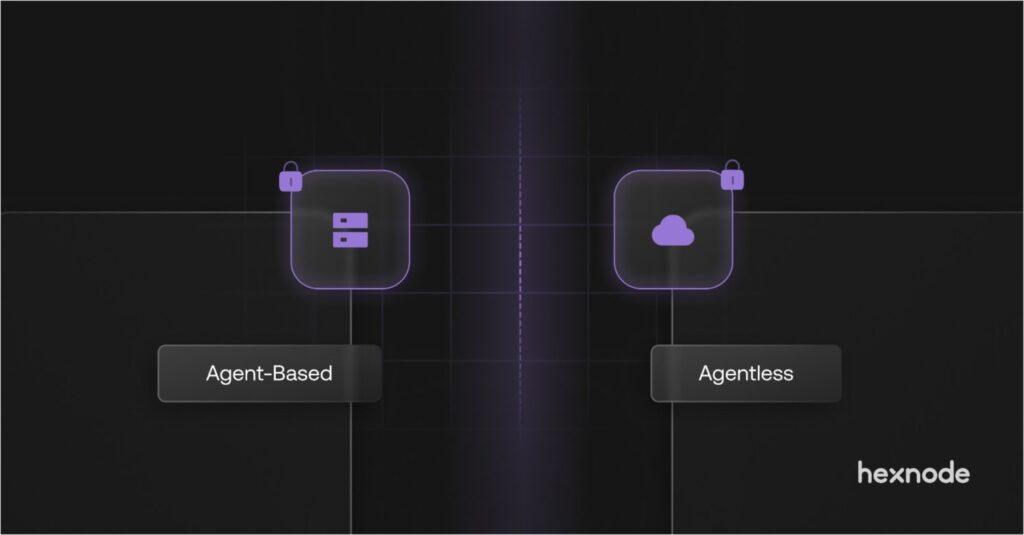
Agentless vs Agent-Based Monitoring: What’s the Difference?
The discussion around agentless vs agent-based monitoring is not about choosing one model exclusively. It is about identifying the right operational balance.
Agent-Based Monitoring
Traditional agent-based monitoring installs software agents directly on endpoints.
These agents typically provide:
- deep telemetry collection,
- real-time monitoring,
- script execution,
- advanced diagnostics,
- and granular endpoint visibility.
However, they also introduce:
- deployment overhead,
- maintenance complexity,
- compatibility risks,
- and additional endpoint resource consumption.
Agentless Network Monitoring
Agentless network monitoring relies on:
- APIs,
- native management protocols,
- cloud integrations,
- SNMP,
- WMI,
- and operating system frameworks
to monitor and manage infrastructure without requiring traditional endpoint agents.
This approach helps MSPs:
- reduce endpoint complexity,
- streamline device onboarding,
- simplify management workflows,
- and lower operational overhead.
For many providers, the goal is not eliminating agents entirely. The goal is reducing unnecessary dependency on agent-heavy architectures wherever native management capabilities already exist.
That operational flexibility is driving the modern MSP management model.
Comparison Table
| Feature |
Agent-Based Monitoring |
Agentless Network Monitoring |
| Monitoring Method |
Uses software agents installed directly on endpoints |
Uses APIs, native protocols, and OS management frameworks |
| Deployment Model |
Requires agent installation and configuration on each device |
Does not require traditional endpoint agents |
| Visibility Depth |
Provides deep telemetry and granular endpoint insights |
Focuses on infrastructure, device status, and policy-level visibility |
| Real-Time Monitoring |
Strong real-time monitoring and diagnostics capabilities |
Depends on API polling, integrations, and native framework capabilities |
| Script Execution |
Supports direct script execution on endpoints |
Limited compared to agent-based architectures |
| Endpoint Performance Impact |
May consume system resources and affect performance |
Lower endpoint overhead and reduced resource consumption |
| Maintenance Requirements |
Requires ongoing agent updates and troubleshooting |
Reduces administrative overhead associated with agent management |
| Compatibility Risks |
Potential conflicts with other endpoint agents or tools |
Lower compatibility concerns due to reduced endpoint footprint |
| Scalability |
Can become difficult to manage across large environments |
Simplifies management across distributed and hybrid environments |
| Device Onboarding |
Often requires manual deployment workflows |
Supports faster onboarding using native enrollment frameworks |
| Operational Complexity |
Higher operational overhead in large deployments |
Streamlines management workflows and administration |
| Best Fit Use Cases |
Deep diagnostics, advanced telemetry, and intensive monitoring |
Lightweight management, modern UEM, and distributed environments |
Why MSPs Are Moving Toward UEM-Driven Operations
As MSP environments become more distributed, many providers are shifting beyond traditional RMM architectures and adopting UEM-driven management strategies.
Unified Endpoint Management platforms help MSPs centralize management across:
- desktops,
- laptops,
- smartphones,
- tablets,
- rugged devices,
- and remote endpoints through a single operational framework.
Unlike traditional RMM systems that often rely heavily on endpoint agents, modern UEM platforms leverage native device management frameworks built directly into operating systems.
This approach reduces operational friction while improving scalability.
Simplified Device Enrollment
Modern UEM platforms support:
These capabilities significantly reduce onboarding complexity for MSPs managing large device fleets.
Centralized Policy Enforcement
UEM platforms allow MSPs to standardize:
- security configurations,
- password policies,
- encryption requirements,
- application controls,
- Wi-Fi settings,
- VPN configurations,
- and compliance rules across customer environments.
This centralized approach improves operational consistency and reduces configuration drift.
Improved Support for Remote Work
Cloud-native UEM platforms work effectively across remote and hybrid environments without requiring traditional network dependencies.
MSPs can remotely:
- push policies,
- deploy applications,
- lock devices,
- wipe endpoints,
- and monitor compliance from centralized management consoles.
This flexibility aligns more effectively with modern distributed work environments.
The Growing Role of IT Automation Tools in MSP Operations
Modern MSPs cannot scale efficiently without automation.
As customer environments grow more complex, manual management workflows create:
- slower response times,
- higher operational costs,
- inconsistent configurations,
- and increased technician workload.
This is why IT automation tools have become central to modern MSP operations.
Automation allows providers to:
- standardize workflows,
- reduce repetitive administrative tasks,
- accelerate onboarding,
- and improve operational consistency.
Within modern endpoint management environments, MSP automation tools now support:
- automated policy deployment,
- patch management,
- compliance enforcement,
- device provisioning,
- application deployment,
- and remote remediation workflows.
Automation also improves security operations by reducing human error and accelerating response times.
For MSPs transitioning away from heavily manual RMM workflows, automation becomes one of the biggest operational advantages of modern management platforms.
Building a Modern MSP Stack With Hexnode
Modern MSP operations require more than traditional remote monitoring capabilities. Providers increasingly need centralized visibility, automation, policy consistency, and scalable endpoint management across distributed environments.
Hexnode UEM supports this operational shift through a modern endpoint management framework that leverages native operating system management capabilities alongside centralized administrative controls.
Unified Endpoint Management Across Platforms
Hexnode allows MSPs to manage:
- Windows,
- macOS,
- Linux,
- Android,
- iOS,
- ChromeOS,
- and rugged devices from a centralized console.
This unified visibility helps providers reduce management fragmentation across customer environments.
Leveraging Native Management Frameworks
Instead of relying entirely on traditional agent-heavy architectures, Hexnode integrates with:
- Apple MDM frameworks,
- Android Enterprise,
- Windows modern management APIs,
- and OEM-specific management capabilities.
This approach allows MSPs to streamline management workflows while reducing unnecessary endpoint overhead.
Automating Endpoint Operations
Hexnode supports several automation-driven workflows that align with modern MSP operational requirements.
Providers can:
- automate device enrollment,
- deploy applications remotely,
- enforce security policies,
- manage patching workflows,
- schedule updates,
- monitor device compliance,
- and maintain centralized configuration baselines.
These capabilities help MSPs standardize operations across multiple tenants while reducing manual administrative effort.
Supporting Security and Compliance
Modern MSP environments increasingly require security-first operational controls.
Hexnode supports:
- encryption enforcement,
- password policy management,
- device compliance monitoring,
- kiosk management,
- remote lock and wipe capabilities,
- and role-based administrative access controls.
These controls help providers maintain stronger operational governance across customer environments.
MSP Compliance: Policy Staging and Validation for Preventing Breaches
Prevent MSP breaches with smarter compliance policy staging and validation.
Improving Multi-Tenant Scalability
As MSPs grow, operational simplicity becomes critical. Hexnode’s centralized management capabilities help providers:
- manage multiple customer environments,
- streamline technician workflows,
- reduce policy inconsistencies,
- and maintain visibility across distributed device fleets.
For MSPs modernizing beyond traditional RMM architectures, this centralized operational model provides greater scalability and flexibility.
Conclusion: The Future of MSP Operations Is Operational Simplicity
The shift toward agentless network monitoring and modern endpoint management reflects a broader transformation happening across the MSP industry.
Providers no longer want fragmented management stacks filled with overlapping agents and disconnected workflows.
Instead, they want:
- centralized visibility,
- lightweight management architectures,
- stronger automation,
- simplified onboarding,
- and scalable operational control.
The future of MSP operations will likely combine:
- API-driven management,
- native device frameworks,
- cloud-native administration,
- automation-first workflows,
- and unified endpoint management platforms.
Traditional RMM tools will not disappear overnight. However, MSPs increasingly recognize that legacy agent-heavy models alone cannot support the operational demands of modern distributed environments.
Organizations that modernize their management architecture early will gain stronger operational efficiency, improved scalability, and better long-term flexibility as customer expectations continue to evolve.
Scale MSP Operations Without Complexity
Try Hexnode free for 14 days and simplify multi-tenant device management
Start Your Free Trial! FAQs
What is agentless endpoint management and how does it benefit MSPs?
Agentless endpoint management allows MSPs to monitor and manage devices using native operating system frameworks, APIs, and cloud-based tools instead of installing software agents on every endpoint. This approach reduces deployment complexity, lowers endpoint resource usage, simplifies onboarding, and improves scalability across distributed environments.
Should MSPs replace traditional RMM tools with agentless solutions?
MSPs do not need to completely replace traditional RMM tools. Instead, many providers adopt a hybrid approach that combines agent-based monitoring for deep diagnostics with agentless methods for lightweight management and broader scalability. This balance helps MSPs reduce operational overhead while maintaining visibility and control.