Agent-based vs agentless endpoint management comes down to control versus simplicity. Agent-based offers deep visibility and offline enforcement, while agentless enables lightweight, fast deployment. Modern organizations need both, and solutions like Hexnode UEM unify these approaches to deliver consistent, scalable endpoint management across all devices.
Introduction: What is Agent-Based vs Agentless Endpoint Management?
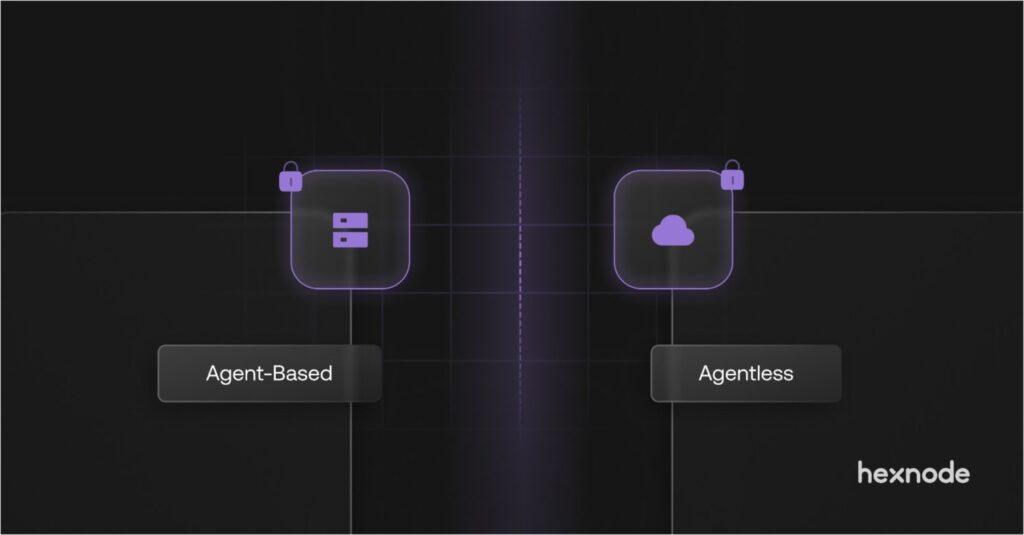
Agent-based endpoint management uses a software agent installed on devices for continuous monitoring and control, while agentless endpoint management relies on native OS protocols to manage devices without installing software.
In modern IT environments, endpoints are no longer confined to corporate networks. Devices operate across home networks, public Wi-Fi, and mobile environments. This shift makes endpoint management strategy a critical decision.
Understanding the difference between these two approaches helps organizations choose the right level of control, visibility, and scalability. More importantly, it highlights why a unified approach through platforms like Hexnode UEM is essential.
Why is Endpoint Management strategy important for modern IT teams?
Endpoint management strategy determines how effectively IT teams can secure, monitor, and control devices across distributed environments.
As organizations adopt hybrid work models, endpoints become more diverse and harder to manage. IT teams must balance:
Visibility into device activity
Control over configurations and policies
Performance impact on endpoints
Choosing the wrong approach can lead to operational inefficiencies and security risks. This is why modern organizations rely on Unified Endpoint Management solutions like Hexnode, which provide centralized control across device types and management methods.
What are the limitations of Agent-Based and Agentless Endpoint Management?
Agent-based and agentless endpoint management each have limitations when used in isolation, making a hybrid approach necessary for modern environments.
Limitations of agent-based management:
Requires deployment and maintenance of agents
Can increase operational overhead at scale
Limitations of agentless management:
Limited visibility into system-level activity
Requires network connectivity for execution
Cannot enforce policies offline
Relying on a single model creates gaps. Hexnode addresses this by combining both approaches into a single, unified management framework.
What is Agent-Based Endpoint Management and how does it work?
Agent-based endpoint management uses a locally installed software agent to enable continuous monitoring, real-time control, and offline policy enforcement.
How agent-based endpoint management works in real environments
The agent runs as a background service on the device and maintains ongoing communication with the management server.
It pulls policies and commands from the server
Executes tasks locally on the device
Pushes telemetry and logs back to the console
Even when a device goes offline, the agent continues enforcing policies and synchronizes updates once connectivity is restored.
Key features of agent-based endpoint management
Persistent communication with the server
Deep system-level visibility
Real-time response capabilities
Offline policy enforcement
In Hexnode, agent-based management enables granular control over Windows and macOS devices, ensuring consistent enforcement across remote environments.
5 factors driving UEM adoption across enterprises
Explores key factors driving UEM adoption, including remote work, security risks, and device diversity.
What is Agentless Endpoint Management and how does it work?
Agentless endpoint management uses native operating system protocols and APIs to manage devices without installing additional software.
How agentless endpoint management works
The management server communicates directly with devices using built-in frameworks such as:
Commands are executed through these interfaces, eliminating the need for a persistent agent.
Key features of agentless endpoint management
No software installation required
Fast onboarding and deployment
Lightweight management approach
Standardized control via OS-level APIs
Hexnode leverages these native capabilities to manage mobile devices and modern platforms efficiently while maintaining security and compliance.
Agent-Based vs Agentless Endpoint Management: Key differences explained
The key difference between agent-based and agentless endpoint management lies in control depth, visibility, and dependency on connectivity.
Aspect
Agent-Based Management
Agentless Management
Deployment
Requires agent installation
No installation required
Visibility
Deep system and process-level insight
Limited to OS-level data
Control
Real-time and automated
Limited to predefined actions
Connectivity
Works offline
Requires active connection
Resource Impact
Minimal, optimized agent footprint
Zero footprint
Quick Summary:
Agent-based management offers depth and control. Agentless management offers simplicity and speed. Hexnode combines both for unified endpoint management.
When should you use Agent-Based vs Agentless Endpoint Management?
Agent-based and agentless endpoint management serve different use cases depending on device type, environment, and security requirements.
Use cases for agent-based endpoint management
Remote and hybrid workforce environments
Security-sensitive organizations
Automation-heavy IT operations
Compliance-driven industries
Use cases for agentless endpoint management
Mobile device management scenarios
Rapid onboarding and provisioning
Restricted environments where agents are not allowed
Basic monitoring and configuration tasks
Hexnode enables organizations to apply the right approach per device without managing separate tools.
Agent-Based vs Agentless Endpoint Management for security: What’s the difference?
Agent-based endpoint management provides deeper security visibility and faster response capabilities compared to agentless approaches.
Agent-based systems enable proactive security measures, while agentless systems provide baseline protection. Hexnode integrates both approaches to ensure consistent security posture across all endpoints.
Real-World example of Agent-Based vs Agentless Endpoint Management
A hybrid workforce highlights the need for both management approaches.
How Hexnode unifies Agent-Based and Agentless Endpoint Management
Hexnode UEM brings agent-based and agentless endpoint management together into a single, cohesive platform, allowing IT teams to apply the right level of control based on device type, user context, and security requirements.
Instead of forcing a one-size-fits-all approach, Hexnode enables adaptive endpoint management that scales across modern, distributed environments.
Hybrid Endpoint Management with Hexnode UEM
Hexnode supports both management models natively and orchestrates them within a unified workflow.
Agent-based management for desktops and laptops
Hexnode deploys a lightweight agent on Windows and macOS devices to enable:
Geofencing policies to enforce location-based restrictions
With agent-based endpoints, Hexnode enables deeper investigation using:
Historical device activity
Process tree analysis
On-demand queries
This allows IT teams to move from visibility to action without switching tools.
Unified Policy Enforcement and Compliance
Hexnode ensures that policies remain consistent across all devices, regardless of how they are managed.
IT teams can:
Define compliance policies centrally
Enforce device configurations uniformly
Integrate device compliance with identity workflows
This reduces policy drift and ensures that all endpoints meet organizational security standards.
Single Pane of Glass for Endpoint Visibility
One of Hexnode’s core strengths is its unified management interface.
All devices appear in a centralized dashboard
IT teams can monitor, manage, and respond from one console
The underlying management method (agent-based or agentless) is abstracted
This simplifies operations by:
Eliminating tool fragmentation
Reducing context switching
Improving response time
Why this matters
In real-world environments, endpoints vary widely in capabilities and constraints. Some require deep control, while others rely on native management frameworks.
Hexnode bridges this gap by delivering:
Flexibility to choose the right approach per device
Scalability to manage growing device fleets
Consistency in policy enforcement and visibility
Instead of adapting your operations to fit a tool, Hexnode adapts to your environment.
Bottom line
Hexnode does not treat agent-based and agentless endpoint management as competing models. It combines them into a unified, adaptive strategy that gives IT teams complete control without added complexity.
Conclusion: Agent-Based vs Agentless Endpoint Management – Which is better?
Agent-based vs agentless endpoint management is not about choosing one over the other. It is about using both effectively.
Agent-based management delivers depth and control. Agentless management provides simplicity and speed.
The most effective strategy is a unified approach powered by Hexnode UEM, which allows organizations to:
Manage diverse device environments
Maintain consistent security policies
Scale operations efficiently
Simplify Endpoint Management Today
See how unified endpoint management can give you complete control across all devices.
Does agentless endpoint management work for remote employees?
Legacy agentless tools require LAN or VPN access, but modern agentless management (like Apple MDM or Windows CSPs) only requires a standard internet connection to receive cloud-based push notifications.
Will an agent affect device performance?
No. Modern endpoint agents, including Hexnode’s, are lightweight and designed to have minimal impact on system performance.
Can I switch between agent-based and agentless endpoint management?
Yes. Unified endpoint management solutions like Hexnode allow you to switch or combine both approaches based on device and use case.
Which is better: agent-based or agentless endpoint management?
Neither is universally better. Agent-based offers deeper control, while agentless provides simplicity. A hybrid approach delivers the best results.
Is agent-based endpoint management more secure?
Yes. Agent-based management provides deeper visibility and faster response capabilities, making it more effective for security and compliance.
Do I need both agent-based and agentless management?
Yes. Most organizations use both to manage different device types and environments effectively.
I write at the intersection of technology, process, and people, focusing on explaining complex products with clarity. I break down tools, systems, and workflows without any noise, jargon, or the hype.