Why do MSPs lose margin as endpoint operations scale?
MSPs can lose margin as they grow because each new client often adds more management portals, repetitive endpoint tasks, technician context switching, and support workload. Evaluating Hexnode ROI for MSPs starts with understanding whether operational effort is scaling linearly with endpoint count and offsetting revenue growth through higher service-delivery costs.
Fragmented endpoint management compounds that problem. Technicians may spend additional time switching between consoles, repeating configuration work, and reconciling device information across tools. These small inefficiencies accumulate across routine MSP workflows, including:
Client onboarding and initial device provisioning
Policy and configuration changes across different environments
Device lifecycle management, from enrollment through retirement
The result is a growing layer of hidden labor cost that can be difficult to isolate in service margins.
The core MSP ROI question is therefore simple: Can the business add clients and endpoints without technician hours and management costs increasing at the same rate?
What does inefficient endpoint management actually cost an MSP?
When evaluating Hexnode ROI for MSPs, inefficient endpoint management is a critical baseline because it lowers technician utilization, increases the cost per managed endpoint, slows resolution times, and reduces service margins.
A meaningful MSP ROI calculation should also account for technician hours lost to repetitive, manual, and fragmented workflows, not just software licensing costs.
How does inefficiency consume technician capacity?
Repetitive Tier 1 requests, manual policy changes, client-by-client administration, and disconnected management tools absorb time that could otherwise support billable projects or higher-value engineering work.
As endpoint counts grow, technicians may spend more time repeating routine tasks, switching between consoles, and managing similar configurations across separate customer environments. This raises service-delivery costs without creating proportional customer value.
How does inefficient endpoint management affect MSP profitability?
Operational inefficiency creates broader business risks, including:
Increased SLA pressure from slower response and resolution times
Inconsistent client experiences across technicians and environments
Greater risk of technician burnout from repetitive work
Increased dependence on additional headcount to sustain service levels
If technician effort rises at roughly the same rate as managed endpoints, scaling services profitably becomes increasingly difficult.
What should MSP ROI measure in endpoint management?
MSP ROI measures the net financial benefit of an endpoint-management investment relative to its total cost, while operational improvements such as technician productivity can be tracked separately or monetized where appropriate. A meaningful ROI model should capture both direct cost savings and improvements in service-delivery efficiency.
What are the three core pillars of MSP ROI?
MSP ROI in endpoint management is evaluated across three operational dimensions that measure service efficiency and cost impact, helping translate benefits into measurable outcomes across the service delivery lifecycle.
Technician time saved
Measure how much technician effort is reduced across repetitive administration, policy changes, endpoint maintenance, and routine support workflows.
Support tickets avoided or resolved faster
Track whether better endpoint management reduces preventable incidents or lowers the time technicians spend diagnosing and resolving recurring issues.
Overlapping tooling eliminated or consolidated
Identify management tools that can be retired or consolidated where capabilities overlap, reducing licensing costs and operational complexity.
Which baselines should MSPs track?
MSPs should distinguish hard-dollar savings from productivity gains. Hard-dollar savings include reduced licensing or labor costs, while productivity gains represent technician capacity redirected toward higher-value work.
Useful baselines include:
Technician hours per endpoint
Tickets per 100 endpoints
Average handling time
Number of management tools
Cost per managed endpoint
Without measurable starting points, any claimed improvement in MSP ROI remains difficult to verify.
How does technician time affect MSP ROI?
Technician time directly affects MSP ROI because recurring administrative work consumes capacity that could otherwise support more clients, higher-value projects, or complex support tasks. Even small inefficiencies become significant when repeated across hundreds or thousands of endpoints.
Where does administrative overhead accumulate?
Common sources include:
Repeated logins across client environments
Manual device actions and configuration changes
Policy deployment and verification
Recurring reporting tasks
Client and endpoint onboarding
Technician handoffs between teams or escalation tiers
How should MSPs measure time savings?
MSP automation improves ROI when repeatable workflows are standardized, scheduled, or triggered instead of performed manually for each client or endpoint.
MSPs should measure the technician hours required for each recurring workflow before and after a platform change. Recovered hours can be measured as additional technician capacity and assigned a productivity value; they should be counted as hard labor-cost savings only when they reduce or avoid actual labor expenditure.
How does ticket volume affect MSP ROI?
Ticket volume affects MSP ROI through both the number of incidents technicians must handle and the effort required to resolve each one. Effective endpoint management can create value by preventing avoidable tickets and improving the resolution of incidents that cannot be prevented.
Ticket prevention vs. faster resolution
Standardized configurations can reduce incidents caused by inconsistent settings or configuration drift. For unavoidable issues, better endpoint visibility and remote troubleshooting can reduce diagnostic work, technician touches, and escalations.
Which ticket metrics matter?
MSPs should track:
Tickets per endpoint
Repeat incident rate
Mean handling time
Escalation rate
Technician touches per issue
A strong ROI model should not assume that success means ticket volume must fall significantly. If technicians resolve the same volume of requests in less time or escalate fewer cases, the MSP still recovers meaningful service capacity without increasing headcount.
How does tool consolidation affect MSP ROI?
Tool consolidation improves MSP ROI when genuinely overlapping capabilities can be replaced without compromising service requirements. The financial benefit includes licensing savings, but the operational impact of reducing tool sprawl can be equally important.
What does tool sprawl cost an MSP?
Separate platforms for endpoint administration, remote troubleshooting, patching, reporting, or OS-specific management can create additional costs through:
Technician training
Integration maintenance
Credential and access management
Switching between workflows and consoles
Maintaining multiple operating procedures
These indirect costs should be included alongside subscription fees when evaluating the existing tool stack.
How should consolidation savings be calculated?
MSPs should identify which capabilities are actually replaceable, calculate the direct and operational costs associated with those tools, and compare them against the proposed platform.
The objective is not to eliminate every specialized MSP tool. Consolidation only contributes to ROI when redundant functionality can be removed without introducing operational or service gaps.
Hexnode UEM MSP: All you need to know
Overview of Hexnode UEM MSP features for centralized client management.
How should MSPs calculate ROI before switching UEM platforms?
MSPs should calculate ROI by establishing their current operating baseline, estimating realistic post-migration improvements, and comparing recurring operational savings against the full cost of switching and running the new UEM platform. The calculation should reflect both measurable savings and the investment required to achieve them.
A simple vendor-neutral formula is:
ROI = (Total quantified benefits − Total costs) ÷ Total costs × 100, using benefits and costs from the same defined evaluation period.
Operational savings can include recovered technician time, lower support costs, and eliminated software expenses. However, the calculation should also account for migration labor, technician training, implementation effort, and temporary workflow disruption.
The evaluation period matters as well. A short measurement window can overemphasize upfront migration costs, while an overly long forecast can exaggerate uncertain savings. MSPs should choose a realistic period and document the assumptions behind each projected improvement.
Step 1: Establish the MSP’s current operational baseline
A credible ROI calculation starts with understanding what endpoint management costs today. Without a measurable baseline, post-migration improvements cannot be attributed confidently to the platform change.
Build an operational inventory
Document the current service environment, including:
Number of managed endpoints
Number of active clients
Supported operating systems
Endpoint-management tools currently in use
Technician headcount
Monthly endpoint-related ticket volume
Next, capture metrics such as administrative hours per client, cost per ticket, average handling time, client onboarding time, and recurring software spend.
Separate high-frequency repetitive tasks from complex engineering work. A routine configuration action performed hundreds of times may offer substantial automation potential, while an infrequent troubleshooting task requiring technician judgment may not. This distinction prevents MSP automation savings from being overstated.
Step 2: Model savings across time, tickets and tooling
Once the baseline is established, MSPs can model how proposed operational changes affect technician capacity, support workload, and software expenditure.
A compact baseline-versus-target model can make the comparison easier:
ROI metric
Current baseline
Target state
Technician hours
Current monthly hours
Expected monthly hours
Support workload
Current ticket effort
Expected ticket effort
Tool costs
Current recurring spend
Expected recurring spend
Cost per managed endpoint
Current cost
Projected cost
Quantify the expected savings
For recurring workflows, calculate time savings using:
Workflow frequency × minutes saved × technician labor cost
Estimate ticket-avoidance savings as tickets avoided × cost per ticket; estimate handling-time savings as tickets handled × time saved per ticket × fully burdened technician labor rate.
Rather than relying on one optimistic forecast, build conservative, expected, and aggressive scenarios. Scenario-based modeling makes the MSP ROI case more useful to both service-delivery leaders and financial stakeholders by exposing how dependent projected returns are on operational assumptions.
Step 3: Validate projected ROI with a controlled migration pilot
Before committing to a fleet-wide migration, MSPs should test the prospective UEM platform with a representative subset of their managed environment. The pilot should include different clients, endpoint types, operating systems, and common technician workflows.
Re-measure the same operational KPIs
During the pilot, compare the new environment against the original baseline by measuring:
Client and endpoint onboarding effort
Routine administration time
Ticket handling time
Remote-resolution capability
Number of external tools still required
Using the same KPIs prevents the assessment from becoming a feature-by-feature comparison that does not reflect actual service delivery.
Migration success should instead be defined by measurable operational improvement. If the pilot demonstrates realistic reductions in technician effort, support overhead, or tooling costs, those observed results can replace assumptions in the ROI model and produce a more defensible forecast for a broader rollout.
Featured resource
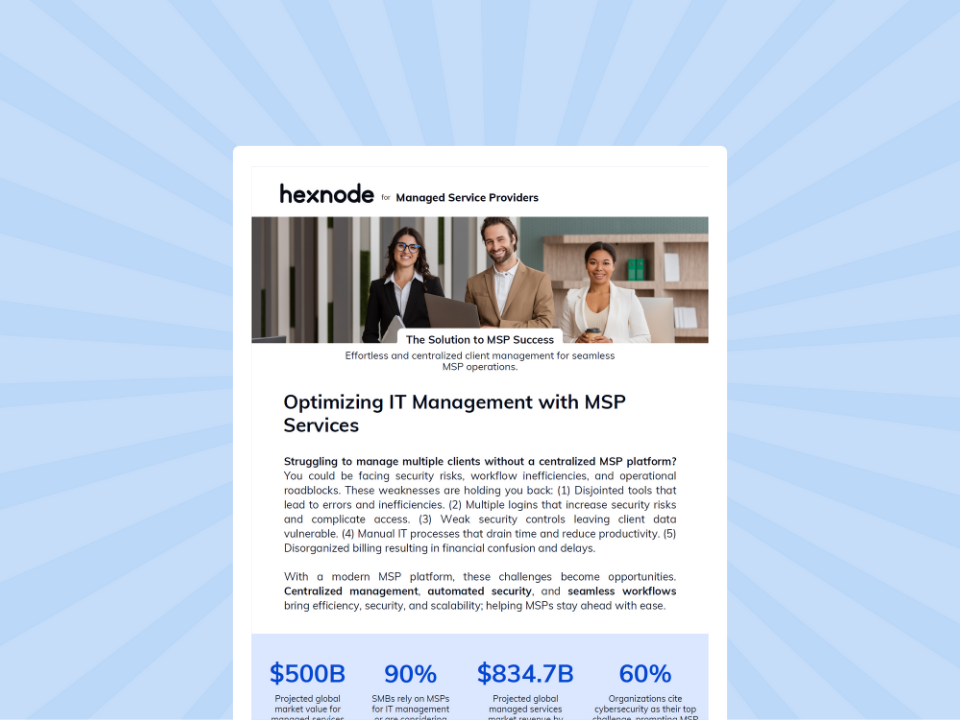
Hexnode UEM for MSPs
Hexnode UEM MSP centralizes client management, automates routine tasks, and strengthens security across managed environments.
Where does Hexnode create measurable ROI for MSPs?
Hexnode provides centralized multi-tenant management, automation workflows, and remote troubleshooting capabilities that MSPs can evaluate against their existing operational baselines.
Centralize multi-tenant management
Hexnode UEM MSP uses Multi-Tenant Management, where each customer operates as a separate Node within the MSP environment. A centralized dashboard lets technicians manage multiple tenants, while roles and scopes restrict access to authorized clients.
This gives MSP administrators centralized visibility across separate customer Nodes from the Hexnode MSP environment.
Automate repetitive endpoint tasks
Hexnode Automations supports:
Time- and activity-based triggers
Multi-action workflows
Target filtering
Manual workflow execution
Policy association, scripts, app actions, scans, and supported device controls
For MSPs, these capabilities can automate supported repeatable administration and maintenance actions that would otherwise require manual execution.
Reduce ticket and tooling overhead
Remote View and Remote Control can support endpoint troubleshooting without requiring physical access. Dynamic Device Groups automatically organize devices based on defined criteria, while built-in, custom, and scheduled reports support recurring operational visibility.
Because feature availability varies by platform and endpoint type, MSPs should validate these capabilities against their client environments before including projected savings in an ROI calculation.
FAQs
Which MSP workflows are best suited for automation?
Repetitive tasks such as policy deployment, device actions, scans, and app operations are strong automation candidates. Complex troubleshooting should still rely on technician judgment.
Can Hexnode replace every tool in an MSP stack?
No. MSPs should only count tooling savings where Hexnode can genuinely replace overlapping capabilities in their environment.
How can MSPs verify projected Hexnode ROI before migration?
Run a controlled pilot and compare results against current operational baselines. Track technician time, ticket handling, onboarding effort, and remaining tool requirements.
Is Hexnode a fit for your MSP operating model?
The answer depends on your endpoint count, client mix, technician workflows, ticket volume, and existing tool stack. MSP ROI should be based on measurable operational improvements, not generic savings claims.
Hexnode UEM MSP provides Multi-Tenant Management, a centralized MSP dashboard, single-login access across authorized Nodes, and role- and scope-based administrative controls, alongside its endpoint-management capabilities.
The next step is to compare these workflows against your current operating baseline.
A storyteller for practical people. Breaks down complicated topics into steps, trade-offs, and clear next actions—without the buzzword fog. Known to replace fluff with facts, sharpen the message, and keep things readable—politely.