Manual endpoint management drains MSP margins. Hexnode transforms this cost center into a profit driver by automating onboarding, patching, and proactive remediation. By centralizing multi-tenant operations, Hexnode eliminates manual overhead, slashes ticket volumes, and scales security; boosting profitability without increasing headcount.
Endpoint management has become one of the most expensive and complex responsibilities for managed service providers. Device sprawl, remote work, and multi-OS environments continue to increase operational overhead. At the same time, enterprise customers demand faster response times, stronger security controls, and consistent performance; often without a corresponding increase in contract value. MSP automation directly reduces operational variance and technician dependency across endpoint environments. By investing in endpoint automation for MSPs, service providers can reduce manual effort, improve consistency, and unlock higher endpoint margins at scale.
Platforms like Hexnode enable MSPs to move from reactive endpoint management to automated, policy-driven operations that scale across tenants and device types.
The shift toward device-centric environments has transformed endpoints into the frontline of enterprise IT, yet this expansion is actively cannibalizing MSP profitability. The sheer variety of hardware, from mobile devices to rugged kiosks, demands constant, high-touch oversight that shatters traditional labor models. Without rigorous standardization, every fragmented device becomes a cost center that drives up ticket volumes and forces expensive manual intervention.
The following operational factors systematically compress endpoint margins:
Manual provisioning slows onboarding
Custom configurations increase support complexity
Delayed patching leads to security incidents
Reactive troubleshooting consumes senior technician time
As endpoint counts grow, many MSPs rely on additional staff to keep up. This approach increases costs and limits scalability.
Addressing margin pressure requires more than incremental process improvements; it demands a structural shift toward MSP automation.
Understanding the Real ROI of MSP Automation
The ROI of MSP automation is realized through measurable reductions in labor dependency, incident frequency, and operational variance. While reduced technician effort is important, the real value comes from predictability, consistency, and scale.
When MSPs adopt the right MSP automation tools, they see measurable improvements across key performance indicators:
Lower tickets per endpoint
Faster mean time to resolution
Reduced escalation rates
Better SLA compliance
Higher customer retention
Automation compounds over time. Even marginal reductions in per-device intervention time produce significant margin expansion when applied across large endpoint fleets.
Hexnode supports this ROI-driven approach by turning endpoint policies into automated enforcement mechanisms. MSPs stop reacting to problems and start preventing them through structured automation.
Featured Resource
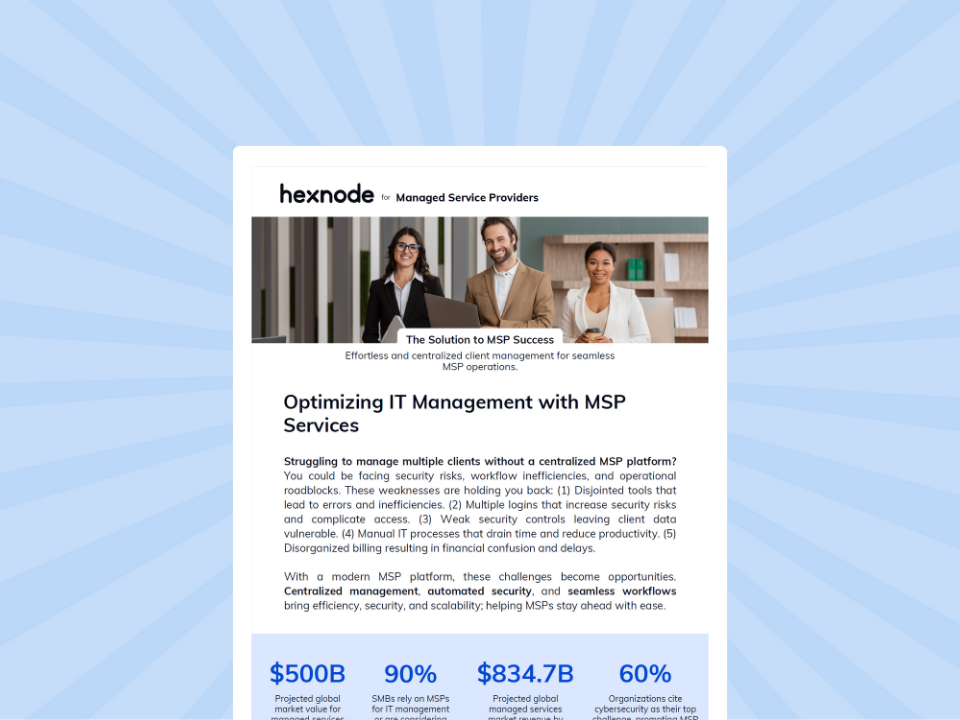
Hexnode UEM for MSPs
Hexnode UEM simplifies multi-client management with automation and centralized control.
Strategy 1: Automate Device Onboarding With Zero-Touch Provisioning
Device onboarding is one of the most margin-sensitive stages of endpoint management. Manual provisioning requires technicians to configure settings, deploy apps, and secure devices individually. This process does not scale for enterprise MSPs.
With Hexnode, MSPs can enroll devices using platform-native enrollment methods such as Apple Automated Device Enrollment, Android Enterprise, and Windows Autopilot. Once enrolled, predefined policies apply automatically—without technician involvement.
This enrollment architecture allows MSPs to:
Reduce onboarding time dramatically
Eliminate configuration errors
Apply security controls from day one
Accelerate enterprise client rollouts
By automating onboarding, MSPs reduce labor costs while onboarding more endpoints faster. This is a clear example of endpoint automation directly contributing to margin expansion.
Strategy 2: Standardize Endpoint Policies Across Customers
Custom configurations increase complexity and reduce efficiency. Each exception introduces risk, delays troubleshooting, and increases support effort.
Policy standardization solves this problem.
Hexnode allows MSPs to create reusable policy templates aligned to specific industries, device types, or compliance requirements. These policies define security baselines, restrictions, network settings, and application behavior.
Standardized automation helps MSPs:
Maintain consistent security posture
Reduce configuration drift
Simplify issue resolution
Lower training and onboarding costs
Operationally, policy automation enforces uniform security baselines and minimizes tenant-level configuration divergence. MSPs using standardized automation tools can support more endpoints with fewer resources—an essential factor in improving MSP profitability.
Hexnode enables:
Standardized policy creation within individual customer tenants
Dynamic grouping based on OS, ownership type, compliance state, or device model
Automated group-based policy assignment
OS-specific configuration profiles (iOS/macOS payloads, Windows configuration policies, Android restrictions)
App blacklisting and whitelisting enforcement
Kiosk lockdown configurations for dedicated-use endpoints
Strategy 3: Move From Reactive Support to Automated Remediation
Reactive endpoint support is one of the biggest margin killers in managed services. User-reported issues generate tickets, escalations, and manual intervention.
Automation shifts this model.
Hexnode continuously monitors endpoint compliance and device status. When a device deviates from defined policies, the platform can automatically trigger alerts and restrict access to corporate resources. From the console, MSPs can then quickly execute remote actions to lock devices, reset credentials, push configurations, or wipe compromised endpoints.
Automated remediation enables MSPs to:
Reduce ticket volume
Shorten resolution times
Prevent recurring issues
Protect SLA performance
This proactive approach is central to endpoint automation for MSPs. By resolving issues before users notice them, MSPs lower operational costs and improve service reliability.
Strategy 4: Automate Patch Management and OS Updates
Patch management remains one of the most critical yet resource-intensive endpoint tasks. Manual patching increases security risk and operational cost, especially in large enterprise environments.
Automation removes this burden.
Hexnode allows MSPs to schedule OS updates, enforce critical patches, and monitor compliance across devices and tenants. MSPs can define maintenance windows, delay non-essential updates, and force security patches when required.
Automated patch management helps MSPs:
Reduce vulnerability exposure
Avoid emergency remediation costs
Maintain regulatory compliance
Eliminate manual update workflows
When MSPs rely on MSP automation tools for patching, they gain predictability and control. This stability directly supports improving MSP profitability by reducing risk-driven support spikes.
Tool sprawl and context switching slow down MSP operations. Managing multiple consoles, credentials, and workflows reduces technician efficiency and increases response times.
Centralized management addresses this issue.
Hexnode provides a single console for managing multiple customers and tenants. MSPs can maintain tenant isolation while gaining centralized visibility and control. Role-based access ensures technicians operate within defined boundaries.
Centralization enables MSPs to:
Respond faster to endpoint issues
Reduce operational friction
Improve technician productivity
Scale services without adding tools
This centralized model is essential for endpoint automation for MSPs operating at enterprise scale. It simplifies operations while preserving security and separation.
This centralized model is essential for endpoint automation for MSPs operating at scale. Beyond core automation, Hexnode’s specialized capabilities drive further measurable gains in profitability:
Remote troubleshooting and control
Remote deployment of Wi-Fi configurations and enterprise certificates
Kiosk mode deployment
Real-time device inventory reporting
Geofencing policies
Comprehensive audit logs
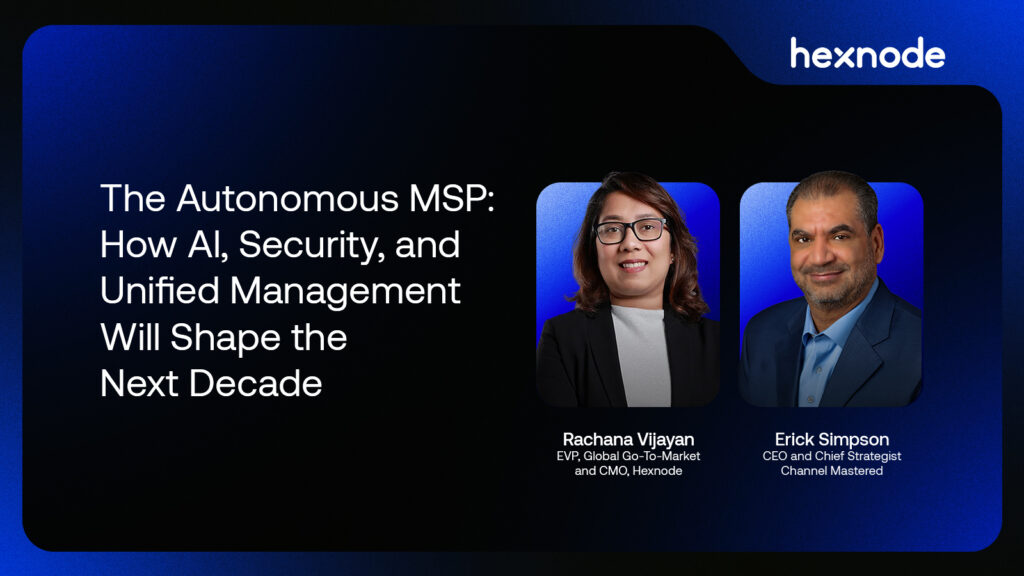
Adapting MSP Services With Unified Endpoint Management
How UEM helps MSPs streamline multi-tenant device management and win high-value clients.
Why Hexnode Is Built for MSP Automation at Scale
Hexnode is designed to support MSPs managing large, diverse endpoint environments. It combines automation, security, and multi-tenant control into a single platform.
Hexnode supports MSP growth through:
Multi-OS endpoint management
Policy-driven automation
Zero-touch enrollment
Real-time compliance monitoring
Secure remote actions
Scalable multi-tenant architecture
These capabilities allow MSPs to deliver consistent, enterprise-grade endpoint services while maintaining operational efficiency. Automation becomes embedded into daily workflows, directly contributing to increasing profitability.
FAQs
How does endpoint automation directly increase MSP profit margins?
Automation replaces expensive, manual labor with scalable, policy-driven workflows. By eliminating “hand-touch” tasks like manual device staging and reactive troubleshooting, MSPs can support significantly larger endpoint fleets without increasing headcount. This shift slashes the cost-per-device and transforms endpoint management from a high-overhead burden into a high-margin revenue stream.
Can MSPs maintain security across diverse hardware without increasing technician workload?
Yes. High-performance automation platforms like Hexnode enforce standardized security baselines across iOS, Android, Windows, and macOS simultaneously. By automating patch management and compliance monitoring, the system identifies and remediates vulnerabilities in real-time. This proactive enforcement ensures a superior security posture while shielding your technicians from the time-consuming cycles of manual auditing and emergency patching.
Conclusion: Automation Is the Fastest Path to Higher Endpoint Margins
Endpoint margins shrink when MSPs depend on manual processes. They grow when MSPs adopt automation as a core operating model.
By automating onboarding, standardizing policies, enabling proactive remediation, streamlining patch management, and centralizing multi-tenant operations, MSPs can significantly improve efficiency and profitability.
With the right MSP automation tools, such as Hexnode, MSPs can scale securely, meet enterprise expectations, and double endpoint margins without increasing operational costs.
Turn Endpoint Operations Into a Profit Center
Reduce manual effort, cut ticket volume, and improve MSP profitability with automated endpoint management.
Content writer at Hexnode. Fueled by good coffee and the occasional cat cuddle, I enjoy crafting content that informs, connects, and resonates. Nothing excites me more than knowing my words have been read, appreciated, and maybe even bookmarked.