The managed services market is evolving rapidly. Traditional MSP offerings like device management, software deployment, and helpdesk support no longer provide enough differentiation in a security-driven landscape. Customers now expect providers to deliver proactive cybersecurity, compliance readiness, and continuous protection against growing threats.
As a result, many providers are transitioning from MSP to MSSP models. However, building managed security services requires more than adding new security tools.
Providers need a layered, security-first operational framework that starts with endpoint visibility, strengthens identity controls, and matures into threat detection and response. This framework helps MSPs scale security operations without increasing operational complexity.
The shift toward managed security services is not just a market trend. It is becoming a business necessity.
Customers increasingly expect their service providers to:
reduce cyber risk,
improve compliance posture,
manage endpoint security,
monitor threats continuously,
and respond quickly to incidents.
Traditional IT management alone cannot meet those expectations.
At the same time, cybersecurity complexity continues to grow. Businesses now manage:
remote employees,
unmanaged devices,
cloud applications,
identity-based attacks,
and evolving compliance mandates.
Most small and mid-sized organizations lack the internal resources to handle these challenges independently. As a result, they increasingly rely on external providers for security expertise.
This demand creates a major opportunity for MSPs.
By expanding into managed security services, providers can:
create higher-value service offerings,
increase recurring revenue,
strengthen customer retention,
improve competitive positioning,
and establish long-term strategic partnerships with clients.
However, providers must approach the MSP to MSSP transition carefully. Security operations require stronger operational discipline than traditional IT management.
The challenge is not simply adding more tools. The real challenge involves building a security-first operational model that scales effectively.
Step 1: Build Endpoint Visibility and Control
Every successful MSSP foundation starts with endpoint visibility.
Before providers can deliver advanced security services, they need centralized control over the environments they manage. Without consistent visibility into endpoints, applications, configurations, and device posture, security operations quickly become fragmented and reactive.
This is where unified endpoint management becomes critical.
A strong UEM strategy allows providers to:
inventory managed devices,
standardize security policies,
automate patch deployment,
enforce compliance baselines,
manage applications centrally,
and reduce configuration drift across environments.
In other words, providers cannot secure what they cannot manage.
Many MSPs attempt to deliver security services while operating disconnected management systems across customer environments. That approach creates inconsistent policies, limited visibility, and operational inefficiencies that directly impact security outcomes.
A centralized endpoint management framework solves these problems by establishing operational consistency.
Providers should focus on several core capabilities during this stage.
Standardization improves both security and operational efficiency.
Automate Patch Management
Unpatched systems remain one of the most common attack vectors. Manual patch management becomes increasingly difficult as customer environments grow.
Automation helps providers:
reduce vulnerability exposure,
maintain compliance,
and improve response times across distributed environments.
Establish Device Compliance Monitoring
Continuous compliance monitoring helps providers identify risky or non-compliant devices before they become security liabilities.
This process becomes especially important in hybrid work environments where devices frequently operate outside traditional network boundaries.
Improve Operational Visibility
A centralized management platform gives providers better insight into:
device health,
application inventory,
operating system versions,
user activity,
and policy violations.
That visibility creates the operational foundation required for more advanced security services later.
For many providers, this phase represents the most important step in transitioning from MSP to MSSP. Without operational maturity at the endpoint layer, advanced security tools often generate more complexity than value.
Step 2: Introduce Identity and Zero Trust Principles
Once providers establish endpoint visibility, the next phase involves strengthening identity and access security.
Modern attacks increasingly target identities instead of infrastructure. Compromised credentials, privilege escalation, and unauthorized access now play a central role in many successful breaches.
As a result, identity has become the new security perimeter.
Providers expanding into managed security services must move beyond traditional network-centric security models and adopt Zero Trust principles.
A Zero Trust approach assumes that no user, device, or application should receive automatic trust. Every access request requires validation based on identity, device posture, location, and risk context.
This approach significantly reduces the likelihood of lateral movement and unauthorized access within customer environments.
Featured Resource
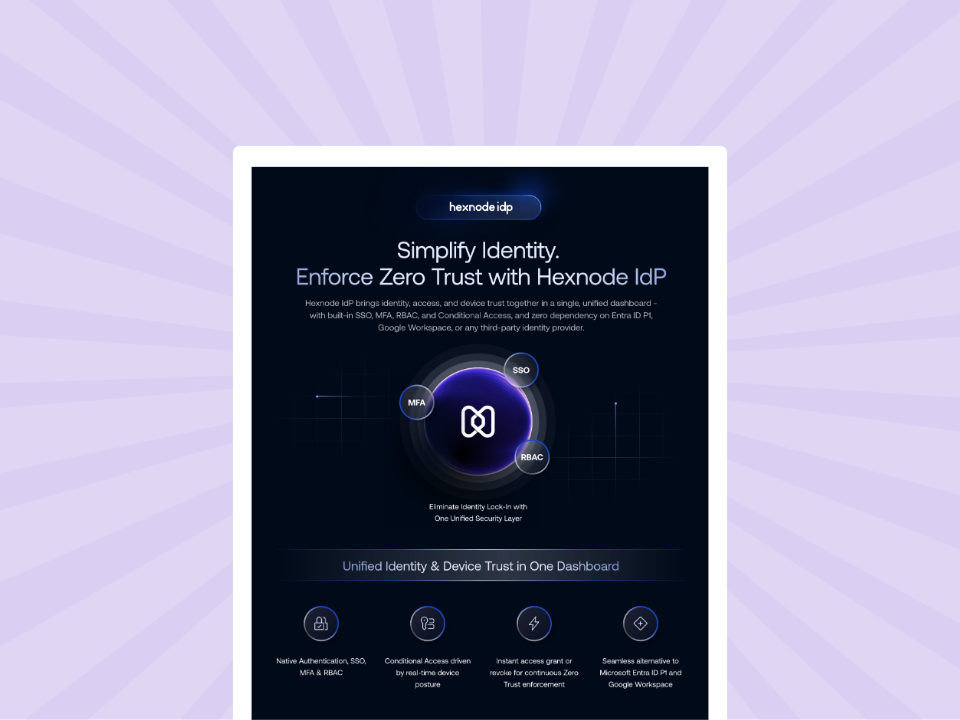
Hexnode IdP Info sheet
Simplify identity management and strengthen device trust across your organization with Hexnode IdP.
These controls reduce credential-based attack risks significantly.
Support Compliance Objectives
Identity governance also plays an important role in regulatory compliance. Many compliance frameworks require:
access auditing,
user accountability,
privilege management,
and authentication controls.
A mature identity strategy helps providers support those requirements more effectively.
This stage represents a major operational shift in the MSP to MSSP journey. Providers begin moving from reactive device management toward proactive security governance.
Step 3: Add Detection, Response, and Security Automation
After establishing operational visibility and identity security, providers can begin expanding into advanced security operations.
This stage introduces capabilities commonly associated with mature MSSPs:
threat detection,
behavioral analysis,
incident response,
telemetry correlation,
and security automation.
However, providers should approach this phase strategically.
Many organizations attempt to implement advanced detection tools before developing operational discipline in earlier stages. That mistake often leads to overwhelming alert volumes, inconsistent response workflows, and understaffed security operations.
Once those foundations exist, providers can scale security capabilities more effectively.
The Ultimate Guide to XDR
Understand XDR essentials, architecture, benefits, and implementation for stronger threat detection.
Consolidate Security Signals
Security teams often struggle with disconnected tools generating isolated alerts across different systems.
A unified detection strategy helps providers:
correlate security events,
identify suspicious behavior faster,
and reduce investigation time.
Extended Detection and Response (XDR) platforms can improve visibility across:
endpoints,
users,
applications,
and network activity.
Reduce Alert Fatigue
One of the biggest operational challenges for growing MSSPs involves alert fatigue. Security teams cannot investigate every low-priority event manually.
Automation helps providers:
prioritize high-risk incidents,
streamline triage workflows,
and reduce operational overhead.
Improve Incident Response Readiness
Security incidents require fast, consistent response procedures. Providers should establish:
escalation workflows,
containment procedures,
remediation policies,
and reporting processes.
Operational consistency becomes increasingly important as customer environments scale.
Scale Security Operations Efficiently
Hiring large security teams is not always realistic for growing providers. Automation and unified management platforms help organizations scale security services without dramatically increasing staffing requirements.
This stage represents the operational maturity layer of managed security services. Providers move beyond IT management and begin delivering measurable security outcomes.
Common Mistakes Providers Make During the MSP-to-MSSP Transition
Many providers struggle during the transition because they prioritize tooling over operational strategy. Several common mistakes repeatedly create problems.
Buying Too Many Disconnected Tools
Security tool sprawl increases operational complexity and reduces visibility. Providers often deploy multiple overlapping products without establishing unified workflows.
A fragmented stack creates management overhead and slows incident response.
Skipping Foundational Security Controls
Some providers jump directly into advanced detection platforms without standardizing endpoint management or identity controls first.
Advanced security capabilities work best when built on strong operational foundations.
Ignoring Identity Security
Endpoints matter, but identity-based attacks continue to rise rapidly.
Providers that overlook identity governance leave major security gaps unaddressed.
Underestimating Operational Requirements
Managed security services require:
continuous monitoring,
policy management,
incident handling,
and process maturity.
Providers must build repeatable operational workflows instead of relying on ad hoc security practices.
Treating Security as an Add-On Service
Security cannot operate effectively as a disconnected add-on. Successful MSSPs integrate security into every operational layer, from endpoint management to access control and threat response.
Building a Unified Security-First Stack with Hexnode
A fragmented security stack creates operational friction for growing MSSPs. Separate tools for endpoint management, identity governance, patching, compliance monitoring, and threat detection often produce inconsistent policies, duplicated workflows, and limited visibility across customer environments.
As providers transition from MSP to MSSP, operational consolidation becomes critical.
A unified platform approach helps providers standardize security operations across tenants while reducing the administrative overhead associated with managing multiple disconnected systems.
Hexnode supports this layered security model by combining endpoint management, policy enforcement, identity-aware controls, and emerging security operations capabilities within a centralized management framework.
Establishing Endpoint Visibility Across Multi-Tenant Environments with Hexnode UEM
The foundation of managed security services starts with endpoint visibility.
Hexnode UEM enables providers to manage:
Windows,
macOS,
Linux,
Android,
iOS,
ChromeOS,
and rugged devices
from a centralized console.
For MSPs managing distributed customer environments, centralized visibility improves:
asset tracking,
device lifecycle management,
policy enforcement,
and compliance monitoring.
Technicians can monitor:
device health,
OS versions,
encryption status,
installed applications,
security posture,
and policy deviations, without switching between isolated management tools.
This visibility becomes especially important in hybrid and remote work environments where unmanaged or non-compliant endpoints frequently introduce security risks.
Standardizing Security Policies at Scale
Hexnode allows providers to create and deploy standardized security configurations across multiple customer environments using policy-based management.
Teams can enforce:
password complexity requirements,
BitLocker and FileVault encryption policies,
USB and peripheral restrictions,
kiosk configurations,
firewall settings,
VPN configurations,
Wi-Fi policies,
and browser restrictions through centralized policy controls.
This standardization reduces configuration drift across endpoints and helps providers maintain consistent security baselines across tenants.
Role-based access control (RBAC) also allows MSPs to segment technician access securely between customer environments while maintaining centralized administrative oversight.
Patch and Application Management
Patch management remains one of the most operationally intensive responsibilities for providers delivering managed security services.
Hexnode helps reduce this burden through automated patch deployment workflows for operating systems and third-party applications.
Providers can:
schedule patch deployments,
automate update enforcement,
define maintenance windows,
monitor patch compliance,
and identify missing updates and outdated endpoints from a unified console.
Application management capabilities further improve operational control by allowing technicians to:
remotely deploy applications,
blacklist unauthorized software,
manage application updates,
and maintain approved software inventories.
These capabilities help reduce attack surfaces while improving compliance readiness across managed environments.
Strengthening Zero Trust Through Identity-Aware Controls
Modern security architectures increasingly depend on identity validation and device trust rather than traditional perimeter-based controls.
Hexnode strengthens Zero Trust strategies by combining device posture enforcement with identity-centric access management.
Providers can implement conditional access policies based on:
device compliance status,
encryption state,
operating system versions,
and security policy adherence.
This approach allows organizations to restrict access from unmanaged, compromised, or non-compliant endpoints before they introduce security risks into the environment.
Identity-focused controls also support:
least-privilege access models,
authentication governance,
and access segmentation strategies
that reduce lateral movement opportunities for attackers.
For MSSPs supporting compliance-driven industries, centralized identity and device governance simplifies audit preparation and strengthens overall security posture.
Improving Threat Visibility with Hexnode XDR Capabilities
As providers mature their managed security services offerings, visibility into suspicious activity and threat telemetry becomes increasingly important.
Hexnode XDR capabilities help organizations correlate security events across endpoints and improve incident visibility through centralized monitoring workflows.
Security teams can use XDR-driven telemetry to:
identify anomalous behavior,
investigate suspicious activity,
prioritize high-risk incidents,
and streamline response workflows.
Instead of relying entirely on isolated security alerts, providers gain broader operational context across managed environments.
This centralized visibility helps reduce alert fatigue while improving investigation efficiency for growing security operations teams.
Simplifying MSSP Operations Through Centralized Management
Operational scalability often becomes the biggest challenge during the MSP to MSSP transition.
As providers onboard more customers, disconnected tools create:
administrative overhead,
inconsistent workflows,
fragmented reporting,
and slower incident response processes.
Hexnode helps simplify MSSP operations through centralized administration, multi-tenant management capabilities, and unified policy orchestration.
Providers can:
manage multiple customer environments from a single interface,
apply standardized security controls across tenants,
streamline technician workflows,
and reduce operational complexity without dramatically increasing staffing requirements.
For organizations building managed security services incrementally, this operational efficiency becomes a significant advantage.
Rather than stitching together multiple overlapping products, providers can build a more cohesive security-first operational framework that supports both scalability and long-term security maturity.
Conclusion
The MSP to MSSP transition is no longer optional for many providers. Customers increasingly expect security expertise alongside traditional IT management services.
However, successful providers do not approach security as a collection of disconnected tools. They build a security-first operational framework that matures in stages.
The process starts with endpoint visibility and control. It expands into identity-driven security and Zero Trust principles. Finally, it evolves into advanced detection, response, and security automation.
Providers that establish strong operational foundations early can scale managed security services more effectively while avoiding unnecessary complexity.
As cybersecurity expectations continue to rise, MSPs that operationalize security maturity now will position themselves for long-term growth, stronger customer relationships, and greater competitive differentiation.
Grow Beyond Traditional MSPs
Start securing every managed endpoint with scalable, enterprise-ready endpoint management.
MSPs can use tiered security packages that align with different customer risk levels and budgets, making adoption easier while creating opportunities for upselling.
How can providers evaluate their MSSP growth?
Key indicators include increased security revenue, higher customer retention, improved incident response times, and greater adoption of security services.
Content writer at Hexnode. Fueled by good coffee and the occasional cat cuddle, I enjoy crafting content that informs, connects, and resonates. Nothing excites me more than knowing my words have been read, appreciated, and maybe even bookmarked.