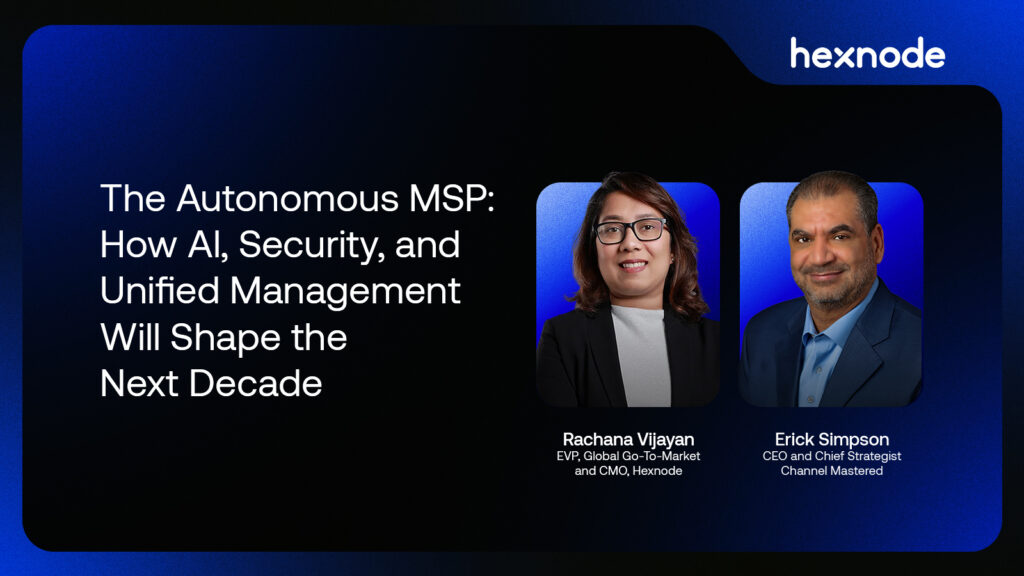
- At HexCon26, Erick Simpson and Rachana Vijayan explored how AI is reshaping MSP services, technology decisions and the value providers deliver.
- Erick Simpson highlighted how AI savings – such as four hours per technician each week– can create room for more customer-facing work and better client outcomes.
- Rachana Vijayan reported around a 300% increase in customer or prospect communication and said Hexnode Genie successfully handled about 65% of chats, illustrating AI’s role in daily operations.
- For the Autonomous MSP, Erick advised auditing the technology stack, while Rachana emphasized connecting management, security and identity signals to support employees’ ability to work.
If AI saves a technician four hours a week, what should an MSP do with that time?
The answer has implications for the provider’s costs, client relationships and service offering. Faster ticket resolution is useful. So is having more capacity to help a client improve onboarding, prepare for compliance requirements or put existing technology to better use.
At HexCon26, Erick Simpson, CEO and Chief Strategist at Channel Mastered, joined Rachana Vijayan, Hexnode’s EVP of Global Go-To-Market and CMO, to discuss the autonomous MSP. Their conversation connected the practical uses of AI with a broader business question: how can providers turn greater efficiency into a service clients recognize and value?
Turn AI Savings into Value Clients Can See
Ticket volumes and technician utilization help an MSP understand its workload. They reveal less about whether a client’s business is running better. Erick pointed to faster onboarding and smoother compliance as results that show the value of managed services. When competing proposals list similar activities, those results give clients a reason to look beyond price. “We’re taking the conversation from the server room into the boardroom,” he said.
AI savings need the same focus. Erick used the example of a technician saving four hours a week. Providers should decide how to use that time before introducing the tool. Some MSPs use it to help clients adopt AI and other technologies, supporting customer retention and growth.
IT teams also need more than device policies to make informed decisions. Rachana described bringing device management, security and identity signals together to protect employees while they work. Moving to this approach takes time and training.
Hexnode Genie shows how AI can help with daily tasks. Rachana described users asking it to find information, navigate the product or explore what might be causing an issue. This saves them from searching through documentation and tabs. She reported around 300% more communication with customers or prospects, with Genie successfully handling about 65% of chats. Leaders still need to decide where AI fits and set policies for its use.
Build a Stack That Connects Devices, Security and Access
Many MSPs use remote monitoring and management, or RMM. But Rachana stressed the need for more: device policies, patching, compliance checks and identity information. Devices may be company-owned or personal and used across locations. “It’s the user’s access that you’re managing. It is the user’s experience that you’re managing,” she said.
Using separate tools adds work. Teams must connect them and check whether their information gives a reliable picture. Each vendor may also have access to customer systems or data, with its own security and incident response practices.
Combining tools needs care too. Erick advised reviewing each product’s access and how problems would be handled. Together, the tools should support the outcome promised to the client.
Know the Cost. Price the Outcome. Deliver the Promise.
An MSP needs to know its delivery costs before setting a price. Erick said this includes software, the work of managing it, and time spent by technicians and customer-facing staff. Providers can then price the service and review it as costs change.
The offer should make the client’s expected results clear. A monthly service might include guidance on cybersecurity or AI alongside routine support. Erick advised making those results the focus of the sales conversation.
For Rachana, managed security means protecting data while giving employees the access and resources they need. Digital employee experience, or DEX, helps teams spot and fix problems before they interrupt work.
Changing endpoint platforms needs the same care. Teams must prepare staff and keep devices and applications working during the move. Rachana pointed to Hexnode Gateway as a tool to help clients move from an existing UEM platform. The aim is to introduce new controls without disrupting employees’ work.
The Next 12 Months: Assign Ownership and Audit the Stack
For the next 12 months, Erick recommended giving one person ownership of AI planning, rollout and client conversations. He also advised reviewing the tools already in use. Check which products are underused and whether new ones support client goals at a cost the MSP can sustain.
Rachana focused on employees. Policy and device changes can affect access and interrupt work. Teams should anticipate these issues across locations and ensure employees have the devices, apps and access they need from day one.
For MSP leaders, the next steps are clear: assign an AI owner, review the stack and keep employees’ ability to work central to security decisions. That helps turn promised outcomes into everyday service.
Frequently Asked Questions (FAQs)
What should an MSP define before offering an outcome-based service?
Choose a result the client can recognize, such as faster onboarding or smoother compliance work. Work out the staff time, software and support needed to deliver it. Use those costs to price the service, then check whether it delivers the promised result.
How can an MSP turn time saved by AI into value for clients?
Plan how to use the time before introducing the tool, and assign someone to carry out that plan. Staff could spend more time helping clients adopt existing technologies. Success means clients get more from the service, beyond faster responses.
What should an MSP assess when expanding beyond RMM?
Check whether the tools provide enough information to manage device policies, patching, security and access together. Review each product’s access and the vendor’s incident response plans, even when consolidating tools. If changing platforms, prepare staff and keep applications and employee access available during the move.