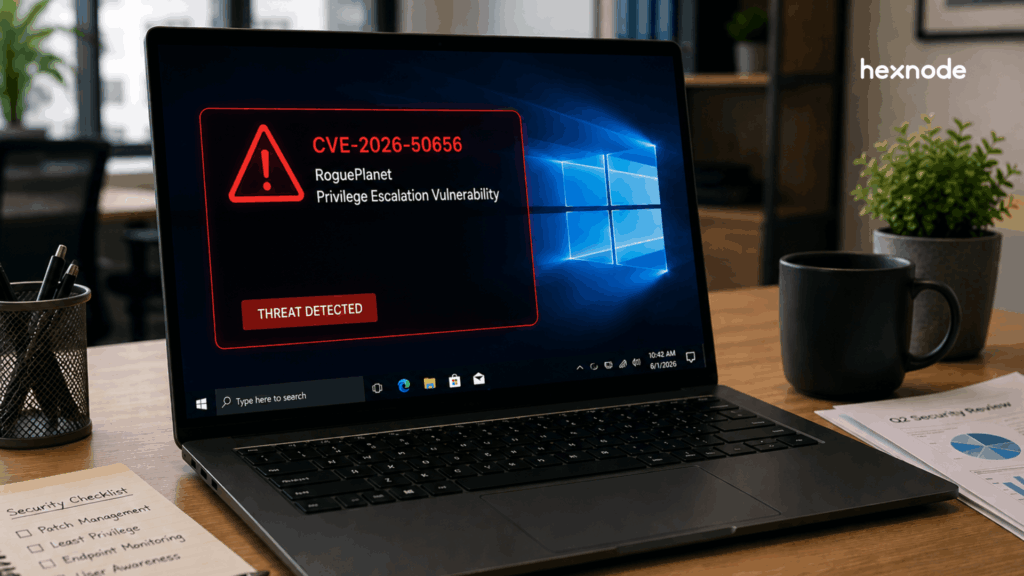
Microsoft has confirmed RoguePlanet, a newly disclosed Microsoft Defender zero-day tracked as CVE-2026-50656, and says a security update is in development. The vulnerability affects the Microsoft Malware Protection Engine and has been classified as an elevation-of-privilege flaw with a CVSS score of 7.8.
Public proof-of-concept code reportedly demonstrates a race-condition-based technique that may allow an attacker with local access to obtain SYSTEM-level privileges on Windows systems. While no active exploitation has been publicly confirmed, organizations should review endpoint hardening measures and prepare to deploy Microsoft’s fix when it becomes available.
Microsoft Acknowledges RoguePlanet as CVE-2026-50656
Microsoft has formally acknowledged a vulnerability known as RoguePlanet, assigning it the identifier CVE-2026-50656. The flaw affects the Microsoft Malware Protection Engine used by Microsoft Defender and has been classified as an elevation-of-privilege vulnerability.
Security researcher Chaotic Eclipse, also known as Nightmare-Eclipse, publicly disclosed the issue by releasing technical details and proof-of-concept code that demonstrated the reported behavior. After the initial reports emerged, Microsoft acknowledged the vulnerability, began investigating it, and later confirmed that it is developing a security update.
The disclosure follows several previously reported Defender-related vulnerabilities from the same researcher, including BlueHammer, UnDefend, and RedSun, all of which have since received patches.
Although Microsoft has acknowledged the issue, the company has not announced a release date for remediation and has not publicly disclosed evidence of active exploitation.
Based on publicly available information, RoguePlanet is described as a race-condition vulnerability within Defender-related operations. The proof-of-concept reportedly exploits this condition to spawn a command shell running with SYSTEM-level privileges, one of the most privileged local account contexts on Windows endpoints.
Importantly, RoguePlanet is not an initial access vulnerability. It does not appear to provide remote code execution or direct access to a device. Instead, it may allow an attacker who already has code execution or user-level access on a system to elevate privileges.
Reports indicate that the proof-of-concept can function regardless of whether Microsoft Defender real-time protection is enabled. However, Microsoft has not publicly validated every technical claim associated with the researcher’s demonstration.
Because Microsoft Defender protects a large number of enterprise Windows environments, a vulnerability affecting one of its core security components can impact more than a single application or workload.
What Security Teams Know So Far
Several important details have been confirmed.
Microsoft has assigned the vulnerability CVE-2026-50656 and given it a CVSS score of 7.8. The company has acknowledged the issue, confirmed that it affects the Microsoft Malware Protection Engine, and stated that a patch is under development.
Public proof-of-concept code is available, and the vulnerability has been described as capable of obtaining SYSTEM-level privileges when exploitation succeeds.
At the same time, significant questions remain unanswered.
There has been no public confirmation of widespread exploitation in real-world attacks. No victim organizations have been identified, and no public reporting reviewed at the time of writing has linked the vulnerability to data theft, credential theft, ransomware deployment, or other post-compromise activity.
Microsoft has also not disclosed the complete scope of affected environments or provided a timeline for patch availability.
As a result, organizations should focus on the confirmed technical risks while avoiding assumptions about active exploitation or operational impact.
Best Enterprise Patch Management Tools for 2026
Learn what separates effective enterprise patch management tools from the rest.
Why RoguePlanet Matters for Enterprise Endpoints
Privilege escalation vulnerabilities often become valuable tools after an attacker establishes an initial foothold. While RoguePlanet does not appear to provide direct access to a system, it may enable attackers to expand their control over a compromised device.
If an attacker already gains access through phishing, malware execution, misuse of remote support tools, or compromised credentials, a successful privilege escalation could provide elevated permissions that make subsequent actions easier.
Potential post-compromise objectives may include persistence, credential harvesting, security control tampering, or lateral movement. Although no public reports have linked these activities to RoguePlanet, attackers commonly pursue them after obtaining elevated privileges on Windows systems.
The vulnerability is particularly relevant because Microsoft Defender is widely deployed across enterprise environments. Any weakness affecting a core security component warrants close attention from endpoint security teams responsible for maintaining device integrity and operational resilience.
Preparing for Microsoft’s Fix
Until Microsoft releases a patch, organizations should focus on reducing opportunities for privilege escalation and strengthening endpoint security controls.
Organizations can also review CISA’s guidance on reducing privilege escalation risks and strengthening endpoint security controls as part of their interim mitigation strategy.
Organizations evaluating exposure to RoguePlanet can benefit from a combination of endpoint management and endpoint investigation capabilities.
Hexnode UEM
Hexnode UEM can help administrators maintain security posture across Windows devices through centralized policy enforcement and compliance management. Teams can use it to support least-privilege initiatives, enforce device security configurations, manage applications, and manage Windows patch posture where applicable.
Centralized visibility into managed devices can also help organizations identify systems that require remediation and validate compliance with internal security requirements.
Hexnode XDR
Hexnode XDR provides endpoint-focused detection, investigation, and response capabilities that can assist security teams during a potential compromise.
Security analysts can investigate suspicious endpoint activity using endpoint telemetry, detailed endpoint data searches, and process tree analysis. Security teams can respond to malicious activity by isolating affected devices, terminating suspicious processes, quarantining files, and deleting the process root where applicable.
While no public information currently confirms active exploitation of RoguePlanet, maintaining endpoint visibility and response readiness remains important during any zero-day disclosure period.
Conclusion
The disclosure of RoguePlanet highlights the challenges organizations face whenever a security vulnerability emerges in a widely deployed endpoint protection component.
Microsoft has confirmed the issue as CVE-2026-50656 and is developing a fix, but enterprises should not wait for a patch before reviewing their defensive posture. Strengthening least-privilege controls, maintaining device compliance, and ensuring visibility into endpoint activity can help reduce risk during the period between disclosure and remediation.
As more technical details and patch guidance become available, security teams should continue monitoring vendor updates and prepare for rapid deployment across affected Windows environments.
Stay Ahead of Emerging Security Threats
Stay informed about critical threats and learn how to strengthen your organization's security posture.
I write at the intersection of technology, process, and people, focusing on explaining complex products with clarity. I break down tools, systems, and workflows without any noise, jargon, or the hype.