Government endpoints are harder to secure because distributed devices, sensitive data, legacy systems, shared use, and compliance requirements create complex risks. Gov Cloud strengthens the management environment, while UEM helps agencies control, monitor, and protect the endpoints accessing government systems.
Government endpoints are harder to secure because they often support sensitive public-sector workflows across distributed laptops, mobile devices, rugged devices, shared tablets, and kiosks. Unlike a standard corporate fleet, these devices operate across departments, field teams, public facilities, contractor environments, and mission-critical response scenarios.
IT admins and IT directors may need to secure law enforcement devices, field inspection tablets, healthcare endpoints, public-service kiosks, contractor laptops, education devices, and emergency-response devices under the same endpoint security strategy. Each device type carries a different risk profile, user model, connectivity pattern, and compliance requirement.
The operational challenge is control without disruption. Agencies need centralized endpoint visibility, policy enforcement, access control, and configuration management, but endpoint teams often work within strict procurement cycles, legacy applications, remote-user constraints, and limited IT bandwidth.
Shared-device use adds another layer of complexity. A tablet used by multiple field workers or a kiosk accessed by the public requires tighter session control, app restrictions, and data protection than a single-user office laptop. This is where Gov Cloud endpoint security becomes an operational requirement, not just a security initiative.
What is at risk when government endpoints are not secured properly?
Weak endpoint security exposes government agencies to risks that extend beyond individual devices. An unmanaged laptop, shared tablet, rugged handheld, or kiosk can become an entry point for:
Unauthorized access to agency systems and applications
Data exposure from lost, stolen, or misused devices
Outdated operating systems with unpatched vulnerabilities
Shadow IT that bypasses IT visibility and control
These gaps also weaken operational oversight. Without consistent endpoint controls, IT teams may struggle to:
Prove device compliance during audits
Identify policy drift across departments
Detect risky or unauthorized apps
Respond quickly when a device is lost, stolen, compromised, or used outside approved workflows
The result is slower incident response and larger audit gaps.
For public-sector teams, endpoint risk directly becomes mission risk. A compromised or unmanaged endpoint can disrupt citizen services, public safety operations, field reporting, healthcare delivery, education access, and day-to-day agency productivity.
Law enforcement and criminal justice environments face additional pressure because endpoints may interact with systems that process, store, or transmit Criminal Justice Information. In those cases, endpoint security must support the safeguards required under CJIS Security Policy expectations, especially around access control, system integrity, accountability, and data protection.
Featured Resource
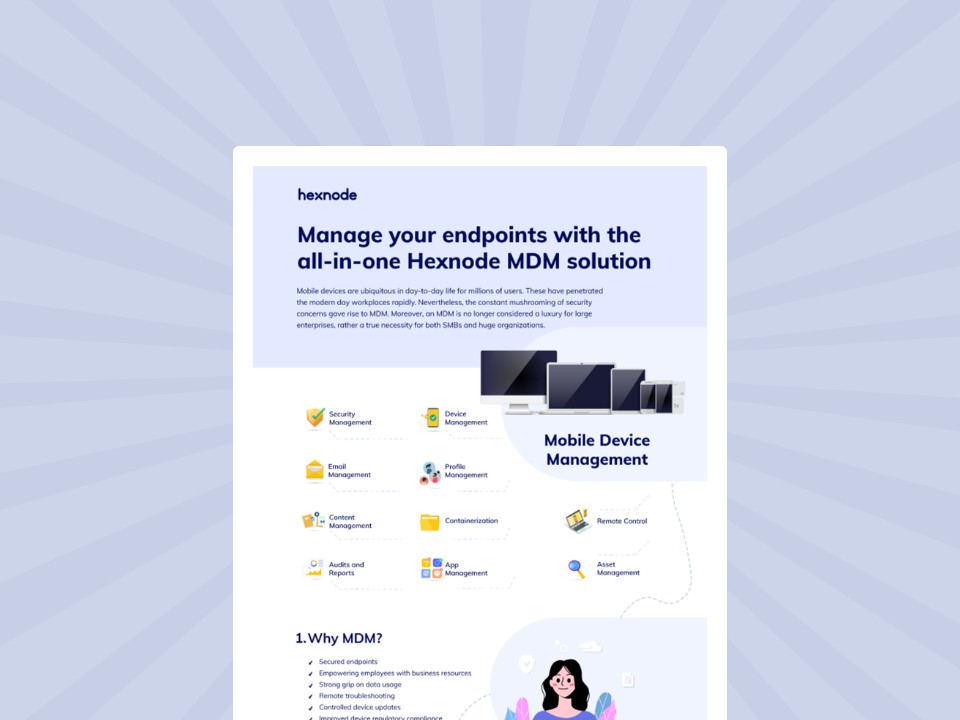
Manage your endpoints with the all-in-one Hexnode UEM solution
See how Hexnode UEM empowers mobile workforces with secure, efficient device management.
Gov Cloud is a cloud environment designed for government or regulated workloads that need stronger controls around security, compliance, data residency, access, and audit readiness. In endpoint security, Gov Cloud refers to the trusted cloud environment where endpoint management and security services may be hosted and operated.
Gov Cloud is not an endpoint security feature by itself. It does not automatically secure laptops, tablets, kiosks, rugged devices, or mobile endpoints. Instead, it provides the hosting and operational foundation through which cloud services, including Unified Endpoint Management platforms, can deliver:
Device enrollment
Policy deployment
Compliance monitoring
Identity-based access
Reporting and audit support
This distinction matters for Gov Cloud endpoint security. The cloud environment helps address infrastructure-level requirements, while endpoint controls still depend on how agencies configure:
Device policies
Access rules
Application restrictions
OS update enforcement
Encryption
Logging
Incident response workflows
Official cloud providers describe Gov Cloud environments in infrastructure and compliance terms. Microsoft states that Azure Government uses physically isolated U.S.-only datacenters and networks for government workloads. AWS says AWS GovCloud helps customers architect solutions for requirements such as FedRAMP High, CJIS, ITAR/EAR, and DoD cloud security requirements.
How does Gov Cloud strengthen endpoint security programs?
Gov Cloud strengthens endpoint security programs by improving trust in the environment around endpoint management, especially the cloud control plane agencies use to configure, monitor, and govern devices. It helps address concerns around hosting boundaries, access restrictions, data residency, auditability, and compliance evidence for regulated public-sector workloads.
This matters because cloud-based endpoint management depends on a management system that stores configurations, receives device signals, applies policies, and produces reports. When that control plane runs in a government-focused cloud environment, agencies gain stronger alignment with public-sector expectations for infrastructure separation, identity controls, logging, and compliance documentation.
However, Gov Cloud does not replace endpoint controls. Agencies still need to manage what happens on the actual devices, including device enrollment, policy enforcement, application management, OS update visibility, encryption, passcode rules, remote wipe, and compliance reporting.
A simple way to frame the relationship is this: Gov Cloud secures where the management system runs; UEM secures what happens on the devices. For Gov Cloud endpoint security to work in practice, agencies need both a trusted cloud operating environment and disciplined endpoint governance across every device type.
How to Conduct an Endpoint Security Audit
Learn how to conduct an endpoint security audit with a practical checklist and best practices.
How should agencies secure endpoints using Gov Cloud and UEM?
Agencies should secure endpoints by pairing the right Gov Cloud model with a structured UEM workflow that governs devices from enrollment to remediation. The goal is to standardize controls without ignoring the different risk levels across field, public-facing, shared, and remote endpoints.
A practical workflow includes:
Classify device use cases: Separate rugged field devices, shared tablets, law enforcement devices, healthcare endpoints, public-service kiosks, contractor laptops, and mobile devices used outside agency networks.
Identify sensitive data exposure: Determine which endpoints access citizen records, health data, criminal justice systems, field reports, internal applications, or regulated agency resources.
Choose the appropriate cloud model: Match the cloud environment to the agency’s security, data residency, procurement, and compliance requirements.
Enroll devices into UEM: Bring agency-owned and approved contractor devices under centralized management before they access sensitive workflows.
Assign baseline policies: Enforce passcodes, encryption, screen-lock rules, network restrictions, and minimum OS requirements.
Deploy required apps: Push approved applications, certificates, Wi-Fi settings, VPN profiles, and agency resources based on role or department.
Control application access: Block or allow specific apps to reduce shadow IT, prevent unapproved data sharing, and limit risky software.
Monitor compliance continuously: Track OS versions, policy status, encryption state, app inventory, and device health.
Remediate risky endpoints: Use remote lock, remote wipe, app removal, or access restriction when devices are lost, stolen, non-compliant, or no longer assigned.
Controls should map directly to mission use cases. Public-service kiosks need kiosk mode and app lockdown. Rugged field devices need update visibility and offline-tolerant policies. Law enforcement and healthcare endpoints need stricter access, encryption, and audit controls. Contractor laptops and remote mobile devices need clear compliance checks before accessing agency systems.
FAQs
Does Gov Cloud automatically make an agency compliant?
No. Gov Cloud can support compliance, but agencies must still configure endpoint policies, access controls, logging, and audit processes correctly.
What should IT teams check before choosing a Gov Cloud UEM model?
IT teams should check data residency, admin access controls, supported device types, log retention, procurement requirements, and compatibility with legacy systems.
How can agencies move toward stronger endpoint security?
Agencies can move toward stronger endpoint security by treating Gov Cloud and UEM as complementary controls. Gov Cloud helps build trust in the cloud control plane, while UEM controls help secure the endpoints that access government systems, applications, and data.
Before choosing a deployment model, IT teams should assess endpoint risk by device type, user role, data sensitivity, connectivity pattern, and compliance expectation. This evaluation should cover shared tablets, kiosks, rugged devices, contractor laptops, and mobile devices used outside agency networks.
Explore how Hexnode UEM helps IT teams centralize endpoint visibility, configure device compliance policies, and manage endpoint fleets from a unified console.
Secure Government Endpoints With Hexnode
Centralize visibility, enforce compliance, and manage distributed agency devices securely with Hexnode UEM Gov Cloud.
Content writer at Hexnode. Fueled by good coffee and the occasional cat cuddle, I enjoy crafting content that informs, connects, and resonates. Nothing excites me more than knowing my words have been read, appreciated, and maybe even bookmarked.