Hexnode IdP secures BYOD access through MFA, SSO, conditional access, device trust verification, and centralized identity management. This identity-driven approach protects corporate resources from unauthorized access while preserving employee privacy and providing a seamless login experience across remote and hybrid workplaces.
Bring Your Own Device (BYOD) policies have become a standard part of modern workplaces, especially with the rise of remote and hybrid work. While allowing employees to use personal devices improves flexibility and productivity, it also introduces serious security risks for organizations. Unmanaged devices, weak passwords, and unauthorized access attempts can expose sensitive business data if proper controls are not in place.
This is where identity-driven security becomes essential. Hexnode IdP helps organizations secure BYOD environments through intelligent authentication, conditional access, device trust verification, and centralized identity management. Instead of relying on outdated perimeter-based security models, businesses can enforce secure access based on user identity and device context.
In this article, we’ll explore how Hexnode IdP secures BYOD environments while maintaining a smooth and user-friendly access experience for employees.
Why Traditional Security Models Fall Short in BYOD Environments
Traditional security models were designed for a time when employees worked primarily from office networks using company-managed devices. In today’s BYOD-driven workplaces, these perimeter-based approaches are no longer enough. Employees now access business applications from personal devices, home networks, and multiple geographic locations, making it difficult for organizations to maintain consistent security controls.
Relying only on VPNs and passwords creates significant security gaps. VPNs may secure connections, but they cannot fully verify whether a device is secure or if a login attempt is legitimate. Similarly, passwords alone are vulnerable to phishing, credential theft, and reuse attacks.
BYOD environments also reduce visibility into device ownership and compliance, increasing the overall attack surface. This has pushed organizations toward Zero Trust and identity-centric security models that continuously verify user identity, device posture, and access context before granting access to corporate resources.
What Is Hexnode IdP?
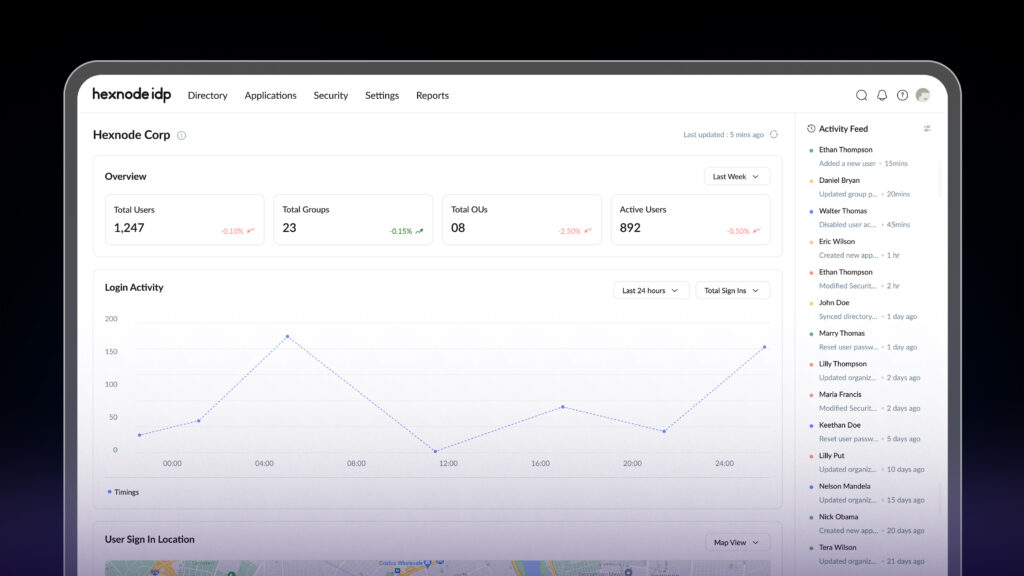
Hexnode IdP is a cloud-based identity and access management (IAM) solution designed to help organizations secure user access across modern work environments. It enables businesses to centrally manage identities, authentication policies, and application access from a single platform, simplifying security administration while improving user experience.
Built for today’s distributed workforce, Hexnode IdP supports modern authentication standards and secure login methods that help organizations protect business resources from unauthorized access. It integrates with business applications, cloud services, and directory platforms, allowing IT teams to manage user identities and permissions efficiently across the organization.
Hexnode IdP also plays a critical role in enabling secure remote work and BYOD strategies. By combining features such as Single Sign-On (SSO), Multi-Factor Authentication (MFA), and conditional access controls, it helps organizations verify user identity and device trust before granting access. This identity-centric approach strengthens security while ensuring employees can securely access the tools they need from personal devices.
How Hexnode IdP Secures BYOD Environments
Securing BYOD environments requires more than traditional login protection. Organizations need a security framework that can verify users, evaluate device trust, and protect sensitive business resources without creating friction for employees. Hexnode IdP addresses these challenges through identity-driven security controls that balance strong protection with a seamless user experience.
Strong Authentication with Multi-Factor Authentication (MFA)
Passwords alone are no longer enough to secure modern workplaces, especially in BYOD environments where employees access company resources from personal devices and networks. Weak or compromised credentials remain one of the leading causes of unauthorized access and account breaches.
Hexnode IdP strengthens account security through Multi-Factor Authentication (MFA), which requires users to verify their identity using additional authentication methods.
Key advantages of MFA include:
Adds an extra security layer beyond passwords
Reduces risks from phishing and credential theft
Prevents unauthorized account access
Improves security for remote and hybrid work environments
Hexnode IdP supports contextual authentication, enforcing an extra layer of security with two-factor MFA for high-risk actions. The platform also supports contextual authentication, stepping up verification with two-factor MFA to enforce an extra layer of security for high-risk actions.
Conditional Access Based on User and Device Context
Not every login attempt should receive the same level of trust. Hexnode IdP uses conditional access policies to evaluate multiple risk factors before granting access to business resources.
Conditional access helps organizations make access decisions based on factors such as:
User identity
Device compliance
Security context
User roles and permissions
With this approach, organizations can:
Block suspicious or high-risk login attempts
Restrict access from untrusted devices
Apply stricter authentication requirements when needed
Enforce least-privilege access policies
This ensures users only gain access to the resources necessary for their role while reducing the organization’s attack surface.
Single Sign-On (SSO) for Secure and Seamless Access
Employees in BYOD environments often use multiple business applications throughout the day. Managing separate passwords for every application can create both security and usability challenges.
Hexnode IdP simplifies access through Single Sign-On (SSO), allowing users to securely authenticate once and access approved applications without repeated logins.
Benefits of SSO include:
Reduced password fatigue
Fewer password-related support requests
Faster access to business applications
Improved employee productivity
Centralized authentication and access control
SSO also strengthens security by minimizing password reuse and giving IT teams greater visibility into application access across the organization.
Device Trust and Compliance Verification
Personal devices accessing corporate resources must meet certain security standards to reduce risk. Hexnode IdP helps organizations verify device trust and enforce compliance policies before granting access.
The platform can evaluate device security posture through checks such as:
Operating system version validation
Screen lock enforcement
Device encryption requirements
Security policy compliance verification
These controls help organizations:
Prevent access from non-compliant devices
Reduce exposure to vulnerable endpoints
Maintain stronger security across BYOD environments
Support regulatory and compliance requirements
By continuously validating device trust, organizations can better protect sensitive corporate data without fully controlling personal devices.
Centralized Identity Management
Managing user identities across multiple applications and devices can quickly become complex in distributed work environments. Hexnode IdP simplifies administration through centralized identity management.
Key capabilities include:
Unified user identity management
Integration with business directories and cloud applications
Centralized authentication policy enforcement
Simplified user onboarding and offboarding
Centralized identity management also improves security response times by allowing IT teams to:
This streamlined approach improves both operational efficiency and overall BYOD security posture.
When to Use an Identity Provider: A Practical Guide for IT Teams
Read the blog to learn when an Identity Provider is required and how Hexnode IDP integrates identity with device management.
Balancing Security and Employee Privacy in BYOD
While BYOD policies improve flexibility and productivity, they also raise important privacy concerns among employees. Many users worry that allowing work access on personal devices could lead to excessive monitoring, restricted device usage, or unauthorized access to personal information. Organizations must therefore strike a careful balance between protecting corporate resources and respecting employee privacy.
A modern identity-focused security approach helps achieve this balance by securing access to business applications without requiring intrusive control over personal devices. Instead of monitoring personal content, organizations can focus on verifying user identity, device trust, and access behavior before granting access.
Key ways organizations can maintain this balance include:
Separating work-related access from personal data
Avoiding unnecessary device monitoring
Limiting access controls to business applications and resources
Applying security policies only where required
Clearly communicating BYOD policies to employees
Transparency is also essential for building trust between employees and IT teams. Organizations should ensure users understand:
What data is monitored
Why security policies are necessary
How corporate data is protected
What level of control IT administrators have over devices
By adopting transparent, identity-centric security practices, organizations can strengthen BYOD security while maintaining employee confidence and privacy.
Key Benefits of Using Hexnode IdP for BYOD Security
Organizations adopting BYOD policies need security solutions that not only protect business resources but also support productivity and operational efficiency. Hexnode IdP helps businesses achieve this balance by combining strong identity security with streamlined access management.
Key benefits of using Hexnode IdP for BYOD security include:
Improved access security
Verifies user identity before granting access
Applies security policies based on user and device context
Simplifies login experiences with Single Sign-On (SSO)
Reduces repeated authentication prompts
Scalable support for hybrid workforces
Supports remote, hybrid, and distributed teams
Adapts to growing workforce and application environments
Maintains consistent access security across locations
Reduced friction during authentication
Balances security with user convenience
Supports adaptive authentication methods
Improves overall user experience
Faster incident response and access revocation
Allows IT teams to quickly disable compromised accounts
Centralizes access control during security incidents
Improves overall security response times
Best Practices for Implementing Secure BYOD Policies with Hexnode IdP
Successfully securing a BYOD environment requires more than deploying authentication tools. Organizations need clear policies, consistent access controls, and continuous monitoring to reduce security risks while maintaining a smooth user experience. Hexnode IdP helps businesses strengthen BYOD security through identity-driven access management and policy enforcement.
Define clear BYOD policies
Organizations should establish clear guidelines on acceptable device usage, security expectations, and employee responsibilities. Clearly documented policies help users understand how personal devices can access corporate resources and what compliance requirements must be followed.
Implementing MFA across all critical applications adds an extra layer of identity verification beyond passwords. This significantly reduces the risk of phishing attacks, credential theft, and unauthorized access attempts in BYOD environments.
Apply role-based access controls (RBAC)
Access permissions should be assigned based on user roles and job responsibilities. Limiting access to only necessary resources helps reduce unnecessary exposure to sensitive business data and strengthens overall security.
Use conditional access policies strategically
Organizations should evaluate login attempts based on factors such as device trust, user behavior, location, and risk level. Conditional access policies can restrict access from untrusted devices and require additional verification for suspicious login attempts.
Regularly review device compliance
IT teams should continuously ensure devices meet organizational security standards, including OS updates, encryption requirements, and screen lock enforcement. Non-compliant devices should be restricted from accessing corporate resources.
Educate employees on security best practices
Employees should receive regular training on phishing awareness, password hygiene, and safe usage of personal devices. User awareness plays a major role in reducing human-related security risks.
Monitor login activity and anomalies
Continuous monitoring helps organizations detect suspicious authentication attempts and unusual user behavior early. This improves visibility into potential threats and strengthens incident response capabilities.
Maintain least-privilege access principles
Organizations should regularly review user permissions and remove unnecessary access rights. Limiting privileges helps reduce the impact of compromised accounts and strengthens overall access security.
Feature Resource
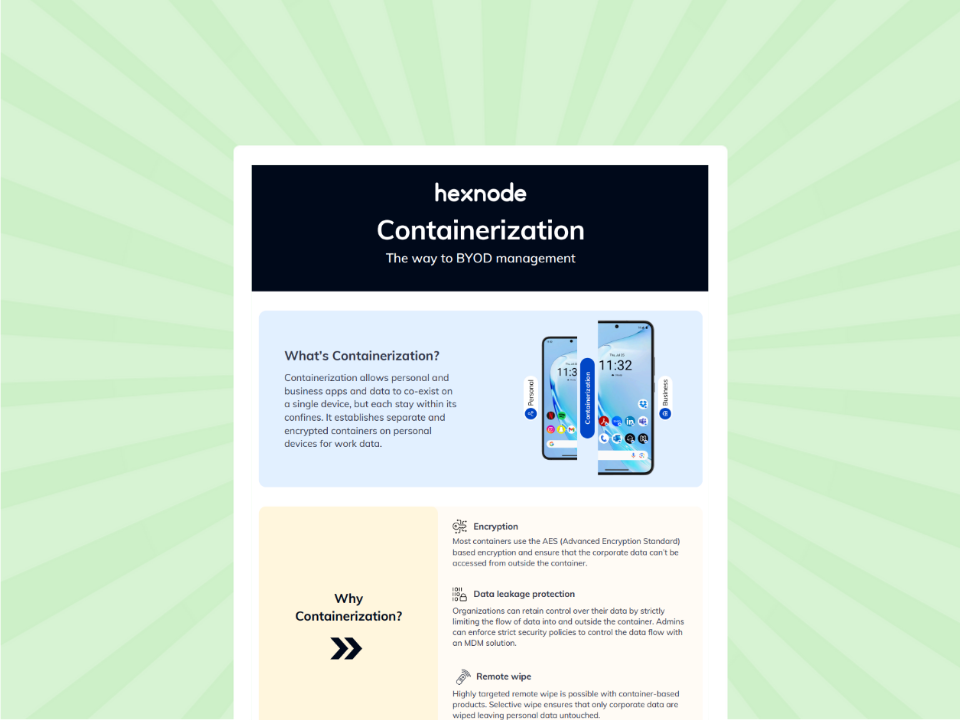
Containerization: Smarter BYOD Management for Enterprises
Discover how containerization transforms BYOD management.
As BYOD adoption continues to grow, organizations must address the security challenges that come with employees accessing corporate resources from personal devices. Risks such as unauthorized access, compromised credentials, unmanaged endpoints, and data leakage make traditional security approaches insufficient for modern work environments.
Hexnode IdP helps organizations overcome these challenges through an identity-centric security approach that combines Multi-Factor Authentication (MFA), conditional access, Single Sign-On (SSO), device trust verification, and centralized identity management. These capabilities allow businesses to secure access without creating unnecessary friction for employees.
By balancing strong security controls with a seamless user experience, Hexnode IdP enables organizations to confidently support remote and hybrid work models. As workplaces continue to evolve, adopting modern identity and access management strategies will be essential for building secure, scalable, and future-ready BYOD environments.
Try Hexnode free for 14 days
Secure every BYOD login with identity-driven access control and seamless authentication.
BYOD security refers to the policies and technologies used to protect corporate data when employees access business resources from personal devices such as smartphones, laptops, and tablets.
Why are traditional security models not enough for BYOD environments?
Traditional security models mainly protect office networks and company-managed devices. In BYOD environments, employees access applications from personal devices and different locations, which requires continuous identity and device verification instead of perimeter-based security alone.
How does Multi-Factor Authentication (MFA) improve BYOD security?
MFA improves security by requiring users to verify their identity using additional methods beyond passwords, such as OTPs, authenticator apps, push notifications, or biometrics. This helps reduce unauthorized access and credential-based attacks.
What is conditional access in BYOD security?
Conditional access is a security approach that evaluates factors such as user identity, device trust, location, and login behavior before granting access to business resources. It helps organizations block risky or suspicious login attempts.
How does Single Sign-On (SSO) help employees in BYOD environments?
SSO allows employees to log in once and securely access multiple business applications without repeatedly entering passwords. This improves user experience, reduces password fatigue, and simplifies access management.
How can organizations protect employee privacy in BYOD environments?
Organizations can protect privacy by separating work-related access from personal data, limiting unnecessary device monitoring, and applying security controls only to business resources instead of personal content.
I’m a technical content writer at Hexnode who loves simplifying tech. I break down complex ideas, remove the fluff, and help readers clearly understand our product for what it actually is: simple, reliable, and built to solve real problems.