Identity sprawl is the uncontrolled growth of unmanaged accounts and credentials across disconnected systems, driven by SaaS adoption, weak onboarding/offboarding, and no single source of truth. Left unchecked, it widens your attack surface, breaks audit readiness, and drains IT capacity. Fixing it is sequential: centralize visibility, standardize joiner-mover-leaver workflows, enforce least privilege with regular reviews, and automate lifecycle actions. Prevention is a discipline of cadence and ownership, not a one-time cleanup — and it’s most sustainable when identity and device oversight live in one place.
Identity sprawl is the uncontrolled growth and fragmentation of digital identities, accounts, and credentials across an organization’s systems, applications, and platforms. It occurs when identities are created and managed in disconnected silos, with no single authoritative source of truth governing who exists, where, and with what level of access.
The scale becomes clear at the individual level. A single employee routinely holds dozens of distinct accounts — spread across SaaS tools, IaaS and PaaS environments, legacy on-prem systems, VPNs, and managed devices. When these identities aren’t federated or governed from a central plane, each one becomes an independent object to track, secure, and eventually decommission.
It’s worth drawing a distinction from two adjacent problems:
Shadow IT refers to unsanctioned apps and services adopted outside IT’s purview. It’s a cause of sprawl, not sprawl itself.
Access sprawl (or privilege creep) describes excessive permissions accumulating on existing accounts. Identity sprawl is about the proliferation of the accounts and identities themselves.
The acceleration is structural, not incidental. Cloud migration, SaaS proliferation, remote and hybrid work, and BYOD have each multiplied the number of identities an organization must manage — while the tooling to govern them centrally has often lagged behind.
Identity sprawl is rarely the result of a single failure. It accumulates through routine operational decisions that individually seem reasonable but compound over time. Understanding the root causes is the first step toward closing them.
Rapid SaaS and Cloud Adoption
New applications increase identity management overhead. Maintaining local accounts instead of centralized federation compounds this burden. Independent tool procurement frequently creates accounts outside IT’s visibility.”
The result is a growing population of identities that were never registered against a central directory. Without federation, SCIM, or another centralized identity-management integration, SaaS applications are more likely to require separate account administration and can increase identity-management fragmentation.
Poor Onboarding and Offboarding Processes
Manual, inconsistent joiner-mover-leaver workflows are one of the most reliable generators of sprawl. When provisioning is handled ad hoc, employees accumulate accounts that don’t get cleaned up as their roles change.
The offboarding gap is more dangerous still:
Orphaned accounts persist after an employee leaves, remaining active and exploitable.
Duplicate accounts appear when role changes spawn new identities without retiring the old ones.
Contractor and temporary accounts can remain active longer than intended when expiration or de-provisioning controls are not consistently enforced.
Lack of Centralized Visibility
Many organizations operate multiple directories, identity providers, and application-level identity stores, which can create fragmentation when those systems are not adequately integrated. The absence of a single source of truth means no one can reliably answer who has access to what. Consolidating managed user and device oversight through Hexnode UEM provides centralized visibility into users present in the portal, their associated devices, and user data synchronized from supported directory services.
Mergers and acquisitions can amplify identity-management complexity by bringing together separate directories, applications, account structures, and access policies.
Why Identity Sprawl Is a Serious Risk
Identity sprawl isn’t technical debt to be triaged later — it’s an active liability that expands attack surface, erodes audit readiness, and drains operational capacity. Each unmanaged identity carries a cost, and those costs compound silently until a breach or an audit forces a reckoning.
Expanded Attack Surface
Every account can expand the identity attack surface, and accounts that are not centrally governed can be harder to monitor, rotate, and revoke consistently. Orphaned and dormant accounts can present elevated risk because they may receive less oversight and can provide attackers with access if they remain enabled or inadequately monitored.
The 2026 Verizon DBIR found that credential abuse accounted for 13% of known initial access vectors and appeared in 39% of breaches when considered across the full breach progression; stolen credentials also remained the leading action in Basic Web Application Attacks, while credentials represented 52% of the data compromised in that pattern.
More identities across more ungoverned systems means a larger pool of credentials for an adversary to harvest and replay.
Compliance and Audit Failures
Identity sprawl can undermine important audit controls, including least-privilege enforcement, account management, access reviews, and evidence of access governance. Stale and unnecessarily privileged accounts can conflict with access-control, account-management, and security requirements found across frameworks and regulatory regimes such as SOC 2, ISO/IEC 27001, HIPAA, and GDPR.
In practice, the failures look like:
No definitive access inventory to produce within an audit window.
Orphaned accounts that indicate weaknesses in account de-provisioning or periodic access-review processes.
Broken attestation trails, where no one can show who approved an identity or when it was last certified.
A control gap here isn’t just a finding — it translates into remediation costs, delayed certifications, and stalled enterprise deals that hinge on your compliance posture.
Operational Cost and Inefficiency
The quieter tax falls on your IT and security teams. Fragmented identities generate manual work at every step — access reviews that require reconciling disconnected directories, password resets for accounts no central system tracks, and access requests with no clear owner.
That burden generally increases as the number of fragmented and unmanaged identities grows. Every new ungoverned identity adds recurring overhead to provisioning, support, and audit cycles — capacity that should be funding higher-value security work, not chasing accounts no one can fully trace.
Warning Signs Your Organization Has Identity Sprawl
Sprawl rarely announces itself. It surfaces as friction — an audit that takes weeks instead of days, an access request no one can approve with confidence. Use the following indicators as a quick self-assessment; the presence of several may indicate that identity fragmentation or lifecycle-governance gaps deserve closer investigation.
You can’t produce a current access inventory on demand. If answering “who has access to what?” requires a multi-day, multi-team reconciliation effort, you don’t have centralized governance — you have fragmentation.
Former employees or contractors with active accounts are a strong indicator that de-provisioning controls may be incomplete or ineffective.
The same user holds multiple accounts across overlapping tools. Duplicate identities for one person — often the residue of role changes or redundant SaaS — inflate your credential footprint and confuse attribution.
Access is granted ad hoc, with no review or de-provisioning cadence. When entitlements are handed out on request but never systematically revisited, privilege accumulates and never contracts.
Parallel directories and application-level identity stores without a clearly governed authoritative source increase the risk of inconsistent identity and access data.
A unified view of enrolled users and their devices — through a platform like Hexnode — makes several of these gaps immediately visible rather than something you discover mid-audit.
The value of this exercise is diagnostic: each symptom maps to a specific control failure you can target directly, which is where the next section begins.
How to Prevent and Reduce Identity Sprawl
Containing sprawl is less about a single tool and more about sequencing the right controls. The order matters: you can’t automate what you can’t see, and you can’t enforce least privilege without a clean baseline. Treat the following as a phased playbook.
Centralize Identity and Access Visibility
Start by establishing a single source of truth. Before you can remediate anything, you need one authoritative view of who exists, what they can access, and which devices they’re operating from.
Practically, this means consolidating fragmented directories and app-level stores into a governed plane rather than tolerating parallel systems that drift out of sync. Hexnode UEM provides a consolidated view of users managed in the portal and the devices associated with them, helping administrators monitor enrollment, device compliance, and user-device associations.
Enterprise Identity Management: What to Look for in an IdP
Privilege creep, stale accounts, disconnected systems—learn what to prioritize when evaluating an IdP.
Standardize Onboarding and Offboarding
Ad hoc provisioning is an important contributor to identity sprawl, so organizations should replace it where practical with repeatable joiner-mover-leaver workflows. Every identity event should follow a defined, documented path.
Joiner: Provision access from role-based templates, not one-off requests.
Mover: Reconcile entitlements on role change — grant the new, revoke the old.
Leaver: Trigger full de-provisioning on a defined timeline, with no manual exceptions.
Effective offboarding is critical because incomplete de-provisioning is a major source of orphaned accounts and lingering access.
Enforce Least-Privilege and Regular Access Reviews
A clean baseline degrades without maintenance. Privilege creep reintroduces sprawl even in well-governed environments, so pair least-privilege provisioning with a recurring review cadence.
Schedule periodic access certifications at a frequency appropriate to the system’s risk, sensitivity, and applicable compliance requirements. Establish a defined process for investigating and removing access that cannot be appropriately re-certified. This catches the drift that accumulates between onboarding and offboarding events and keeps your entitlement footprint contracting rather than only expanding.
Automate Provisioning and De-provisioning
Manual lifecycle management doesn’t scale, and every manual step is a place where an account gets missed. Automation is what makes the previous steps sustainable rather than aspirational.
Wire lifecycle events to authoritative triggers — typically your HR system — so account actions fire automatically as people join, move, and leave. Hexnode supports periodic and on-demand synchronization of users, groups, OUs, and domains from supported directory services; when a synchronized user is deleted or deactivated, user-targeted policies can be disassociated from linked devices, which remain enrolled as unassigned devices.
Consolidate and Integrate Directories/Tools
Finally, reduce the raw number of identities you have to govern. Every additional SaaS tool can increase identity-management and integration overhead, particularly when it maintains separate local accounts or credentials.
Rationalize your app portfolio — retire overlapping tools with duplicate functionality.
Use identity federation and SSO to centralize authentication and reduce the need for users to maintain separate authenticators for each application.
Where supported, use SCIM or comparable provisioning integrations to automate and standardize user and group lifecycle changes across systems.
Fewer identity stores mean fewer places for sprawl to take root — and a materially smaller surface to secure and audit.
Best Practices to Keep Identity Sprawl From Coming Back
Remediation is a project; prevention is a discipline. Without ongoing governance, identity sprawl can re-accumulate after an initial cleanup. Consistent review cycles and clear ownership are important factors in preventing identity-governance problems from re-emerging.
Institutionalize a review cadence. Schedule quarterly access certifications and routine dormant-account sweeps as standing calendar events, not reactive responses to an upcoming audit. Predictable rhythm is what keeps entitlement drift from compounding.
Assign explicit ownership for identity governance. Sprawl thrives in ambiguity. Name an accountable owner — whether an IAM lead or a governance function — with a clear mandate over identity lifecycle and policy. Shared responsibility is functionally no responsibility.
Govern SaaS procurement. Unsanctioned applications can reintroduce identity sprawl by creating accounts and identity stores outside established governance processes. Require new applications to route through IT for SSO and SCIM integration before adoption, so no new identity store spins up outside your control plane.
Shift from point-in-time to continuous monitoring. Periodic cleanups only tell you the state at a single moment. Continuous visibility into identities, entitlements, and access patterns lets you catch drift as it happens rather than quarters later.
Treated as governance rather than remediation, these practices convert sprawl from a recurring fire drill into a managed, measurable risk.
Bringing Identities and Devices Under One Roof With Hexnode
Most sprawl remediation stalls when identity and endpoint information remain disconnected. Hexnode UEM helps address the endpoint side of that gap by providing centralized visibility into managed users and their associated devices, while Hexnode IdP can separately manage and expose application-access assignments.
Three capabilities map directly to the failure modes we’ve discussed:
Unified visibility. A single Hexnode UEM console provides visibility into enrolled devices, the users associated with them, and endpoint information such as enrollment, ownership, activity, and compliance status through dashboards and reports. This improves visibility into managed users, their associated endpoints, and relevant enrollment and compliance status within Hexnode UEM.
Automated lifecycle actions. Hexnode supports automated device-enrollment methods and user provisioning through supported directory integrations, while directory synchronization keeps imported users and groups updated so user- or group-targeted endpoint policies can reflect organizational changes. These workflows can reduce offboarding delays by propagating directory changes to Hexnode and removing user-targeted access or configurations from managed endpoints.
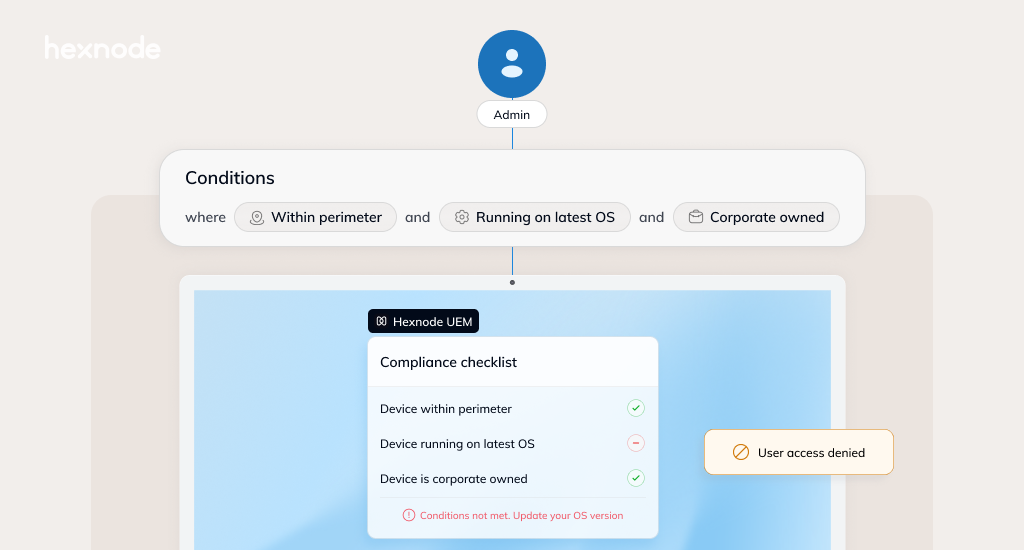
Policy-driven control and compliance. Consistent security and compliance policies apply across the fleet and can be tied to the user at enrollment, supporting least-privilege objectives and audit-readiness against frameworks like SOC 2, HIPAA, and GDPR.
Hexnode UEM can reduce manual endpoint administration and provide auditable user-device and compliance information, while Hexnode IdP separately provides visibility into and control over application assignments for identities managed in the IdP.
For teams looking to consolidate this oversight rather than manage identities and devices in parallel silos, Hexnode is worth evaluating.
Featured Resource
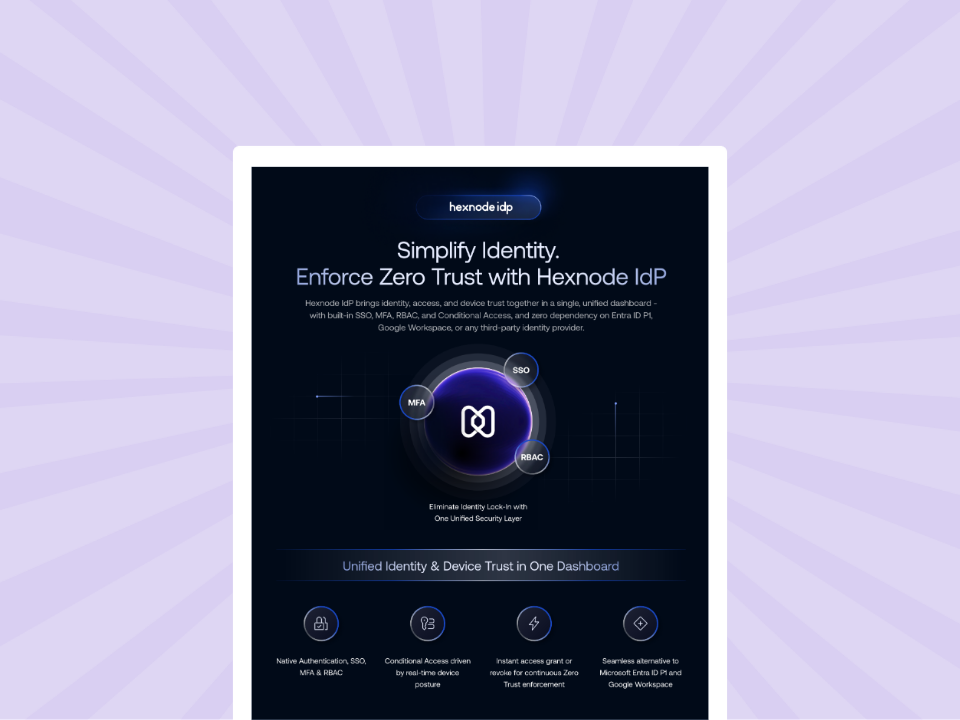
Hexnode IdP Info sheet
See how Hexnode IdP centralizes identity management, application access, authentication, and SCIM-based user provisioning.
Is identity sprawl the same as having too many passwords or logins?
Not quite. Multiple logins are merely symptoms of identity sprawl across ungoverned systems. The true issue is lacking a central source of truth to track identity ownership.
Where should we start if we suspect we already have identity sprawl?
Begin with visibility, not cleanup. Establish a central view of identities and access rights before attempting remediation or automation. A self-audit checking on-demand access inventory readiness reveals risk severity and priority focus areas.
How is identity governance different from an identity provider (IdP) or SSO?
Identity providers centralize user authentication and support SSO across applications, eliminating separate credentials. However, individual applications may still retain local account records. Identity governance is the broader discipline of deciding who should have access, reviewing it regularly, and retiring it reliably. SSO reduces reliance on separate application credentials. However, it does not replace provisioning, de-provisioning, or identity lifecycle controls.
Who in the organization should own identity sprawl?
Identity lifecycle and policy require a single accountable owner. This is typically assigned to an IAM lead or dedicated governance function. Shared responsibility across IT, security, and app teams creates operational gaps. Without a defined owner, identity sprawl quickly re-accumulates.
How often should we review access to keep sprawl under control?
A recurring cadence works better than one-off cleanups. Quarterly access certifications for sensitive systems, paired with routine dormant-account sweeps, catch privilege drift before it compounds. The key is treating these as standing, scheduled events rather than reacting only when an audit is looming.
Can automation alone solve identity sprawl?
No. Automation sustains lifecycle management and eliminates the manual gaps that create orphaned accounts. However, it requires a clean baseline and clear process to succeed. Without centralized visibility, defined onboarding/offboarding workflows, and an accountable owner, automating a messy environment just scales the mess.
Conclusion
Identity sprawl is the silent, compounding growth of unmanaged identities across your systems, applications, and devices — and for all its inertia, it remains a preventable problem. Leading organizations do not rely on tool volume. Instead, they pair visibility with disciplined processes and automation.
The stakes are worth restating plainly. “Unchecked sprawl expands your attack surface and undermines regulatory compliance. Concurrently, it drains IT capacity away from strategic initiatives. None of those costs announce themselves — they accumulate until an incident or an audit forces the reckoning.
The path forward is sequential, not optional. Centralize identity and access visibility so you know what you’re governing, standardize onboarding and offboarding so accounts are created and retired reliably, enforce least privilege with regular reviews to catch drift, automate lifecycle events to eliminate the manual gaps where orphaned accounts appear, and shift from point-in-time cleanups to continuous monitoring. Work in that order and each step reinforces the next.
Control is not achieved through a single product. It requires combining governance discipline with supporting, sustainable tooling. Hexnode consolidates device and user visibility into a single platform. Automating lifecycle workflows closes operational gaps before sprawl takes root.
As environments keep expanding, proactive identity hygiene is no longer a nice-to-have. It’s becoming a baseline expectation of a defensible security and compliance posture — and the time to establish it is before sprawl, not after.
Rein in identity sprawl before it spreads
Consolidate device and user oversight in one place and automate the lifecycle work sprawl feeds on.
Associate Product Marketer at Hexnode focused on SaaS content marketing. I craft blogs that translate complex device management concepts into content rooted in real IT workflows and product realities.