Enterprise device management trends in 2026 focus on AI-driven automation, Zero Trust enforcement, UEM consolidation, and real-time visibility. As device ecosystems expand, platforms like Hexnode help IT teams unify control, enforce compliance, and manage endpoints at scale efficiently.
Enterprise device management trends in 2026 reflect a clear shift from operational tooling to strategic infrastructure. IT teams no longer manage a fixed fleet of corporate laptops and phones.
They now oversee a dynamic mix of personal devices, rugged endpoints, IoT systems, and remote workstations operating across distributed environments.
This expansion introduces real challenges. Device visibility becomes fragmented, and security policies lose consistency. Compliance requirements tighten. Traditional MDM approaches fail to keep pace with this scale and diversity.
Modern enterprises need a unified control plane that enforces policy, automates lifecycle management, and integrates deeply with security frameworks.
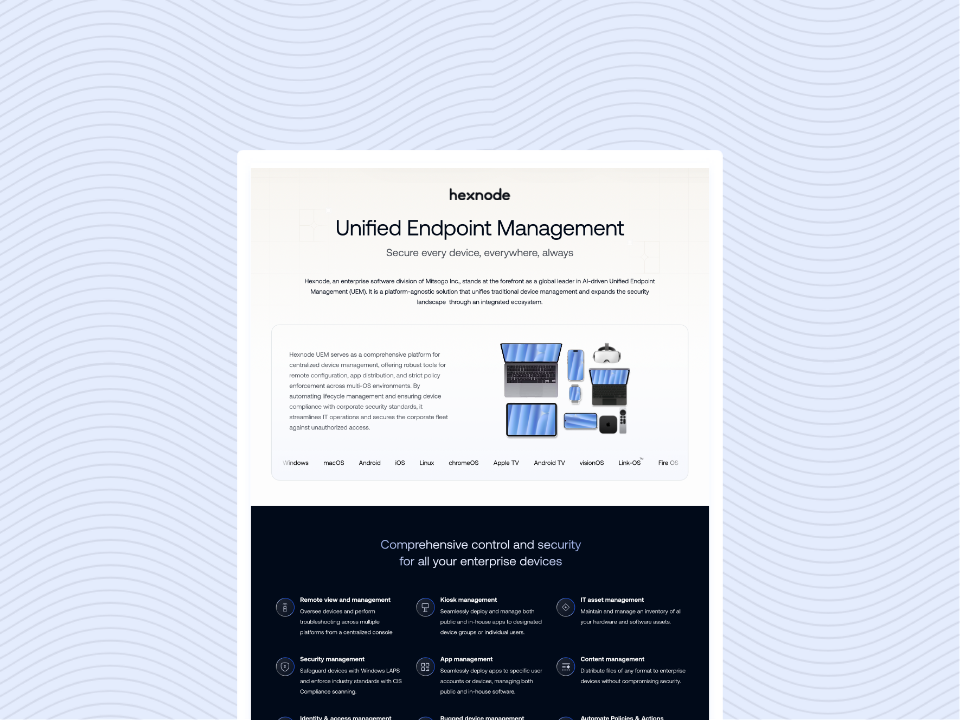
Hexnode addresses this need by delivering a comprehensive unified endpoint management platform that enables IT teams to manage, secure, and monitor every endpoint from a single interface.
The Future of Enterprise Device Management Is Unified, Intelligent, and Predictive
The future of enterprise device management is not about managing devices individually. It is about orchestrating entire endpoint ecosystems using intelligence and automation.
Enterprises are moving toward predictive management models. Instead of reacting to device failures or security incidents, IT teams now rely on telemetry and analytics to anticipate risks. Endpoint data streams provide insights into device health, compliance posture, and user behavior.
Unified Endpoint Management platforms consolidate control across operating systems and device types. This eliminates tool fragmentation and reduces administrative overhead. IT admins gain a single policy engine that governs provisioning, configuration, and security enforcement.
Hexnode aligns with this direction by offering centralized management with real-time intelligence. IT teams can define granular policies, automate enforcement, and maintain visibility across all endpoints without switching between tools.
Top Enterprise Device Management Trends in 2026
The growing scale and diversity of enterprise endpoints demand faster response times and reduced manual intervention. This is driving a shift toward automation-first management, where AI handles routine decisions and enforcement.
AI-Driven Automation Becomes the Control Layer
Automation has moved beyond scripting and scheduling. AI-driven systems now analyze endpoint behavior and trigger actions autonomously.
Enterprises use AI to detect anomalies such as:
Detect unusual login behavior across endpoints
Identify unauthorized application installations in real time
Flag deviations from defined compliance baselines
Automatically isolate compromised or non-compliant devices
Enforce remediation policies without manual intervention
Trigger administrator alerts for critical events
This reduces manual intervention and improves response time. IT teams can focus on strategic initiatives rather than repetitive tasks.
Hexnode enables automation through policy-based workflows and dynamic rule enforcement. Admins can configure actions that trigger automatically based on device state or compliance conditions.
Zero Trust Extends Deep into Endpoint Management
Zero Trust principles now operate at the device level with continuous validation.
Continuously verify device trust before granting access
Enforce encryption, OS version, and security configuration checks
Evaluate contextual signals such as location and network state
Integrate endpoint posture with identity and access systems
Restrict or revoke access for non-compliant devices
Hexnode enables strict compliance enforcement and supports Zero Trust architectures by ensuring that only trusted devices access enterprise resources.
Zero Trust and cybersecurity with Hexnode MDM
Implement Zero Trust security with Hexnode MDM for continuous device and access verification
Modern device ownership models require a balance between security and user privacy.
Separate corporate and personal data using containerization
Apply policies only to enterprise-controlled data
Prevent data leakage without affecting personal usage
Enforce security controls on unmanaged networks
Enable secure access for remote and hybrid workforces
Hexnode provides granular BYOD management capabilities that protect enterprise data while preserving user privacy.
IoT and Non-Traditional Endpoints Expand the Scope
Enterprise environments now include specialized endpoints that require tailored management.
Manage kiosks, POS systems, and rugged devices centrally
Enforce restricted usage modes for dedicated devices
Monitor uptime and operational health of critical endpoints
Apply device-specific policies for industry use cases
Extend endpoint management to IoT ecosystems
Hexnode supports kiosk management and IoT-ready deployments, ensuring consistent control across all endpoint types.
Why Enterprises Are Moving Toward UEM-Centric Architectures
Enterprises are consolidating their endpoint management strategies around UEM platforms for several reasons.
First, they reduce tool sprawl. Managing multiple systems increases complexity and introduces inconsistencies. A unified platform simplifies operations.
Second, they improve security posture. Centralized policy enforcement ensures that all devices adhere to the same standards.
Third, they enhance user experience. Employees benefit from consistent configurations and fewer disruptions.
Hexnode provides a single pane of glass for managing all endpoints. This reduces administrative effort while improving visibility and control.
How Hexnode Powers Modern Enterprise Device Management
Enterprises need a platform that operationalizes enterprise device management trends into measurable outcomes. Hexnode delivers this by combining unified management, automation, and security enforcement into a single system.
It enables IT teams to manage complex endpoint environments without increasing operational overhead.
Centralize management across mobile, desktop, kiosk, and IoT devices
Enforce granular policies across Android, iOS, Windows, and macOS
Automate device provisioning with zero-touch enrollment workflows
Monitor endpoint health, compliance, and activity in real time
Execute remote actions such as lock, wipe, and configuration updates
Integrate with identity and security ecosystems for access control
Maintain continuous compliance with policy-driven enforcement
Support kiosk mode and dedicated device deployments at scale
Hexnode aligns with the future of enterprise device management by enabling predictive control and automation. IT teams can shift from reactive troubleshooting to proactive governance using real-time insights and automated workflows.
For organizations evaluating the latest trends in unified endpoint management, Hexnode provides a scalable architecture that reduces tool sprawl while improving control and security posture.
As enterprises redefine how they manage devices in 2026, Hexnode acts as the central control plane that unifies endpoint management, security enforcement, and operational efficiency.
Wrapping Up
Enterprise device management trends indicate that endpoint control is no longer a supporting function. It is a core component of enterprise IT strategy.
Organizations that adopt unified, intelligent management platforms will gain a competitive advantage. They will improve security, streamline operations, and support a flexible workforce.
Hexnode enables this transformation by providing a comprehensive UEM solution that integrates automation, security, and lifecycle management into a single platform.
Start managing endpoints with Hexnode today
Stay ahead of enterprise device management trends with unified, automated control
Content writer at Hexnode. Fueled by good coffee and the occasional cat cuddle, I enjoy crafting content that informs, connects, and resonates. Nothing excites me more than knowing my words have been read, appreciated, and maybe even bookmarked.