- Hybrid work has moved corporate data beyond office networks, making endpoint visibility and control a major security priority.
- IT teams are battling severe visibility decay, unpatched remote devices, and a data-governance vacuum caused by unmanaged BYOD practices.
- A strong endpoint security strategy for hybrid work should combine device visibility, patch management, BYOD containerization, compliance controls, and continuous monitoring —unified through a UEM platform.
Table of Contents
- Why Endpoint Security for Hybrid Work Starts with Device Visibility
- The BYOD Privacy Paradox: Protecting Work Data on Devices You Don’t Own
- Endpoint Compliance in Hybrid Work: Why Audit Readiness Starts at the Device
- Data Residency Solves the “Where;” Endpoint Security Solves the “How”
- Building Endpoint Security into Your Hybrid Work Strategy in 2026
- Frequently Asked Questions (FAQs)
When the global paradigm shifted toward remote work, corporate leadership viewed the transition as a temporary operational bridge. Tools were deployed quickly, policies were adjusted on the fly, and security teams made do with the time and resources they had. Fast forward to 2026, that emergency measure has solidified into the default operating model for modern enterprise. The result is a growing gap in endpoint visibility, patching, BYOD control, and compliance readiness. That gap is what turns endpoint security for hybrid work from a technical concern into a business-level priority.
During a recent Hexnode Live session, Mujabdeen Sirajudeen, Director of IT OfficersTM, a Subsidiary of Al Kendi Computer Systems, shared how organizations across the UAE are facing this shift in real time.
Why Endpoint Security for Hybrid Work Starts with Device Visibility
When employees transitioned away from the office, IT teams lost more than physical proximity. They lost the controlled environment that made device management predictable. In a traditional setup, admins could see connected devices, push updates over the corporate network, enforce security policies, and respond quickly to anything suspicious. As Mujab puts it, “The moment people began working from home, cafés, or client sites, visibility disappeared almost overnight.” For many organizations, that blind spot still exists. Devices continue to access corporate systems, but IT may not always know who owns them, whether they are updated, what network they are using, or whether they meet basic compliance requirements.
This is where endpoint security for hybrid work begins. Before organizations can secure remote laptops, Bring Your Own Device (BYOD) devices, or distributed teams, they need a clear inventory of every endpoint touching business data. Without device visibility, patching becomes inconsistent, policy enforcement turns reactive, and unmanaged devices quietly expand the attack surface.
The BYOD Privacy Paradox: Protecting Work Data on Devices You Don’t Own
When hybrid work sent employees home, it also sent corporate data onto personal devices the organization can’t fully manage. BYOD appeals to both sides: employees keep the devices they already know, and companies skip the upfront cost of issuing hardware. But it reshapes the security relationship entirely. As Mujab puts it, “Once corporate data lives on a personal device, the rules change completely.”
Ivanti’s research found that BYOD is already a regular occurrence for three in four IT workers, even though only 52% of organizations formally permit it — and where it’s banned outright, 78% of employees use personal devices anyway. In other words, unmanaged personal devices are touching corporate data whether policy allows it or not. The same study found that 38% of IT professionals admit they lack sufficient data about the devices accessing their network — the exact visibility gap that makes BYOD so hard to secure.
And the risk isn’t just business apps on personal phones. It’s that customer records, emails, and contracts can sit right beside personal apps, cloud storage, and casual sharing habits. Effective endpoint security for hybrid work means controlling corporate data without intruding on the employee’s personal space.
That’s where containerization earns its place. Mujab describes it as “a locked room within your phone,” where work email, apps, and files stay separated from personal photos, chats, and applications. When an employee leaves, IT wipes only the work container. The device remains personal, but corporate data stays protected.
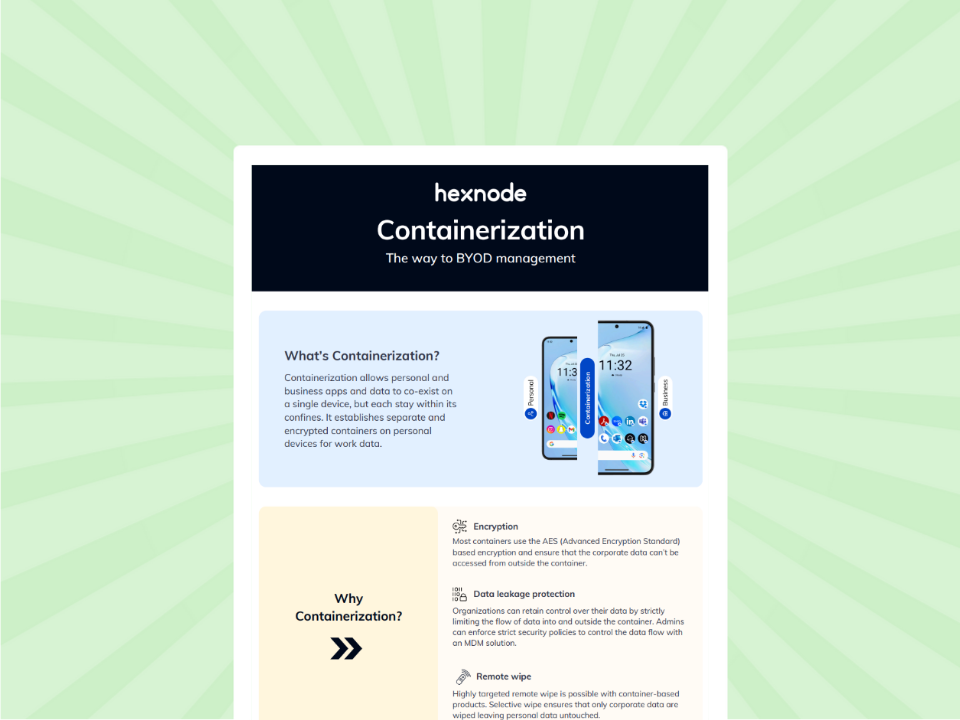
The Key to Secure and Seamless BYOD Management
Containerization: Smarter BYOD Management for Enterprises
This infographic explores how containerization simplifies BYOD management while enhancing security and compliance.
Get the InfographicEndpoint Compliance in Hybrid Work: Why Audit Readiness Starts at the Device
For financial services, healthcare, government, and professional services, compliance is not just a policy statement — it must show up in the way devices are managed, monitored, and verified. This becomes even more complex for organizations navigating UEM compliance across the MEA region, where regulatory requirements can vary across jurisdictions.
Mujab was clear about the stakes: “If you fail to meet the compliance requirements, you lose the license.”
When corporate data is accessed from remote laptops or personal phones, organizations need to know whether the device was compliant, who accessed the data, what controls were applied, and whether the activity can be traced later.
This is where a Unified Endpoint Management (UEM) solution becomes part of compliance posture, not just the IT stack. Instead of relying on assumptions, IT teams need systems that can enforce compliance requirements consistently and expose gaps before auditors do. As Mujab noted, “Compliance isn’t a project you finish. It’s a posture you maintain.”
Simplifying Compliance: An Actionable Guide for IT
Read about addressing various compliance challenges and the tips to build a strong security foundation
DownloadData Residency Solves the “Where;” Endpoint Security Solves the “How”
For organizations in regions like the UAE, localized cloud data centres from major cloud service providers have simplified data residency requirements. Businesses can now use scalable cloud infrastructure while keeping sensitive information within national borders, which is especially important for sectors handling financial, healthcare, government, and legal data.
But data residency does not complete the security equation. Storing data inside a regional data centre answers where the information lives, but it does not control how that information is accessed, downloaded, shared, or stored on employee devices.
As Mujab explained: “Local data residency solves where problem; endpoint management and security solve the how problem. You need both.”
Under frameworks like the UAE Personal Data Protection Law (PDPL), auditors demand immutable, documented proof of protection. Storing data in a regional data centre means little if a remote employee accesses that information via an unpatched, unmanaged phone over public Wi-Fi. Achieving true compliance means your endpoint security must provide a clear, verifiable audit trail at the device level.
Building Endpoint Security into Your Hybrid Work Strategy in 2026
The path forward isn’t to add more disconnected tools, but to build a clear endpoint strategy that turns visibility, security, and compliance into everyday operations. For IT teams, this starts with knowing every device that accesses corporate data, enforcing baseline controls, securing BYOD devices, and maintaining audit-ready records across remote and personal endpoints.
A UEM solution gives organizations the framework to do this consistently. It brings device visibility, patch enforcement, encryption, access management, remote wipe, compliance checks, and audit trails into a single management layer. Instead of waiting for a breach, a failed audit, or a lost device to expose the gaps, IT teams can take a proactive approach to endpoint security for hybrid work.
As Mujabdeen concluded, “What is missing in most organizations is not the tool. It is the clarity on where to start. The real question is: What is your endpoint strategy? Because that is the foundation everything else sits on.”
Frequently Asked Questions (FAQs)
Can IT track an employee’s location or personal browsing history on a BYOD device under UAE privacy laws?
Not on the personal side, and not without a lawful basis and a clear policy. With proper containerization, corporate IT sees only the managed work profile — not personal browsing, messages, or photos. Location is personal data under the PDPL, so any tracking needs a lawful basis, employee consent, and a documented BYOD policy. This holds for company-owned devices too: ownership doesn’t remove the consent requirement. The real line isn’t who owns the device — it’s whether you have a policy, a lawful basis, and consent for what you monitor. In practice, location tracking is reserved for narrow cases like locating a lost or stolen device.
How can organizations maintain data sovereignty when employees travel with corporate devices?
Data residency refers to where data is physically stored, while data sovereignty concerns which jurisdiction’s laws govern that data. When a hybrid employee travels outside the Middle East with a corporate laptop or phone, the data itself may still reside in a UAE or GCC-based cloud. But sovereignty risk arises the moment that data is accessed, downloaded, cached, or synced from an out-of-region network — because it can then fall within the legal reach of another jurisdiction.
To stay in control, organizations need strong endpoint controls: device encryption, VPN or Zero Trust access, location-aware conditional access policies, restrictions on downloading sensitive files, disabled unmanaged file sharing, and audit logs of user and device activity. A UEM or MDM solution lets IT apply these consistently, so sovereignty is protected not just at the cloud level, but at the device level too.
What are the reporting requirements for a data breach on a remote device under the UAE PDPL?
Under the UAE Personal Data Protection Law (PDPL), a controller must notify the UAE Data Office within 72 hours of becoming aware of a personal data breach that is likely to pose a risk to individuals’ rights. The 72-hour clock starts at awareness, not once the investigation is complete — if you can’t rule out the full scope in time, you file an initial notification with what you have and supplement it in phases. Where the breach poses a high risk to individuals, affected data subjects must also be notified without undue delay.
Regulators have made clear that weak monitoring is not a valid excuse for a late filing: if you lack the visibility to detect a breach quickly, you’re already exposed. This is why a Unified Endpoint Management (UEM) system matters for remote and BYOD scenarios. It lets IT isolate a compromised device fast and produce the device and access logs needed to file an accurate, timely report — turning a 72-hour scramble into a controlled process and reducing regulatory liability.