PCI DSS compliance has become increasingly complex as enterprise environments expand beyond controlled networks into distributed endpoints. Laptops, mobile devices, and POS systems now interact directly with cardholder data, making them critical components of the Cardholder Data Environment.
The problem is straightforward. Most enterprises still approach compliance from a network-first perspective, while attackers target endpoints where controls are weaker and visibility is limited. This disconnect creates gaps in enforcing PCI compliance requirements, increases audit friction, and exposes sensitive payment data to avoidable risks.
Hexnode addresses this gap by shifting compliance enforcement to where it matters most. It enables enterprises to secure, monitor, and control endpoints with precision, ensuring that PCI DSS compliance is not just achieved but continuously maintained.
Understanding PCI DSS Compliance in Modern Enterprise Environments
PCI DSS certification is not a one-time milestone. It is an ongoing process that demands continuous enforcement of security controls across all systems that store, process, or transmit cardholder data.
Modern enterprise architectures complicate this process. Remote work, BYOD policies, and cloud-based workflows have dissolved traditional network boundaries. Endpoints now act as independent access points into the Cardholder Data Environment.
This shift requires a new approach. Enterprises must treat endpoints as first-class security assets and enforce PCI DSS requirements directly at the device level. Unified Endpoint Management platforms like Hexnode play a central role in enabling this transition by providing visibility and control across all endpoints.
Key PCI DSS Requirements That Impact Endpoint Security
To understand how endpoint management supports compliance, it is important to examine the PCI DSS requirements most relevant to device-level security.
Secure System Configuration and Hardening
PCI DSS requires organizations to eliminate default configurations and enforce secure system settings. Unmanaged endpoints often retain insecure defaults, open ports, or unauthorized applications that create vulnerabilities. Enterprises must standardize configurations across all devices to ensure consistency and reduce risk exposure.
Access Control and Authentication
Strong access control is a core component of PCI compliance requirements. Only authorized users should access systems containing cardholder data. This includes enforcing role-based access and implementing multi-factor authentication. Without centralized control, endpoints become entry points for unauthorized access.
Continuous Monitoring and Logging
PCI DSS mandates detailed logging and monitoring of all access to cardholder data. Endpoints generate critical activity data, but without centralized visibility, tracking and analyzing this data becomes difficult. This lack of visibility delays incident response and complicates audits.
Vulnerability Management
Regular patching and vulnerability management are essential for maintaining compliance. Endpoints often lag in updates due to fragmentation across operating systems and user behaviors. This delay increases exposure to known exploits and directly impacts PCI DSS certification readiness.
Featured Resource
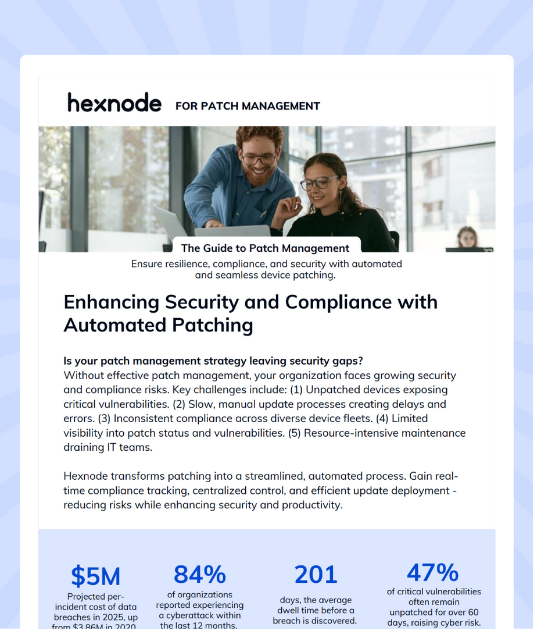
Hexnode UEM for Patch Management
Discover how Hexnode UEM streamlines patch management to keep devices secure and up to date.
PCI DSS requires strong encryption for stored and transmitted cardholder data. Endpoints pose a significant risk when data is stored locally or transmitted over unsecured channels. Without proper controls, data leakage becomes a serious compliance violation.
How Hexnode Enables PCI DSS Compliance at the Endpoint Level
Hexnode provides endpoint management and security capabilities that help organizations align with PCI DSS security requirements. It transforms endpoint management into a compliance-driven security strategy.
Centralized Endpoint Management Across the CDE
Hexnode delivers a unified console to manage and monitor enterprise endpoints from a centralized interface. IT teams gain real-time visibility into device status, configurations, and compliance posture. This centralized approach eliminates blind spots and ensures consistent enforcement of policies across the enterprise.
Device Hardening and Configuration Enforcement
Hexnode enables enterprises to enforce secure configurations aligned with PCI DSS requirements. Administrators can restrict application installations and enforce device policies to reduce the attack surface. These controls ensure that endpoints remain compliant with secure configuration standards at all times.
Granular Access Control and Identity Enforcement
Access control becomes significantly stronger with Hexnode’s policy-driven approach. Enterprises can implement role-based access, enforce password policies, and integrate with identity providers to support multi-factor authentication. This ensures that only authorized users can access sensitive systems, directly supporting PCI compliance requirements.
Patch and Vulnerability Management
Hexnode supports patch management capabilities for select platforms, enabling administrators to manage OS and application updates.
IT teams can schedule updates, enforce compliance deadlines, and ensure that all endpoints remain protected against known vulnerabilities. This reduces the operational burden while strengthening the organization’s security posture.
Advanced Monitoring, Logging, and Reporting
Hexnode provides device tracking and logging features that offer visibility into endpoint activity. Security teams can track device activity and generate reports based on device and policy data. This level of visibility simplifies compliance validation and reduces the time required for audits.
Data Protection and Loss Prevention
Hexnode enforces encryption policies and provides tools for data protection across endpoints. Features such as remote wipe, device lock, and data access restrictions ensure that sensitive information remains secure even in cases of device loss or compromise. This directly addresses PCI DSS requirements related to data protection.
How to remotely wipe your phone with Hexnode
Learn how to remotely wipe devices to protect sensitive data with Hexnode UEM.
Reducing PCI DSS Audit Complexity with Hexnode
One of the most challenging aspects of PCI DSS compliance is the audit process. Enterprises often struggle with fragmented data, inconsistent policy enforcement, and manual reporting efforts. These challenges increase the time and cost associated with maintaining PCI DSS certification.
Hexnode addresses these issues by centralizing compliance data and automating reporting.
Hexnode provides configurable policies that organizations can tailor to meet their security requirements. It enables administrators to monitor device compliance status and take corrective actions when needed.
Audit teams benefit from comprehensive reports that provide clear evidence of compliance, reducing the need for manual data collection and validation.
Why Enterprises Choose Hexnode for PCI DSS Compliance
Enterprises require solutions that go beyond basic device management. They need platforms that integrate security and compliance into a unified framework.
Hexnode stands out by offering scalability, flexibility, and a compliance-focused architecture.
It supports diverse device ecosystems, enabling organizations to manage everything from mobile devices to desktops within a single platform. Its policy-driven approach ensures consistent enforcement of PCI DSS requirements, regardless of device type or location.
More importantly, Hexnode enables continuous compliance. Instead of treating PCI DSS certification as a periodic task, enterprises can maintain a constant state of readiness, reducing risk and improving operational efficiency.
Conclusion: Endpoint Security Is the Foundation of PCI DSS Compliance
PCI DSS compliance cannot succeed without strong endpoint security. As enterprises continue to expand their digital environments, endpoints will remain a primary target for attackers and a critical focus for compliance efforts.
Hexnode enables organizations to address this challenge with precision. By centralizing control, automating policy enforcement, and providing real-time visibility, it transforms endpoint management into a strategic advantage for compliance.
For enterprises aiming to strengthen their security posture and simplify PCI DSS certification, the path forward starts at the endpoint.
Simplify PCI DSS Endpoint Security
Enforce endpoint security, automate compliance, and simplify PCI DSS audits with Hexnode UEM.
What is PCI DSS compliance and why does it matter for enterprises?
PCI DSS compliance is a set of security standards designed to protect cardholder data. It is essential for preventing data breaches, maintaining customer trust, and avoiding financial penalties.
How does Hexnode support PCI DSS certification efforts?
Content writer at Hexnode. Fueled by good coffee and the occasional cat cuddle, I enjoy crafting content that informs, connects, and resonates. Nothing excites me more than knowing my words have been read, appreciated, and maybe even bookmarked.