AI was everywhere at HexCon26, but the conversation rarely stopped at chatbots.
Across the opening keynote, product sessions and guest talks, one idea came through repeatedly: enterprise AI becomes meaningful when it moves from answering questions to helping organizations act – with context, controls and accountability built in.
That shift has implications far beyond productivity. It changes how IT teams operate, how security teams think about risk and how organizations measure the value of automation.
Here are some of the biggest AI lessons from HexCon26.
Enterprise AI is moving from answers to outcomes
For years, enterprise AI has mostly helped users search, summarize, generate or recommend.
HexCon26 framed the next stage differently.
The Genie AI session described a move from console-driven management to intent-driven operations. Instead of asking where a setting lives or manually navigating through workflows, administrators can begin with the outcome they want to achieve.
That distinction becomes even clearer in the session’s definition of agentic AI: assistants answer questions, while agents can understand objectives, create execution plans, coordinate specialized capabilities and participate in execution under governance controls.
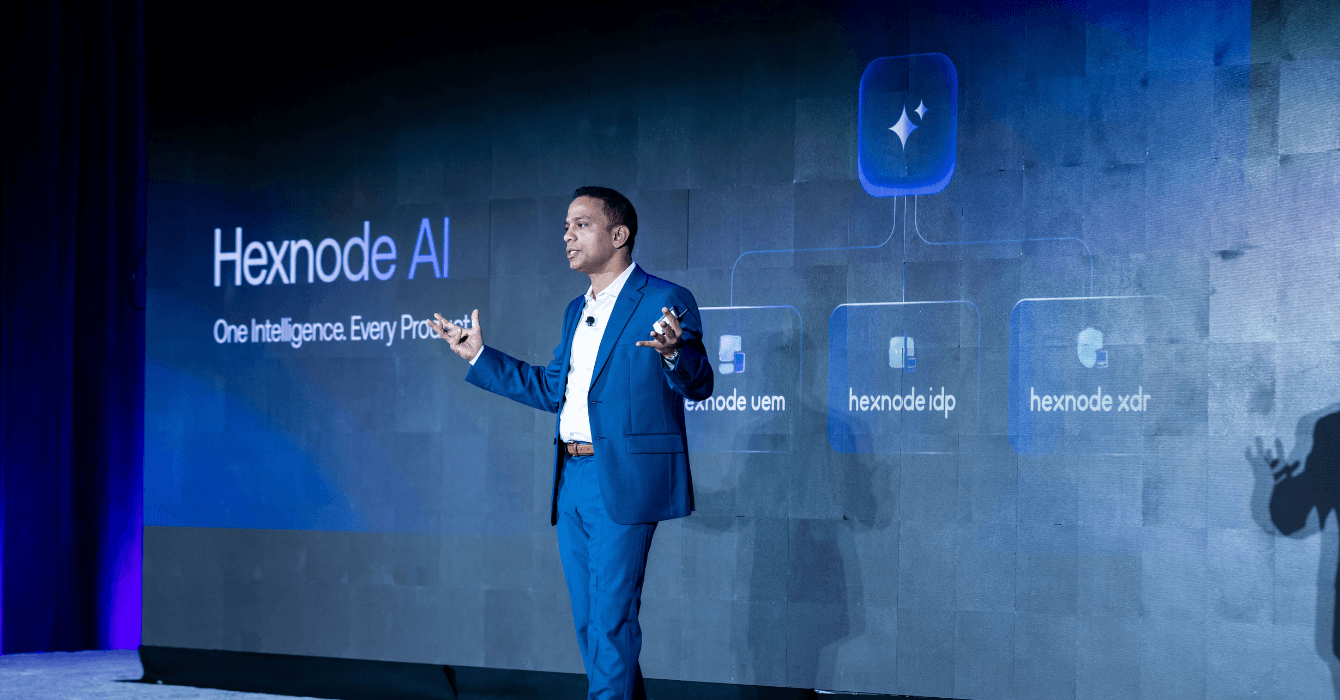
The keynote reinforced the same direction visually with the shift from Agentic AI: From Answers → To Action and, ultimately, from Managed Devices → Managed Outcomes.
The lesson for enterprise IT is straightforward: the value of AI will increasingly be measured by the operational steps it removes, not just the quality of the answer it generates.
Context is what separates useful AI from generic AI
An AI system can generate an answer without understanding your environment.
Enterprise IT cannot work that way.
The Genie session repeatedly emphasizes operational context: live inventory, compliance state, endpoint health and other device data are what allow AI to move from generic assistance toward meaningful action.
That same principle appears in Hexnode Synapse.
Its Intelligence Assistant is designed to synthesize signals across multiple entry points before guiding decisions and actions, while specialist agents work across device, identity and security workflows.
The takeaway: enterprise AI needs access to the right context before it can make the right decision.
For IT teams, that means AI strategy cannot be separated from data quality, endpoint visibility, identity context and the systems that already hold operational truth.
The endpoint becomes even more important in the AI era
A recurring message across the conference was that AI does not make the endpoint less relevant.
It makes it more relevant.
The endpoint is where users authenticate, applications execute, data is accessed and many AI interactions begin.
Cunningham’s session summarized the distinction clearly: identity can tell you whether a credential is authenticated, but device trust determines whether the session should exist in the first place.
That is also reflected in the Hexnode IdP session, where access is positioned as a joint decision between identity and device context, rather than an identity-only check.
For organizations adopting AI at scale, endpoint management, identity and security therefore become increasingly interconnected.
The AI system may be intelligent, but the device, account and application around it still need to be trusted.
What HexCon26 says about the next phase of enterprise AI
The AI story that emerged from HexCon26 was not about replacing IT teams with autonomous systems.
It was about changing where human effort is spent.
AI can help interpret intent, gather context, coordinate specialized systems and automate repetitive actions. But access, risk, approvals and accountability still need clear boundaries.
That leaves IT professionals with a different role: less time translating requests into console operations, and more time defining policy, setting guardrails and deciding the outcomes technology should deliver.
The interface may increasingly look like a conversation.
But the real transformation is everything happening behind it.