Growing IoT fleets require centralized lifecycle management before device diversity, distributed deployments, and manual administration become too complex to govern.
Fragmented management increases configuration drift, visibility gaps, support costs, security exposure, and compliance challenges.
Centralized policies, automation, remote administration, and lifecycle controls help enterprises manage expanding fleets consistently and efficiently.
Hexnode UEM provides policy-based management, device grouping, application controls, reporting, remote actions, and automation for supported IoT and purpose-built endpoints.
As enterprises deploy more scanners, kiosks, displays, rugged endpoints and connected equipment, device administration becomes harder to control. An IoT device management platform gives IT teams a centralized way to configure, monitor, secure and support these endpoints. Without one, every expansion introduces more manual work, inconsistent settings, security gaps and support costs. Businesses must build device management into their IoT strategy before the fleet becomes too complex to govern.
An IoT device management platform helps enterprises control connected endpoints throughout their operational lifecycle. It enables IT teams to enroll devices, apply configurations, distribute applications, monitor status, troubleshoot problems and retire devices from a central console.
The platform does more than report whether a device remains online. It connects visibility with administrative control, allowing teams to respond when a device becomes non-compliant, misconfigured or unavailable. This capability becomes especially important when endpoints operate across multiple sites without onsite IT staff.
Basic monitoring versus dedicated device management
Basic monitoring
Dedicated device management
Shows whether a device is online
Controls the device throughout its lifecycle
Reports health or connectivity
Supports configuration and remediation
Provides operational visibility
Combines visibility, policy and action
Focuses on isolated metrics
Maintains a centralized device inventory
Suits limited deployments
Supports large, distributed fleets
Basic monitoring may help teams detect a failure, but it may not help them resolve it. A dedicated platform lets administrators identify affected devices, understand their configuration and take supported corrective action. This transition from observation to control makes IoT operations more scalable.
Why IoT environments become difficult to manage
Small deployments often appear manageable because administrators can configure devices individually and rely on local staff for support. These methods break down when the organization adds more locations, models, users and business workflows. The problem does not come from device volume alone. It comes from the operational complexity created by a diverse and distributed fleet.
Device diversity increases complexity
Enterprise IoT environments rarely use one type of device. A retailer may deploy kiosks, payment terminals, scanners and digital displays, while a logistics business may use rugged handhelds, warehouse endpoints and vehicle-mounted systems.
Each category can introduce different:
Operating systems
Hardware capabilities
Applications
Peripherals
Connectivity requirements
Update processes
Security controls
Without centralized administration, IT teams must maintain separate configuration procedures for each device category. This fragmentation increases the risk of inconsistent settings and unsupported software. It also makes troubleshooting slower because similar devices may no longer share the same configuration.
Distributed deployments reduce visibility
Connected endpoints often operate in stores, hospitals, factories, warehouses, vehicles or construction sites. Central IT teams may never physically access these devices after deployment. When a problem occurs, administrators may have to rely on local employees to explain the issue or restart the endpoint.
This dependency delays diagnosis and creates blind spots. IT teams may struggle to determine which devices remain active, compliant or correctly configured. Centralized management gives administrators a shared view of devices across locations and reduces their dependence on onsite assistance.
Manual processes create configuration drift
Manual configuration rarely remains consistent across a growing fleet. Different technicians may follow different procedures, skip steps or use outdated instructions. Devices that started with the same configuration can gradually develop different applications, restrictions, permissions and network settings.
Configuration drift creates three immediate problems:
It makes troubleshooting unpredictable.
It introduces avoidable security exposure.
It weakens compliance reporting.
Central policies reduce these risks by giving administrators a repeatable way to apply approved configurations. IT teams can then identify exceptions deliberately instead of discovering them during an outage or audit.
How centralized management supports growth
Growth adds more than devices. It also introduces new sites, teams, use cases and operational dependencies. A centralized management strategy helps enterprises absorb this expansion without increasing administrative effort at the same rate.
Faster and more consistent deployment
Standardized enrollment and policy assignment reduce the number of manual steps required to prepare each endpoint. Administrators can create approved configurations for specific device roles and apply them to the relevant groups.
For example, a business can define separate configurations for:
This approach improves deployment speed and reduces setup errors. It also allows businesses to open new sites without depending on local staff to make security or configuration decisions.
Lower support costs
Onsite support becomes expensive when devices operate across a wide geographic area. Even simple problems can require travel, scheduling and operational downtime. Remote administration allows support teams to inspect device information and perform supported actions without immediately sending a technician.
This model can reduce:
Technician visits
Device shipping
Unnecessary replacements
Resolution time
Dependence on local users
Support costs per device
Remote access will not solve every hardware failure, but it can eliminate many avoidable service calls. It also allows specialist teams to support more locations from a central help desk.
Sustainable automation
Routine administrative tasks consume significant time when teams repeat them across hundreds or thousands of endpoints. Enrollment, application distribution, policy assignment, compliance checks and reporting become difficult to sustain through manual processes.
Automation allows IT teams to manage devices by policy and exception. Instead of monitoring every endpoint individually, administrators can focus on devices that fall outside approved conditions. This approach allows the fleet to grow without requiring a proportional increase in administrative staff.
Why IoT fleet management requires lifecycle control
IoT fleet management involves more than maintaining an asset inventory. Enterprises need to know what each device does, where it operates, which configuration it should receive and whether it remains suitable for active use.
A structured device lifecycle should cover:
Lifecycle stage
Management priority
Procurement
Confirm hardware and platform compatibility
Enrollment
Establish ownership and apply initial settings
Deployment
Assign applications, policies and network access
Active use
Monitor status, compliance and performance
Maintenance
Update software and resolve problems
Reassignment
Remove old configurations and apply new ones
Retirement
Remove access, corporate data and management records
Grouping also plays an important role in fleet administration. IT teams can organize devices by location, department, model, purpose, risk level or deployment stage. These groups allow administrators to target policies more accurately than a fleet-wide configuration would permit.
Historical records also improve decision-making. They help teams investigate incidents, identify recurring failures and verify whether devices received the required configuration. Accurate lifecycle data turns a collection of endpoints into a measurable operational environment.
How enterprise IoT management strengthens security
Connected devices expand the attack surface because they interact with networks, users, applications and business data. Enterprise IoT management gives security and IT teams a consistent way to maintain inventory, enforce configurations and respond to device-level risks.
Top Security Features in an IoT Device Management Platform
Explore essential IoT security features that protect connected devices, data, and enterprise networks.
Enforce secure configurations
Security should begin when administrators enroll the device. Teams can define supported settings for passwords, applications, networks, permissions, restrictions and access controls. Central policies reduce dependence on individual technicians and make approved baselines easier to review.
When requirements change, administrators can update the relevant policy instead of sending instructions to every location. This capability shortens the time between a security decision and its implementation. It also reduces the risk of devices remaining on outdated configurations.
Restrict unnecessary functionality
Many connected endpoints perform a narrow business function, but their default interface may expose settings or applications that users do not need. Excess functionality increases the risk of misuse, unauthorized changes and operational disruption.
Kiosk controls can limit supported devices to:
One business application
A defined group of applications
A controlled home screen
Approved device settings
A restricted browsing experience
These restrictions protect the workflow while creating a predictable user experience. They work particularly well for check-in systems, digital signage, self-service terminals and shared devices.
Improve incident response
Security teams need a reliable way to identify affected endpoints and take action quickly. A centralized console gives administrators visibility into the device’s status, ownership, policy state and available management actions.
Depending on the platform and enrollment method, teams may be able to:
Modify a policy
Restrict device access
Remove an application
Lock the endpoint
Clear managed data
Initiate a device wipe
Reconfigure supported settings
The exact actions vary across devices, but the underlying value remains consistent. Centralized control reduces the delay between identifying a problem and containing it.
The cost of fragmented IoT administration
Fragmented tools create gaps between inventory, monitoring, security and remediation. One system may show that a device exists, while another tracks connectivity and a third distributes applications. IT teams must reconcile these records before they can understand the endpoint’s actual state.
This fragmentation creates several business risks:
Risk
Operational effect
Incomplete visibility
Teams cannot reliably identify unmanaged devices
Configuration drift
Similar endpoints operate with different settings
Delayed updates
Vulnerable software remains in production
Slow support
Teams spend more time gathering device information
Poor scalability
Manual processes fail as deployments expand
Compliance gaps
Reporting lacks consistent policy and audit data
A unified management approach gives IT, security and operations teams a shared source of device information. It also reduces the time they spend switching between tools and reconciling conflicting records.
What enterprises should look for
Organizations should evaluate platforms against their actual device estate and growth plans. A long feature list does not guarantee that the platform can support the required hardware, operating systems or enrollment models.
Enterprises should also test the platform with real devices before making a broad commitment. A practical pilot can reveal compatibility issues, workflow limitations and differences between operating systems. It can also show whether administrators can perform common tasks without excessive manual effort.
Featured Resource
Hexnode UEM Capability Statement
Explore Hexnode UEM capabilities for unified endpoint management, security, and seamless IT administration.
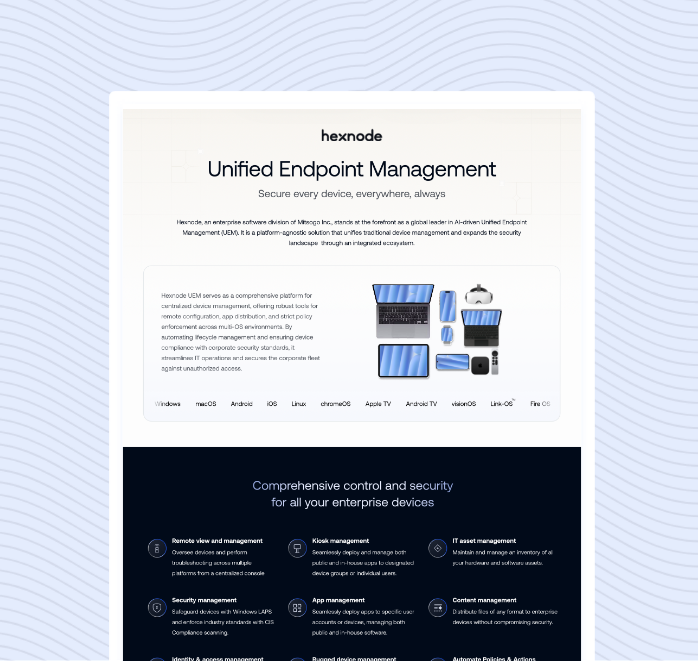
Hexnode UEM provides centralized management capabilities for supported IoT, rugged and purpose-built endpoints. IT teams can use policies, device groups, application management, reports, remote actions and automation to manage devices through a unified console.
Hexnode also supports kiosk lockdown for several documented operating systems. Administrators can configure supported endpoints for single-app or multi-app kiosk use, including documented digital signage configurations. Hexnode also documents remote view and control for supported Android environments, along with Android Enterprise management and OEMConfig capabilities.
These controls help enterprises replace one-device-at-a-time administration with policy-based management. IT teams can group endpoints, apply approved configurations and perform supported actions without relying entirely on onsite technicians. This approach gives growing organizations a more structured foundation for maintaining device visibility, consistency and security.
FAQs
Can a management platform reduce operating costs?
A management platform can reduce repetitive configuration work, onsite technician visits and unnecessary device replacements. Remote actions allow teams to resolve many software and configuration issues without handling the endpoint physically. Centralized reporting also reduces the time spent reconciling separate tools and inventories. These savings become more significant as the fleet expands.
When should a business adopt a dedicated platform?
A business should adopt one before manual administration begins to limit deployment speed, visibility or security. Warning signs include frequent onsite support, inconsistent configurations, incomplete inventory records and difficulty verifying compliance. Planned expansion into new locations or device categories also provides a strong reason to act early. Introducing centralized management before rapid growth usually causes less disruption than implementing it after problems emerge.
Build the management layer before the fleet outgrows it
Enterprises often focus on the business value of connected devices while underestimating the infrastructure required to manage them. Manual processes may support an early pilot, but they rarely remain reliable across multiple sites and thousands of endpoints.
A dedicated management layer turns individual devices into governed enterprise infrastructure. It supports consistent deployment, centralized security, remote troubleshooting and measurable lifecycle control. Organizations that establish this foundation early can expand their IoT operations without allowing management complexity to undermine growth.
Scale IoT Management With Confidence
Centralize device control, automate management, and secure growing IoT fleets with Hexnode UEM.
Content writer at Hexnode. Fueled by good coffee and the occasional cat cuddle, I enjoy crafting content that informs, connects, and resonates. Nothing excites me more than knowing my words have been read, appreciated, and maybe even bookmarked.