Rugged devices require unified management because fragmented tools create policy gaps, higher support workloads, and costly downtime. A modern rugged device MDM platform should combine zero-touch deployment, kiosk controls, OEMConfig support, remote troubleshooting, automated updates, and real-time visibility. Hexnode UEM brings these capabilities into one console, helping IT teams manage mixed rugged fleets securely and efficiently at scale.
Rugged devices are built for harsh conditions, but that does not make them easy to manage. In most frontline environments, they introduce more complexity than standard mobile fleets: company-owned Android Enterprise devices running in fully managed or dedicated modes, zero-touch deployment across locations, OEM-specific controls for scanners and peripherals, and the need to troubleshoot and patch endpoints remotely.
The broader UEM market increasingly treats rugged operations as a centralized management problem rather than a collection of disconnected tools. In this post, we’ll break down why fragmented management fails, what a modern rugged device MDM strategy should include, and how Hexnode UEM helps IT teams deploy, secure, support, and scale rugged fleets from a single console.
Rugged device MDM is the centralized management of purpose-built frontline devices that require strict lockdown, OEM-level controls, remote support, and consistent lifecycle management.
Rugged device MDM focuses on managing company-owned devices like handheld scanners, rugged tablets, and custom Android (AOSP) endpoints used in environments such as logistics, retail, and field services. These devices are typically deployed in fully managed or dedicated (kiosk) modes, where they run only essential apps and workflows.
Unlike standard smartphones, rugged devices demand greater control and reliability. IT teams must ensure devices are:
Secure and tightly restricted
Consistently configured across deployments
Remotely accessible for support and troubleshooting
Operational with minimal downtime
How rugged devices differ from standard mobile fleets
Rugged devices are built for shared, task-specific use in frontline environments, not individual productivity. They are often:
Used by multiple users across shifts
Locked to specific business-critical applications
Deployed in environments where downtime directly impacts operations
Because of this, rugged devices are more operationally critical than typical corporate devices, making centralized and consistent management essential.
Why fragmented management breaks down in rugged environments
A fragmented rugged device MDM stack creates blind spots because IT teams handle enrollment, policy enforcement, OEM settings, troubleshooting, and updates across multiple tools.
In many organizations, IT teams manage rugged devices using disconnected systems: one for provisioning, another for kiosk lockdown, separate tools for OEM configurations, and yet another for remote support. While this might work for small-scale deployments, it quickly breaks down as fleets grow.
The result is policy drift, duplicated effort, and limited visibility. IT teams spend more time switching between tools, manually aligning configurations, and troubleshooting inconsistencies. This slows down response times and increases the risk of misconfigurations.
In rugged environments, these inefficiencies are amplified. Devices are often tied to mission-critical workflows, where even minor downtime can disrupt operations.
Common signs a rugged program is being managed in silos
Inconsistent policies across different device types or manufacturers
Limited visibility into device health and real-time status
Increased manual effort during deployment, maintenance, and device replacement
Fragmentation doesn’t just add complexity; it directly impacts operational reliability and frontline productivity.
The operational realities that make a unified approach non-negotiable
Rugged fleets need a unified management approach because deployment, lockdown, OEM control, troubleshooting, and patching all rely on the same layer of policy and visibility.
Rugged environments combine multiple complex requirements: diverse hardware, task-specific usage, large-scale deployment, and constant uptime expectations. Managing these in isolation quickly leads to inefficiencies and control gaps.
Mixed hardware and OEM-specific controls
Rugged fleets often include AOSP devices and OEM-specific hardware with unique capabilities like barcode scanning and peripheral integrations. Managing these effectively requires OEMConfig and centralized policy control, which becomes difficult with fragmented tools.
Dedicated and shared-device workflows
These devices are typically locked to specific apps or workflows (single-app or multi-app kiosk). Whether it’s inventory, POS, or field operations, maintaining consistent configurations across shared devices is important.
Remote deployment at scale
Rugged devices are often deployed across locations and need zero-touch enrollment and bulk provisioning. A unified approach ensures consistent setup with minimal IT intervention from day one.
Uptime depends on remote support
With devices operating in the field, remote troubleshooting, real-time access, and regular patching are essential. Faster support directly translates to less downtime and smoother operations.
In practice, these needs are too interconnected to manage separately.
What to look for in a unified rugged device MDM platform
At a minimum, the platform should support:
Centralized management across rugged, mobile, and other endpoints
Zero-touch and bulk provisioning for scalable deployments
Full device and dedicated (kiosk) modes for task-specific use cases
OEMConfig and AOSP support for advanced device-level controls
Kiosk lockdown and app management for controlled usage
Remote support and troubleshooting for field devices
Automated patching and updates to maintain security and performance
Tracking, geofencing, and reporting for visibility and policy consistency
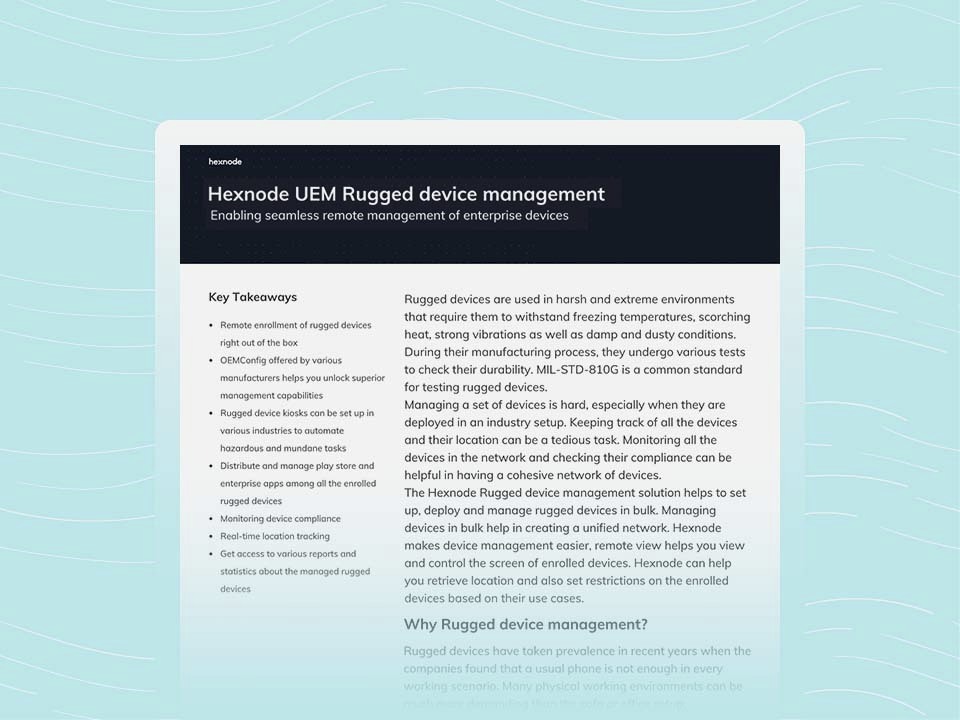
Feature Resource
Hexnode UEM Rugged Device Management
Get started with Hexnode’s Rugged device management solution that secures rugged devices with better efficiency.
Single console management → Eliminates tool-switching and improves efficiency
Scalable deployment → Reduces manual setup during rollouts
Kiosk & app control → Prevents misuse and enforces workflows
OEM-level controls → Enables full use of rugged hardware features
Remote troubleshooting → Minimizes downtime in the field
Automated updates → Keeps devices secure without manual effort
Real-time visibility → Ensures better monitoring and faster decision-making
A platform that brings all of this together doesn’t just simplify management; it directly improves uptime, consistency, and operational efficiency.
How unified management improves outcomes for IT and operations
Faster rollout and easier device replacement: Standardized configurations and centralized provisioning allow IT teams to deploy and replace devices quickly with minimal manual effort.
Lower support burden with faster issue resolution: Remote troubleshooting and real-time device access help IT resolve issues quickly, reducing downtime and field disruptions.
Stronger security and patch consistency: Automated updates and uniform policy enforcement ensure devices stay secure and compliant without manual intervention.
More consistent user experience: Devices remain locked to intended workflows, minimizing errors and ensuring users have a reliable, distraction-free interface.
Improved uptime and operational resilience: With better visibility and control, IT can proactively manage devices, keeping frontline operations running smoothly.
Why Hexnode UEM is a strong fit for unified rugged device management
Hexnode UEM unifies rugged deployment, kiosk control, OEM-level device settings, remote troubleshooting, and ongoing compliance management from a single console.
When managing rugged environments, the real challenge isn’t just controlling devices, it’s doing so consistently across diverse hardware, use cases, and locations. Hexnode UEM is built to handle this complexity by bringing every stage of the device lifecycle into one platform, eliminating the need for multiple tools.
Built for mixed rugged fleets
Hexnode supports a wide range of rugged endpoints, including AOSP devices, handheld scanners, and custom Android builds. This flexibility ensures IT teams can manage any device, regardless of manufacturer or configuration, without compromising control or visibility.
Purpose-built controls for frontline operations
Hexnode provides all the essential capabilities needed for rugged environments:
Zero-touch onboarding and bulk provisioning for faster deployments
Kiosk lockdown for task-specific usage
Remote view and control for real-time troubleshooting
Location tracking and geofencing for device monitoring
Automated patch management to maintain security and performance
Deeper OEM ecosystem support
With OEMConfig integrations, Hexnode enables advanced control over device-specific features such as scanners, peripherals, and hardware-level settings, ensuring rugged devices function exactly as required in real-world conditions.
The broader UEM advantage
Unlike point solutions, Hexnode UEM allows IT teams to manage rugged devices alongside mobile, desktop, and IoT endpoints from a single console. This unified approach improves policy consistency, visibility, and operational efficiency across the organization.
Proven performance and user trust
Users consistently recognize Hexnode for its ease of use, responsive support, and multi-platform capabilities, with strong G2 ratings highlighting its reliability for modern device management.
How Rugged Devices Help the Telecommunication Service Teams Stay Connected
Discover how rugged devices and Hexnode UEM help telecom teams maintain critical connectivity in extreme environments.
Where a unified rugged device MDM strategy matters most
A unified rugged device MDM strategy becomes critical in industries where devices are core to daily operations and downtime directly impacts productivity.
Warehouse and logistics: Handheld scanners and mobile computers must stay connected and operational to avoid delays in inventory tracking and order fulfillment.
Retail and POS: Devices used for billing, inventory, and customer interactions need to be reliably locked down and always available during business hours.
Field service: Technicians depend on rugged devices for navigation, job updates, and reporting, making remote support and uptime essential.
Healthcare: Devices used for patient data access and coordination require strict security, reliability, and seamless functionality.
Transportation and manufacturing: Devices on factory floors or in transit must handle continuous use while supporting real-time tracking and workflow execution.
Conclusion
Rugged devices perform reliably in tough environments, but the wrong management approach can make them complex and difficult to control at scale. As deployments grow and use cases become more critical, relying on fragmented tools is no longer sustainable.
A unified approach to rugged device MDM means bringing deployment, lockdown, OEM controls, remote support, and lifecycle management into a single, consistent framework. This is what enables IT teams to maintain visibility, control, and uptime across every device in the field.
With platforms like Hexnode UEM, organizations can simplify rugged device management, reduce operational overhead, and ensure their frontline operations run without disruption, today and as they scale.
Try Hexnode free for 14 days
Bring your rugged device fleet under one console with Hexnode UEM—start your 14-day free trial today.
Yes, rugged device MDM requires deeper control and consistency because these devices are mission-critical and task-specific. Unlike standard smartphones that support general productivity, organizations typically own and share rugged devices and restrict them to specific workflows. This means IT teams need stricter lockdown, better uptime management, OEM-level controls, and faster remote support to keep operations running smoothly.
Can one platform manage AOSP and OEM-specific rugged devices?
Yes, modern UEM platforms can manage both AOSP and OEM-specific rugged devices through unified policies and OEMConfig support. A capable platform like Hexnode UEM provides AOSP compatibility along with OEMConfig integrations, allowing IT teams to manage device-specific features such as scanners, peripherals, and hardware settings from a single console, regardless of manufacturer.
Which features matter most in rugged device management?
The most critical features are provisioning, kiosk lockdown, remote support, and automated updates. Rugged environments require fast deployment (zero-touch), strict app control (kiosk mode), real-time troubleshooting, and consistent patching. Together, these ensure devices remain secure, reliable, and operational with minimal manual intervention.
I’m a technical content writer at Hexnode who loves simplifying tech. I break down complex ideas, remove the fluff, and help readers clearly understand our product for what it actually is: simple, reliable, and built to solve real problems.